
Ganga, Teesta Pacts: Can BJP's Bangladesh Rhetoric Coexist With River Diplomacy?
Amid the recent diplomatic frost between India and Bangladesh, the issue of river sharing has become an icy wedge.
advertisement
Somnath Rai is a 40-year-old farmer living on River Ganga's "diara" land in the outskirts of Patna. Diara is a riverine tract, formed due to the shifting course of a river. That means Rai has to frequently deal with floods.
This year too, as floodwaters swept into the diara area, Somnath, his wife and their 10-year-old son were stranded for days, waiting for a rescue boat. He has lost another set of belongings to the flood and will have to rebuild his life from scratch, knowing it would happen again.
But the delayed rescue is not Rai's only complaint with the government. He believes that the Farakka Barrage—built in West Bengal in 1975 to divert Ganga water into the Hooghly river—is at the root of of Bihar's flood woes.
"Every time the barrage gates in Bengal is closed, the water rises in Bihar," Rai asserts.
Somnath Rai sits amid floodwaters in Bihar's Patna Diara region.
(Photo: Afzal Abeed Khan/The Quint)
Hundreds of kilometres away from Patna in West Bengal's Jalpaiguri district, on a similar silt island, known here as chawr, created by the meandering Teesta River, lives Jiten Biswas. Like Rai, Biswas is in his 40s—and no stranger to floods.
Biswas has been displaced 12 times since adulthood due to floods, the last time in 2023. With rising water levels during monsoons, the region could just be one cloudburst away from another tragedy.
"I had hoped that when the new government came to power in Bengal, things would change. But, so far, nothing has happened, and we are losing hope," Biswas tells The Quint, sharing Rai's dissipation.
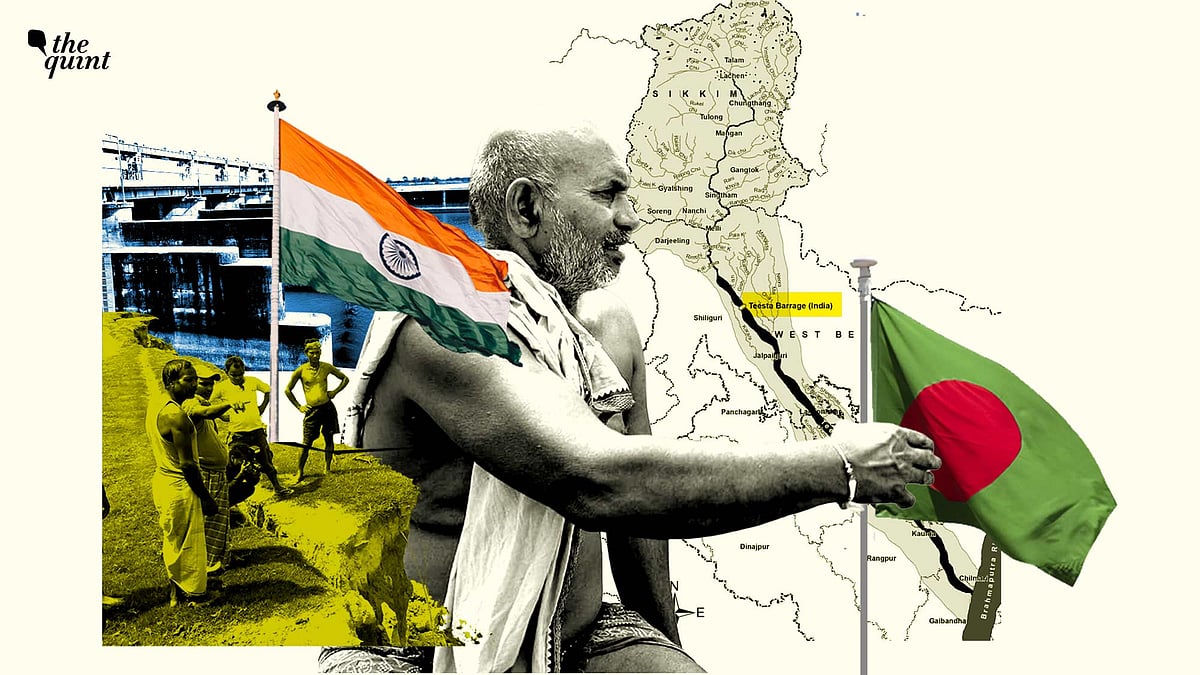
India and Bangladesh share 54 rivers, including Ganga and Teesta. Amid the recent diplomatic frost between the neighbours, the issue of river sharing has yet again become an icy wedge.
And the conflict has boiled down to two treaties—one nearing its end and another yet to be signed.
A Tale of Two Treaties
The 1996 Ganga Water Sharing Treaty between India and Bangladesh governs the dry-season distribution of the Ganga water at the Farakka Barrage and is set to expire in December 2026. The treaty established a 30-year water-sharing arrangement and recognised Bangladesh's rights as a lower-level riparian.
The ruling Bharatiya Janata Party (BJP) at the Centre, which initially seemed keen to recalibrate relations with Bangladesh under the new Tarique Rahman government, is now facing a revolt from its National Democraric Alliance (NDA) allies in Bihar, including some state BJP leaders, who have demanded the agreement be reworked.
He and other JD(U) leaders have demanded that the treaty should not be renewed in its current form. Their argument is that the barrage traps heavy silt and raises the riverbed, which creates the paradox of increasingly severe floods during monsoons and drinking water shortages, along with falling groundwater levels during dry lean seasons.
Bangladesh requires a guaranteed dry-season (January to May) flow of 35,000 cusecs (cubic feet per second) of Ganga water to maintain its ecosystem, irrigation, and salinity control.
During the peak dry period, the treaty historically guarantees 35,000 cusecs to each country in alternating 10-day blocks, depending on real-time availability.
Jha had pointed out only about 400 cusecs enter Bihar's Buxar.
The NDA leaders, including the BJP's state president Sanjay Saraogi, blamed former chief minister and Rashtriya Janata Dal (RJD) leader Lalu Prasad Yadav, who had been in power in 1996 when the treaty was signed, for "compromising" on the needs of Bihar. On social media, many have supported the call for demolition of the barrage, an argument that former chief minister Nitish Kumar has often reiterated since the 2016 Bihar floods.
(Photo: X.com)
Opposition leader and RJD Buxar MP Sudhakar Singh, however, said such reactions were the result of the ruling NDA government's carefully crafted rhetoric that shifts the blame of Bihar's water woes to Bangladesh, allowing the government to evade accountability.
Singh reminded that the barrage was built to regulate water to India after Ganga got split between India and East Pakistan, without which, "all water would have naturally flown down to Bangladesh".
He instead questioned "the water usage of upper riparian states like Uttar Pradesh, which divert Ganga water at Haridwar, then again at Naroda, and yet again in Kanpur". By the time it reaches Buxar, the flow is close to nil, he said.
Sudhakar Singh addressing the Farakka issue at a press conference.
(Photo: Facebook/The Quint)
If India chooses to not renew the Ganga treaty in December 2026, it could create major diplomatic and regional challenges with Bangladesh, where many are increasingly unsure of India's intention to share water. A member of the Joint River Committee in Bangladesh, on condition of anonymity, tells The Quint, "The 1996 treaty was passed at the time of HD Dewe Gowda's coalition government. It was the only reason it could pass. Among Bangladeshi bureaucracy, there is very little hope that the treaty will be renewed per our terms or renewed at all anymore."
Any change to the Ganga treaty could also impact the fate of the Teesta treaty—which brings us to West Bengal.
The Teesta Conflict
In 2021, Prime Minister Narendra Modi met Bangladesh's ousted leader Sheikh Hasina for bilateral talks in which the need to hasten Teesta arrangement was discussed. More recently, when the BJP won the Assembly elections in Bengal, some in Bangladesh and in Bengal had hoped that perhaps the time for the Teesta River Treaty—which has been stuck for years— to actualise had finally come. After all, it was former chief minister Mamata Banerjee who had been at the forefront of opposition against the signing of the treaty, a draft of which was ready to be signed in 2011.
The river plays a crucial role in supporting agriculture and livelihoods in northern Bangladesh. In Bengal, it is essential for irrigation and electricity generation. Its upper catchment hosts multiple hydropower projects, and its water sustains almost six districts in North Bengal.
India and Bangladesh have been negotiating the sharing of Teesta waters since the 1980s. Under an ad hoc arrangement in 1983, 39 percent of the water was allocated to India and 36 percent to Bangladesh, leaving 25 percent unassigned. Subsequent talks were held, but a final, long-term treaty could not be concluded.
According to sources in Bangladesh, the country was keen to move ahead with in-person talks with India over the river-sharing issues under the new BJP government.
"The Bengal government has so far shown no attempt to engage with us on these issues. No one has approached us," a government source in Bangladesh tells The Quint.
Bengal Finance Minister Swapan Dasgupta, when asked about the Teesta treaty in June, had dismissed it, claiming he was "more concerned with provincial matters at the moment."
Meanwhile, New Delhi claims that it has conveyed what it had to inform Bangladesh about the Teesta treaty in July itself. Former High Commissioner to Bangladesh, Veena Sikri, told The Quint that Bangladesh had not yet responded to the communications.
The diplomat explained that unlike the Ganga treaty, the Teesta treaty is "based on thin air". In the Ganga treaty, there was an indication of quantum of water thanks to quantified data available—which isn't the case with Teesta treaty. "There’s such a huge difference in the numbers provided by both sides... you’d think they are talking about two different rivers," Sikri jokes.
PM Rahman's visit to India has been "indefinitely delayed", with sources claiming that New Delhi's continued sympathising with Hasina has led to the impasse.
The Looming China Factor
Besides the regional politics in BJP-ruled states, the issue of river sharing is likely to become a strain for India's geopolitical strategy, especially with the looming China factor.
As per sources, PM Rahman recently returned from a visit to China and declared that the reportedly China-backed Teesta Master Plan is being implemented "at any cost".
The development is a significant security and geopolitical concern, given the Teesta project's proximity to the Siliguri Corridor, commonly known as "Chicken's Neck".
Sikri says that China's "intrusion" into the project is "unacceptable" to India. "India simply cannot allow China access to proximitous regions," Sikri adds.
Altaf Parvez, a Dhaka-based political analyst and academic, tells The Quint the interest in dealing with China on the Teesta issue in Bangladesh is the culmination of a prolonged and futile wait. The plan enjoys local support, he says, adding that it was "increasingly becoming clear to the people of Bangladesh that India is not willing to give any water to Bangladesh."
With the end of the Ganga treaty nearing, that pressure has only increased.
More recently, however, Bangladesh's Water Resources Minister Shahid Uddin Chowdhury Anee told local media that Bangladesh is going ahead with the Teesta barrage project with its own money, not China's.
He also sought for speedy progress on the river talks with India. "The neighbouring country is a friendly country. They have to think that while they have their interests, we have ours... A friend should protect the interests of a friend. We never want our friendly relations with them to deteriorate," Bangladeshi news portal tbsnews.net quoted him as saying on 16 August at a seminar.
Some Indian diplomats have read it as a sign of Bangladesh's response to India over the latter's displeasure with China's involvement.
The apparent distancing from China, however, has failed to enthuse the bureacracy in Bangladesh. "We don't know what the political leadership is thinking but it does not look like India will be interested in any deal. This is what most Bangladeshis believe. That the BNP government is choosing India over Bangladesh is not a very popular notion," a Bangladeshi bureaucrat said.
So, can the treaty ever materialise? To answer this question, there is a need to separate the political mood from the structural economics.
“The treaty has been stalled since 2011, not mainly because of bilateral hostility but because of India's internal water federalism: the Teesta river's lean-season flow is genuinely scarce, and any allocation to Bangladesh has to come out of West Bengal's share, which is why the state has consistently withheld consent. A change of government in either Kolkata or Dhaka doesn't dissolve that scarcity problem,” economist and ORF Fellow Soumya Bhowmick says.
What's changed, however, is that Dhaka now has an alternative.
Another important aspect, already recognised between India and Bangladesh, which makes it vital for the two to cooperate on the Teesta project, is that back in 2010, India and Bangladesh had agreed on a joint river basin development and management approach through water sharing. This is key to improving the lives of those living in the riverine areas, like Somnath Rai and Jiten Biswas, who face the brunt of monsoon floods, siltation, and dry season scarcity.
Sharing Waters Requires Knowing the Rivers
Experts and activists state that approaching river management as a competitive sharing of a common resource between two countries does not see the river as a living ecosystem. River basin management needs data and alternative planning—for instance, agreeing on the kind of crops that can be grown in wet and dry seasons.
River basin management needs data and alternative planning.
(Photo: Dinesh Mishra/The Quint)
Geopolitical commentator Manoj Joshi explains:
Experts like him say a full-length study of the river basin to analyse the impact of climate change as well as construction on the river may be essential at a bilateral level.
As Bangladesh relies heavily on the dry-season flow of the Ganga for agriculture, it is known to have pushed for a guarantee clause during the critical pre-monsoon lean period. But there are similar Indian needs as well. "Rather than a simple 30-year extension, India will likely push for a revised framework. This would incorporate scientific silt management policies, joint river dredging, and updated water allocation formulas that account for climate-induced flow variations up to 2050—balancing Bihar's domestic requirements with India's international obligations," Joshi says.
According to Sikri, shared cropping strategies (alternating between dry- and water-intensive crops) in tune with the river's ebb and swell can be a useful approach.
Teesta river after 2023 floods.
(Photo: Rakhi Bose/The Quint)
For Teesta River, too, even locals like Biswas speak in favour of a study.
Teesta river in flood-prone Teesta Bazar area during monsoons.
(Photo: Rakhi Bose/The Quint)
Dams are built not just to regulate flow, but to store water. "If they don’t do that, they will not be able to do energy generation, which the government has promised to the people of the area," Biswas, who has been a BJP party worker since 2017, states.
Soumitra Ghosh from the North Eastern Society for Preservation of Nature explains that the dams are causing immense siltation, because of "bad construction and deforestation".
In Bihar, river experts like Professor Dinesh Mishra state that blaming treaties is easier than actually working to keep the river systems alive—both at a policy and at grassroots level.
"Embanking rivers to ensure land for roads, railways networks, and cityscapes without providing proper drainage is a recipe for flood disaster. In Bihar, it started with the embankment of Kosi River soon after Independence. Rampant embankment is a major cause of the annual floods that often goes undiscussed today," Mishra says.
The river veteran further points out that closing the Farakka Barrage is not the answer to ending floods—it could cause backwater flow into the state, again leading to floods. "The real issue is siltation," he warns.
Buxar MLA Singh calls it a "management problem".
- Access to all paywalled content on site
- Ad-free experience across The Quint
- Early previews of our Special Projects
Published: undefined