
Who is a Voter in Manipur? The Hurdles to Electoral Accuracy in a Conflict State
Can democratic procedures remain fair when they presume a normalcy that conflict has already destroyed?
advertisement
Every election begins before the first vote is cast. Long before polling stations open or ballots are counted, democracy asks a simpler question: who can be recognised as a voter?
The answer is shaped through electoral rolls, verification exercises, and countless administrative decisions that rarely become matters of public debate. Electoral administration assumes that citizens live where official records place them, that identity documents remain available, and that public officials can reach registered addresses. Most of the time, administrative procedure and lived reality broadly coincide.
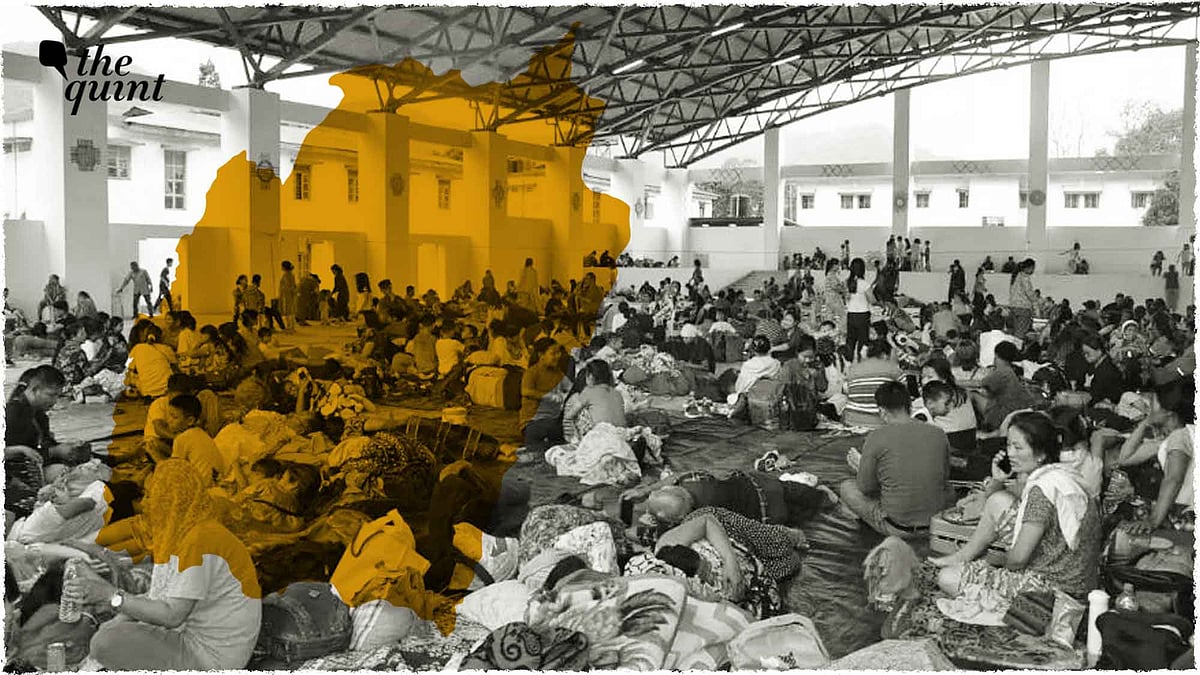
Entire villages have been destroyed. Communities that once shared public spaces now inhabit sharply segregated geographies. Movement across large parts of the state remains constrained by insecurity. For many displaced families, returning to the address recorded on an electoral roll is no longer an administrative formality. Under present conditions, it is simply not possible.
When Administrative Categories Lose Their Meaning
A home address, an identity document, or a visit from a Booth Level Officer (BLO) seldom attracts constitutional attention because each describes something straightforward about civic life. An address tells the state where a citizen lives, a document establishes continuity between the individual and the public record, and verification confirms that the two still correspond. These facts appear almost too ordinary to matter until conflict interrupts the quiet relationship between administration and everyday life.
In conflict-hit Manipur, that relationship has become increasingly difficult to sustain. More than 60,000 people remain displaced from the homes recorded in official registers, hundreds of villages have been destroyed or abandoned, and movement across significant parts of the state continues to be shaped by insecurity and ethnic segregation.
None of these realities alters who possesses the franchise. They alter the administrative facts through which the franchise is ordinarily recognised.
Under such conditions, equal procedures can produce unequal consequences, which puts a constitutional question before us: Can procedures like the Special Intensive Revision (SIR) designed for stable civic life remain democratically legitimate when the ordinary conditions that sustained those procedures have disappeared?
Those figures, viewed on their own, reveal nothing about the circumstances of individual voters. Read alongside the social realities that continue to define much of Manipur, they illuminate a more complicated constitutional problem.
Before the revision, the 19 Scheduled Tribe (ST) constituencies accounted for 37.8 percent of Manipur's electorate. They accounted for 64.2 percent of the 1.58 lakh deletions recorded during the enumeration phase, with an overall deletion rate of 12.9 percent, compared with 4.4 percent in the General constituencies. The pattern becomes sharper in southern Manipur.
Constitutional reasoning requires restraint in the face of such figures. Disproportionate outcomes do not, by themselves, establish discrimination, administrative impropriety, or deliberate exclusion. Electoral data cannot reveal the circumstances surrounding every deletion, nor should numerical disparity be mistaken for proof of constitutional violation.
The figures nevertheless identify where closer constitutional scrutiny becomes necessary. When markedly different outcomes emerge in precisely those regions where conflict has most profoundly transformed patterns of residence, mobility, and documentation, the relationship between administrative procedure and social reality demands closer examination.
Lost in Absentia and Erasure
The reasons recorded for deletion reveal another dimension of that relationship. Bureaucracies necessarily describe citizens through standardised administrative language.
One voter is marked as "Absent"; another as "Permanently Shifted". Those categories enable the electoral roll to function, yet they inevitably compress very different human circumstances into identical administrative descriptions.
It is, therefore, notable that 76.1 percent of deletions in the ST constituencies were recorded under the categories of "Permanently Shifted" or "Absent", compared with 53.9 percent in the General constituencies.
The constitutional question is not whether those classifications are lawful. It is whether identical administrative language continues to describe comparable social realities once conflict has transformed the lives to which that language refers.
Homes burn, families flee with little notice, educational certificates and identity documents disappear with belongings left behind, and official records gradually diverge from lived experience.
The difficulties are compounded by long-standing indigenous-naming practices and variations in transliteration that have historically coexisted with citizenship but may acquire greater administrative significance during the SIR exercise.
The practical implications of these altered conditions did not escape the electoral administration itself. Election officials reportedly sought guidance from the Election Commission on how house-to-house verification should proceed in villages that had been abandoned and how photographs of homes should be uploaded where many structures had been destroyed.
Verification presumes that a home continues to exist as a stable point of contact between citizen and the state. Once conflict has dissolved that assumption, the administrative routine upon which electoral integrity depends begins to encounter circumstances it was never designed to address.
None of this diminishes the constitutional obligation to maintain an accurate electoral roll. The Election Commission is entirely right to insist that no eligible citizen should be excluded while no ineligible name should remain on the register. The constitutional challenge does not arise because the objective is mistaken; it arises because the administrative facts through which that objective is pursued no longer correspond, in many parts of the state, to the realities within which citizens now live.
The Supreme Court recently observed that democracy is "not only a story of voting, but also of identifying the persons entitled to participate." That observation captures an enduring constitutional truth. Manipur does not invite us to abandon it.
Instead, it asks a prior question that extends well beyond the Special Intensive Revision itself. How should a democracy identify eligible citizens when the ordinary facts through which citizenship is administratively recognised no longer describe the world that conflict has left behind?
Recognising Citizens as They Live
Constitutions endure through the capacity of public institutions to carry enduring principles into changing societies. Equality before the law has always been responsive to the circumstances in which citizens exercise their rights. Indian constitutional practice reflects this understanding through special provisions for historically disadvantaged communities, reasonable accommodation for persons with disabilities, and institutional responses to natural disasters or public emergencies. These examples demonstrate that equal citizenship depends upon institutions recognising the conditions within which rights are exercised.
Manipur raises a different question. Administrative fairness here depends upon recognising these altered conditions and applying established procedures in ways that distinguish routine civic mobility from displacement caused by violence.
Citizens who have lost their homes continue to belong to the political community even when the records of ordinary life no longer correspond to their circumstances.
That understanding also shapes the practical operation of electoral procedures. Residence acquires a different constitutional meaning where return to one's home remains impossible. Verification becomes stronger when it draws upon every reliable public record capable of demonstrating continuity, including earlier electoral rolls, local administrative records and other contemporaneous documentation that connects citizens with the communities from which they have been displaced. Claims and objections procedures perform a similar constitutional function by ensuring that exclusion from a draft roll remains open to review before political membership is affected.
Electoral systems designed for settled populations will increasingly serve citizens whose legal status remains constant even as the conditions of their lives change. Democratic legitimacy will increasingly depend upon institutions that can recognise this reality while maintaining public confidence in the integrity of the electoral process.
That responsibility extends beyond any single revision of the electoral roll. Democracies endure because citizenship survives the upheavals of history, and constitutional institutions carry the responsibility of recognising that continuity with fairness, care, and equal regard.
(Sangmuan Hangsing is a policy researcher based in Manipur. This is an opinion piece, and the views expressed above are the author’s own. The Quint neither endorses nor is responsible for them.)
- Access to all paywalled content on site
- Ad-free experience across The Quint
- Early previews of our Special Projects
Published: undefined