
Lebanon is Paying the Price for the World’s Complicity in Gaza
The symbolism of the Israeli flag recently raised on the ancient Beaufort Castle should be lost on no one.
advertisement
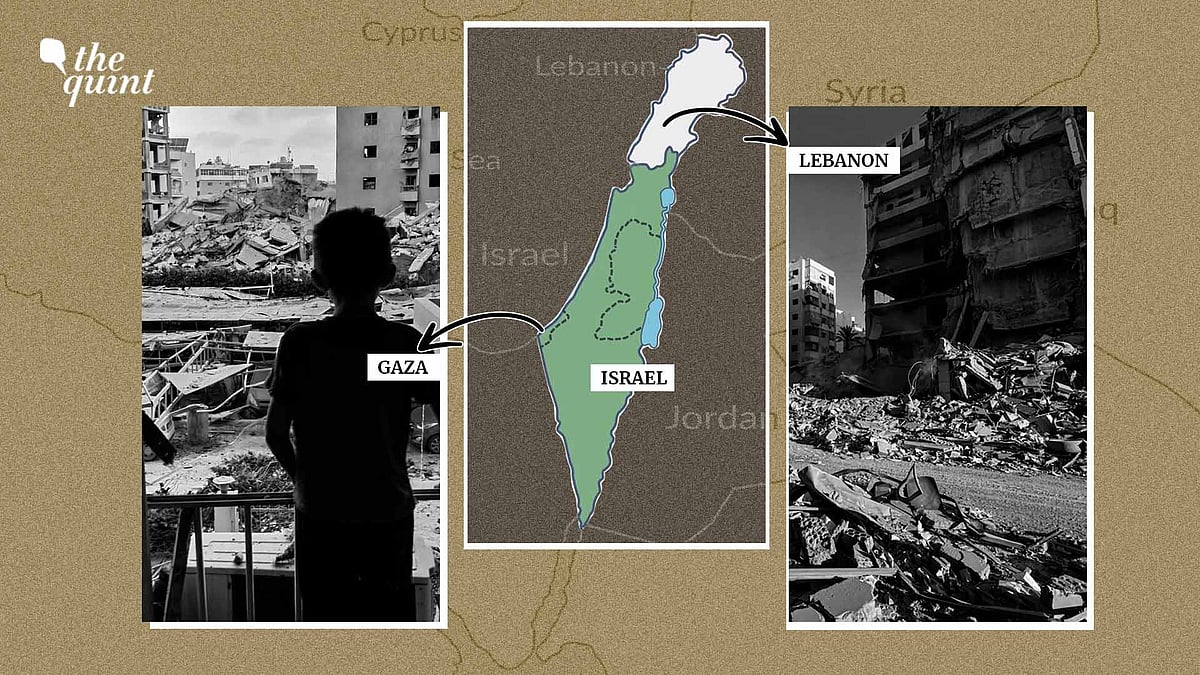
The theatre of the US-Israel war on Iran has monopolised global attention while an escalating catastrophe is unfolding in southern Lebanon—one whose logic, methods, and impunity are unmistakably familiar.
Since Israel resumed its major military offensive against Lebanon in March 2026, at least 3,400 people have been killed; over a million displaced, exceeding 20 percent of the country’s population; and thousands more wounded.
On 8 April alone, Amnesty International documented strikes across more than 100 targets in 10 minutes, on crowded residential neighbourhoods, hospitals, ambulances, and civilian infrastructure, in what Israel called “Operation Eternal Darkness”. On 31 May, Israel expanded its ground assault into its deepest incursion into Lebanon in a quarter-century, with troops seizing the ancient Beaufort Castle and raising an Israeli flag above it.
The pretext, as in Gaza, is militant provocation. Hamas launched its October 2023 attacks; Hezbollah has fired rockets in response to Israeli aggression in the region.
Israel's Repeated Ceasefire Violations
UN human rights investigators have documented direct attacks on civilians and civilian infrastructure in Lebanon, strikes on multi-storey residential buildings that killed entire families, disproportionate use of explosive weapons in densely populated areas and evacuation orders so sweeping—covering more than 14 percent of Lebanese territory—as to amount to forced displacement, itself prohibited under international law.
The November 2024 truce required Israeli forces to withdraw from southern Lebanon and Hezbollah to pull north of the Litani River. Instead, Israeli forces shot at Lebanese civilians returning to their villages on the day of the agreed withdrawal deadline, killing at least 24 people, including six women. Israel declared it would stay in the south “indefinitely”. By late 2025, Israeli strikes had killed at least 127 civilians since the ceasefire began, before the full-scale resumption of hostilities in March 2026.
A second ceasefire, declared by US President Donald Trump on 16 April 2026, has fared no better. More than 1,000 people have been killed by Israeli strikes since then. On 25 May, Netanyahu ordered the military to “intensify strikes” against Hezbollah to “crush” the armed group. By 31 May, Israel had launched its broadest ground offensive in Lebanon in decades, shattering the ceasefire entirely.
A Documented Campaign Against the Press
The targeting of journalists, a war crime under international humanitarian law, has been one of the most documented and deliberate aspects of both the Gaza and Lebanon campaigns. Since October 2023, at least 263 journalists and media workers have been killed by Israel, including 210 in Gaza and 15 in Lebanon, with at least 64 appearing to have been directly targeted.
On 28 March 2026, Israeli forces struck the car of Al Manar reporter Ali Shoeib, along with Al Mayadeen journalists Fatima Ftouni and her brother Mohammed Ftouni, killing all three while they were on a reporting assignment in Jezzine. On 22 April, Amal Khalil, a veteran war correspondent for Al Akhbar who had received prior death threats from an Israeli phone number, was killed in a strike in al-Tayri.
Emergency crews were prevented by Israeli forces from reaching her for over six hours. She died under the rubble. UN experts called these killings “an abominable push by Israel to silence reporting on war crimes committed, just as it did in Gaza”.
Mainstreaming the Zionist Agenda
Underneath the shifting military justifications lies the consistent Zionist project. The concept of “Greater Israel”—a state stretching from the Nile to the Euphrates—has migrated from the fringes of Israeli politics to its governing coalition.
Finance Minister Bezalel Smotrich has publicly advocated annexing the West Bank and spoken of extending Israeli sovereignty to Damascus. Settler leader Daniella Weiss has affirmed biblical borders encompassing much of the Arab world. Israel Defense Forces (IDF) soldiers have been photographed wearing uniform patches depicting this expanded map, including Jordan, Lebanon, Syria, Egypt’s Sinai, and parts of Iraq and Saudi Arabia.
Netanyahu himself has voiced support for the "Greater Israel" vision.
Far from being the eccentric views of isolated extremists, they represent the ideological infrastructure of the government directing these wars. In this context, the symbolism of the Israeli flag raised on Beaufort Castle was lost on no one.
Europe Wakes Late
Europe is stirring very late. Spain, Ireland, and Slovenia have pushed for suspension of the European Union (EU)'s trade agreement with Israel, while Spain has already banned imports from Israeli settlements. On 12 May 2026, the EU unanimously agreed to sanction Israeli settlers and settler organisations—a measure unblocked only after Hungary’s pro-Netanyahu government fell. But the bloc stopped well short of trade sanctions on the Israeli state, with Germany and Italy continuing to shield it from more consequential measures.
These steps, however welcome, arrive after tens of thousands of deaths and the physical destruction of entire communities. They are less acts of conscience than of belated, insufficient realpolitik.
India’s position is no less condemnable. Under Prime Minister Narendra Modi, India has offered Israel a depth of political solidarity that few Global South nations have matched. Modi’s February 2026 visit to Israel, where he and Netanyahu embraced warmly at the Knesset, came with an ICC arrest warrant hanging over the Israeli prime minister for war crimes and crimes against humanity. It was two days later that Israel and the US launched their war on Iran.
The image of that hug—a democratic leader of 1.4 billion people validating a man the world’s foremost criminal court is trying to reach—will not be forgotten.
The world is already paying. Oil prices have surged, supply chains are disrupted, inflation is spreading, and economic insecurity is rising globally as a consequence of a war launched at Israel’s behest.
When a state is permitted to kill journalists, displace a million civilians, violate ceasefire agreements and pursue ethnic cleansing under ideological cover—and when that state enjoys unqualified military and diplomatic support from the world’s pre-eminent power—the consequences ripple outward until everyone pays the price.
Injustice against one people, allowed to fester and expand through the complicity of others, is ultimately injustice against all of humanity, and nowhere is that truth more brutally demonstrated than in Lebanon today.
(Vishal R Choradiya is an Assistant Professor with the Department of Professional Studies, Christ University, Bengaluru. The views expressed above are the author’s own. The Quint neither endorses nor is responsible for them.)
- Access to all paywalled content on site
- Ad-free experience across The Quint
- Early previews of our Special Projects
Published: undefined