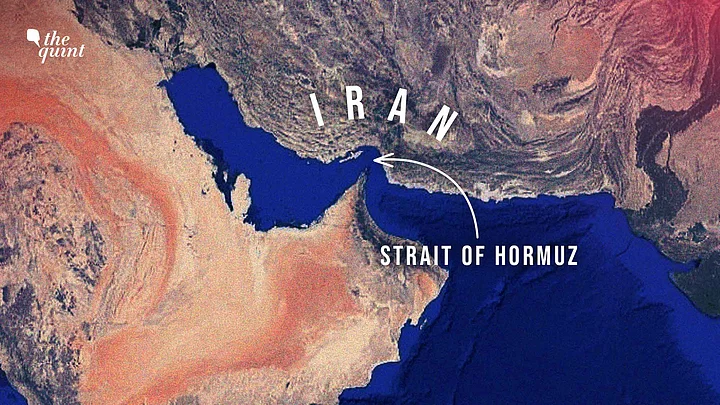
Energy is central to human existence and prosperity. Hydrocarbons—petroleum crude oil and natural gas—are the dominant sources of energy in today's world. Therefore, the Strait of Hormuz, through which about 20 percent of global crude oil and 30 percent of liquified natural gas (LNG) pass through, is critical for global oil and gas supplies.
Iran—after being bombed by the American-Israeli axis for reasons that appear more invented than genuine—controls the Strait of Hormuz. Despite the US-Israel military superiority, Iran’s hold and control over the strait continues largely unaffected. Iran’s attacks on oil and gas facilities and other infrastructure of major producers—Saudi Arabia and the UAE for oil, and Qatar for gas—have compounded supply problem.
There was a moment of panic on 9 March when oil prices briefly touched $120 per barrel. However, some conciliatory signals from US President Donald Trump restored confidence that any closure of the Strait of Hormuz might not be prolonged. Oil prices fell below $100 per barrel on 10 March.
However, nothing is absolutely certain about which way the wind will blow in the coming weeks.
India has enormous import dependence for crude oil and gas—more than 85 percent in case of crude oil, and about 55 percent for natural gas supplies (LNG and CNG together). About half of India’s oil imports and 75 percent of natural gas imports come from West Asia.
A stoppage of Qatari gas supplies for India would be seriously disruptive. Disruption in crude oil supplies from West Asia could also be hugely problematic, especially if Russian and Venezuelan crude is not available to compensate for reduced supplies, for whatever reasons.
There are significant economic, fiscal, and consumer welfare implications of this evolving and disruptive oil and gas scenario. How is the government handling it? What are its options? Will consumers suffer price and availability shocks? Who will bear the cost of higher prices?
Import Dependence: India’s Achilles Heel
India imports about 5 million barrels of crude oil every day to meet its diesel, petrol, and other petroleum products requirement.
When Prime Minister Narendra Modi took office in 2014-15, India’s crude oil import dependence was about 75 percent. He vowed to bring it down to less than two-thirds by 2022. Instead, India’s import dependence has risen above 85 percent by now as demand keeps growing, and domestic production continues to declines.
Consumption of natural gas has also been expanding with more than 320 million households now using LPG (rightly promoted through programmes like Ujjawala), cities rapidly switching to piped natural gas (PNG), and many industries shifting to natural gas to meet their energy requirements.
India imported 18.5 million cubic meter of LNG in 2014, almost 90 percent from Qatar. India’s gas imports increased to 34.7 million cubic meter in 2024. Besides households, many industries—fertilisers, ceramics, and others—depend heavily on natural gas supplies.
Disruption at the Strait of Hormuz has affected both crude oil and natural gas supplies for India.
India might be able to compensate for its reduced supplies from other sources—including Russia, with Trump granting a waiver from sanctions—but at high prevailing prices. India does not have significant strategic reserves either (about 5.25 million barrels in total, equal to roughly a day’s demand). The floating or working reserves of about 30-35 days, required for the system to remain well-supplied, cannot be depleted significantly.
India cannot, however, make up for the shortage in natural gas supplies the same way.
In view of these ground realities, the government has adopted a strategy of buying as much oil from international market, at whatever prices available, and keeping the domestic supplies unaffected. However, as this strategy cannot work for natural gas in view of its physical unavailability, the government has resorted to reducing natural gas supplies to industrial and commercial establishments.
The natural consequence of this policy is that while there is no panic regarding petroleum products such as diesel and petrol, businesses such as restaurants, the ceramic industry, power plants, and fertiliser producers are being adversely affected, forcing them to reduce or stop production.
For now, the government has clearly prioritised domestic consumers. However, this could become increasingly difficult if the disruption continues.
Fiscal Impact
Increase in petroleum crude import prices is real. It has increased from about $60 per barrel 10 days back to over $90 now (disregarding abnormal trades). The estimates suggest that India’s crude oil import bill goes up by about $1.5 billion for every $1 per barrel increase.
India is currently passing through a difficult foreign exchange situation. If India’s crude oil bill were to go up even by $50 billion (for about $30 per barrel increase on average) in a year, it will be quite a devastating impact on the foreign exchange rate.
Any increase in crude oil import costs is typically absorbed or shared by three actors: the Government of India (which receives about Rs 3 lakh crore in excise duties) and state governments (which collect almost an equal amount through VAT), oil marketing companies (OMCs), and consumers (through higher pump prices).
The impact on OMCs is indirectly borne by the government (in the form of lesser dividends or payment of subsidies for under-recoveries).
The government and OMCs have virtually frozen the diesel and petrol prices since 2022. Only state government's VAT changes are reflected in retail prices. OMCs did not change retail prices when the government increased excise duty by Rs 2 per litre on 8 April 2025.
As the international crude prices have been much lower than retail prices charged by OMCs in the last two years, they have been able to report excellent profits. The situation would turn for worse for OMCs if crude oil prices remain around $90 per barrel or go up further.
Considering the fact that there are elections in many key states—West Bengal, Tamil Nadu and Kerala—in the next few months, it is absolutely unlikely that the government will allow OMCs to pass on the additional import cost to consumers.
The government is unlikely to cut excise duties on petrol and diesel either, at least until the crude oil prices cross $100 a barrel. Thereafter, to see that OMCs' balance sheets do not fall very deep in red, the government might start reducing excise duties. Private OMCs stop selling petrol and diesel when it is no longer profitable for them, transferring the losses to public sector OMCs.
Either way—whether through subsidies to OMCs for under-recoveries (the government has already paid about Rs 50,000 crore in two instalments to compensate for LPG under-recoveries) or through reductions in excise duties—there will be a significant adverse impact on government finances. The exact magnitude will depend on how long prices remain elevated.
Addressing Crude Oil and Gas Vulnerabilities
India has seen its import dependence worsening in the last 11 years, despite Prime Minister Modi’s resolve to reduce it, and an expanded ethanol programme being rolled out. Concessions granted for increasing crude oil and natural gas production in the country have also yielded limited results.
It should, therefore, be quite obvious that the real solution lies in reducing the demand for petroleum products. There is only one reliable way for India to achieve this: producing electricity using solar, wind, and other renewable sources, and using that electricity to substitute demand for petroleum products and domestic cooking gas.
This would require India to massively boost generation of electricity using solar, wind, hydrogen, and all other renewable technologies. Additionally, India would need to build humungous battery storage capacity to fully utilise solar-, wind-, and hydro-generated electricity.
Unfortunately, efforts in this direction have been rather lacklustre.
We have not learnt to do business with China to ensure massive expansion in electricity and batteries production.
Even when the share of renewable electricity is only about 10 percent in total electricity generation, there have been instances of solar power plants being ordered to shut down generation. Sales of electric vehicles are also weak—less than 2 percent in case of passenger cars.
Unless India significantly expands electricity generation from renewable sources and builds massive battery storage capacity to utilise this power effectively, our vulnerabilities on crude oil and natural gas imports will continue to trouble and hurt us.
(Subhash Chandra Garg is the Chief Policy Advisor, SUBHANJALI, and Former Finance and Economic Affairs Secretary, Government of India. He's the author of many books, including 'The $10 Trillion Dream Dented, 'We Also Make Policy', and 'Explanation and Commentary on Budget 2025-26'. This is an opinion piece, and the views expressed above are the author’s own. The Quint neither endorses nor is responsible for the same.)