
The Battle for the Hijab Exposes Limits of Indian Secularism
When did India begin to deviate from constitutionally passive secularism to assertive religocentrism?
advertisement
For fifteen years I taught a course in public policy and disadvantaged people in India’s premier business school the Indian Institute of Management, Ahmedabad. My class each year would have a fair sprinkling of overseas exchange students, including often some from France.
I would use the example of the hijab to explain the difference between the French and the Indian notions of secularism. I explained my understanding of India’s secularism as being not the absence of faith, but equal respect for every faith (including the absence of faith).
In France, the secular principle is often interpreted to bar a woman from wearing a hijab in her classroom. In India, I said it is the reverse. Our commitment to secularism would demand from us that we defend her right to wear a hijab, even if we choose not to wear one.
Meanwhile, the management of the Indian Institute of Management, Ahmedabad disinvited me after 15 years of teaching, so I was spared a more complicated discussion with my students. I would have insisted to them that forcing women to wear the veil—as was done in Iran—was as wrong as forcing them not to wear it—as was done in France and now increasingly in India.
The Hijab and Indian Secularism
Social commentator and historian Mukul Kesawan observes that in denying hijab-wearing girls admission to classrooms, the college authorities claimed they outlawed the hijab because it violated the school uniform. But actually the college authorities and their political patrons were invoking the larger principle of hard uniformity built into the French construction of secularism, laïcité.
“The principals of these Udupi colleges should be asked,” Kesawan says, “if they would admit turbaned men. If they say yes (as they must), they must admit hijabi women. If they choose not to, it should be clearly understood that they are actively discriminating against Muslims.” For this reason, he says, we owe the hijabi girl students both solidarity and concern.
Kesawan also describes how the Sikh turban became a global challenge to the shibboleths of laïcité, as every Western country changed the uniform rules of its armed forces to permit Sikh soldiers to wear their turban and beard.
The Karnataka Hijab Combat
This was the settled constitutional position in India until the Bhartiya Janta Party government led by Modi took office in New Delhi. There were since then—and more aggressively since 2019—a range of attacks on Muslim religious and cultural symbols and practices.
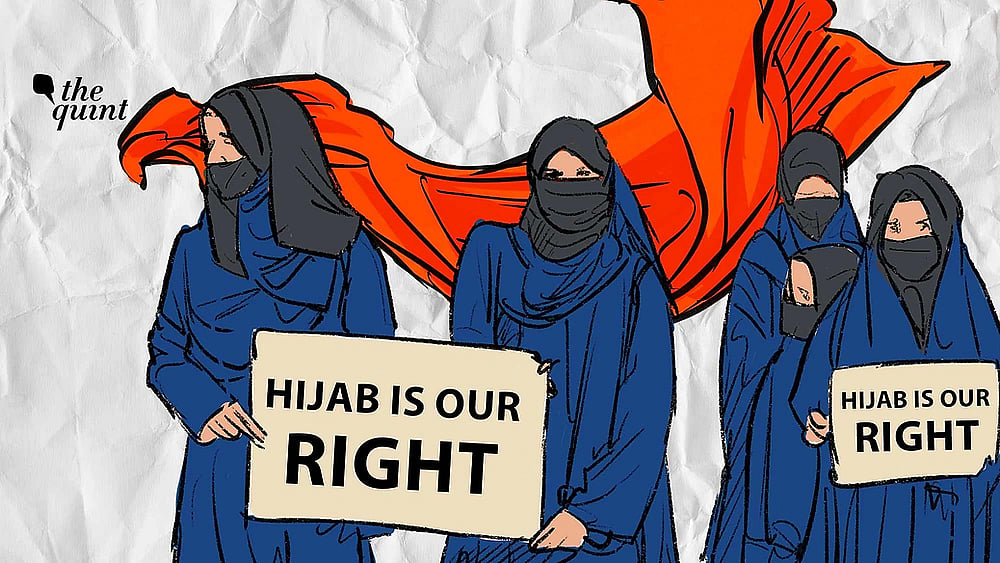
The controversy about whether Muslim female students should have the right to veil their heads and faces with a hijab snowballed from December 2021, when six girl students wearing the hijab in a government-run school in coastal Karnataka were barred from entering school if they insisted on wearing their hijab.
The girls protested outside the school gates for many weeks, wearing their hijabs while still trying to continue with their lessons. They argued that girl students had worn headscarves for the past many years with no objections, but to no avail. More schools banned the hijab, prompting demonstrations by hundreds of Muslim women as protests spread across the state.
Hindu students mounted counter-protests to the protests by Muslim students that spread across the state. Mainly boys, but also sometimes girls also wore saffron scarves, and recited war-cries like Jai Shri Ram, even as fellow students marched to schools wearing their headscarves. In one school, a student climbed a flagpole and unfurled a saffron flag as other students cheered.
Muslim students alleged that behind the scenes was the militant Hindutva Hindu Jagran Vedike, associated with Rashtriya Swayamsevak Sangh. But Mahesh Bailur, a senior member of the Vedike denied this. They extended only “moral support” to the students who protested wearing saffron scarves. “Today these girls are demanding hijab in colleges. Tomorrow they will want to pray there. Finally, they’ll want separate classrooms for themselves,” he said to AP, “This is unacceptable.”
Tensions rose further in and outside the schools, sometimes edging dangerously to face-offs. Ministers also spoke out against the hijab, questioning the need to wear a hijab, or describing it as school indiscipline. In other BJP-ruled states like Madhya Pradesh, some schools began barring girls from coming to school with a hijab. BJP MP Pratap Simha declared, “You can wear a burqa, hijab… and then go to a madrassa.”
Battlelines deepened further. Senior BJP leader Yashpal Suvarna claimed that the girls who challenged the hijab ban in Karnataka were “anti-national” and “members of a terrorist organisation.” Suvarna’s comments came after the Karnataka High Court upheld the hijab ban, stating that the hijab is not an essential religious practice of Islam. He was later given the party ticket to contest from the Udupi Assembly constituency.
Faith and Future
“It’s not just a piece of cloth,” said Aliya Assadi who has been wearing a hijab since she was 12, to AP. “Hijab is my identity. And right now what they’re doing is taking away my identity from me.” “I’m an Indian and a Muslim,” she said. “When I see this with the point of view of a Muslim, I see my hijab is at a stake, and as an Indian, I see my constitutional values have been violated.” “We are brave Muslim women,” she said, “and we know how to fight for our rights.”
In one college, more than 20 girls came wearing hijabs that matched the colour of their uniform, but they were denied entry at the college gates. The video of the college gate being closed on them went viral. Videos circulated of hijab wearing girl students being hectored by male students with saffron scarves as they marched determinedly to school.
In one video that I recall seeing, a hijab-wearing student marched through the throng of her jeering colleagues, saying Allah u Akbar. Later, when asked by a reporter if she would complain to the police against her male classmates, she replied, “How can I? They are like my brothers.”
The state government also went on to ban the saffron scarves, and then shut the schools. But it drew by this a false equivalence between saffron scarves, that were not prescribed markers of religious faith, in the way that the hijab and the Sikh turban are.
Article 14 reports how the hijab ban inside government educational institutions upheld by the courts left Muslim women students feeling they had to choose between their faith and future. Many institutions refused to even let them sit for their examinations unless they took off their hijab.
“It took me 15 years to get here,” said one student. “I begged the teacher to let us give the exam.” But she did not relent. “I collapsed—mentally, physically, emotionally," said another student. ”Many girl students were not even allowed to give their examinations if they refused to give up the hijab.
One student in Gujarat, Jenisha Shah, in December 2025, appeared for her Railway Recruitment Board exam at JSM Infotech in Gujarat. But she was stopped before the entrance and was asked to remove her burqa and hijab. After arguing with the security guard and staff members, who she alleges were rude to her, for more than half an hour, she left without giving the exam.
She recalls, “I told them politely to do a proper check to ensure that I had nothing under my hijab with which I could cheat. I also asked them to show me any written proof or a notice that puts a ban on the hijab, but they did not comply. They were so rude to me and told me to better skip exams if I wanted to keep my hijab on. They mocked me by saying that we Muslims are the only ones who argue while everyone else complies with the rules.”
Her friend Nida Sheikh told the Observer Post “I have faced many job rejections because of what I choose to wear. Recently, I appeared for a clerical recruitment examination, and they asked me to remove my hijab and were very rude to me while I was conversing with them. I had to leave.” She recalled that in college, her male classmates often mocked her and other hijabi Muslim girl students, chanting Jai Shri Ram when they would enter class.
Crimes Against Minorities
The freedom of worship of India’s religious minorities—mainly Muslims and Christians—is grievously under siege in Modi’s India. Prayer by these minorities often becomes a crime. Being seen in public wearing religious and cultural markers has become perilous. Religious clergy—priests, nuns and imams—live under threats of mob attacks and criminal charges of forced religious conversion. Mobs or government bulldozers—sometimes both working together—vandalise mosques, mazaars, madrassas, churches and chapels.
Months before I write this, the warhorse ten-time chief minister of Bihar, Nitish Kumar in an award function thought it fit to pull off the hijab from the face of the woman doctor when she went on stage to receive her award.
The political opposition was quick to condemn his act as despicable. Their condemnation is of course entirely apt. However, what it obscures is that such disdainful and derisive attacks on Muslim women who cover their heads and faces have become commonplace in India’s public life. Kumar’s abhorrent act was sadly not an aberration.
Women’s Freedom of Choice
Law professor Nizamuddin Ahmad Siddiqui does not agree with the view taken by the Supreme Court that the hijab is not essential to Islam. He explains that Islam is a public faith. A belief in the unity of God and the teachings of the Prophet are not enough. There is also the requirement of public affirmations of one’s faith, through symbols and rituals, many of which are public.
He points to the reality that each of us wear many identities. The hijabi students of Udupi were Indian, Muslim, Kannadiga, girls and students. But the movement sought to strip from them the right to publicly display their religious faith, forcing on them the uniformity of the majoritarian Hindutva identity.
However, opposition to the hijab came not just from the Hindutva far-right. In a blogpost senior journalist Saba Naqvi speaks of her personal opposition to the veil because she is convinced that women should not hide anything—head, face, limbs, mind, views. But she learned that it was not just a male-dominated social order that interprets faith to establish that the religion ordains the veil. She learned that Muslim women choose to wear the veil for many reasons, including as a response to a world that is hostile to Muslims.
Independent journalist Alishan Jafri and architect Sara Ather delve into the critiques of the right to hijab from feminist and progressive commentators. They observe that if “practising Muslims are imagined to be pre-programmed for rigidity and fanaticism by the right wing… a sisable section of liberals also subscribe to the same stereotype.”
They rightly underline that “secularism has to be understood not as the erasure of cultural symbols but as the presence of choice to either embrace or reject them as one wills.”
(Harsh Mander is a social activist, writer, and researcher who started the Karwan-e-Mohabbat campaign in solidarity with the victims of communal or religiously motivated violence. This is an opinion piece and the views expressed are the author’s own. The Quint neither endorses nor is responsible for them.)
- Access to all paywalled content on site
- Ad-free experience across The Quint
- Early previews of our Special Projects
Published: undefined