
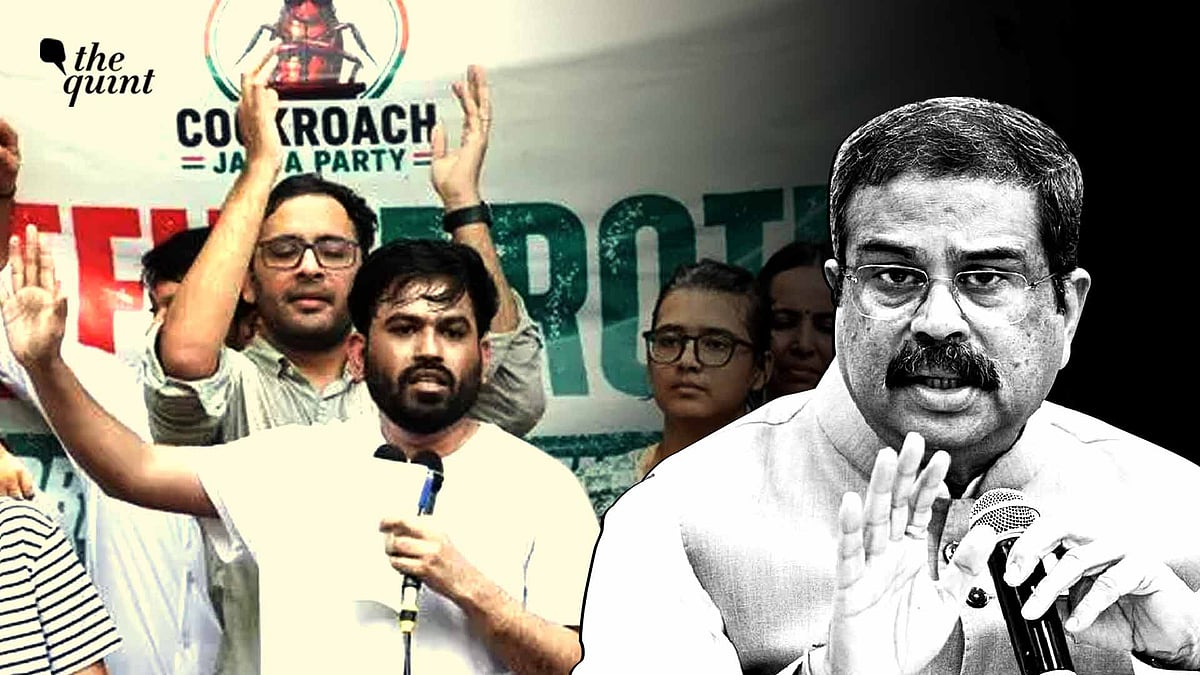
Why the Modi Govt May Still Refuse to Sack Dharmendra Pradhan
Every movement should have an exit route before its launch, writes Ashutosh.
advertisement
So, finally, the worst has happened for the Modi government. That students would gather in such large numbers was, of course, not anticipated by them, and now the government would be cursing the day it granted permission to Abhijeet Dipke to hold a dharna at Jantar Mantar when he landed at the Delhi Airport.
Frankly speaking, even I hadn't thought that the Indian youth would pour its anger with such collective energy. This shows that the youth are really suffering from tremendous anguish, are worried about their future, and are greatly disappointed with the government.
Narendra Modi is one of the Prime Ministers who does not want to be seen as crumbling under pressure or as being pressured by anyone to get things done. No. That is anything but Modi. Therefore, I am not sure that, even if Wangchuk continues his hunger strike; the numbers at Jantar Mantar swell for a few more days; and Wangchuk’s health deteriorates further, the Modi government will budge.
Movement Without an Exit Strategy
From the beginning, I had said that the whole show by the Cockroach Janta Party (CJP) was without any careful planning. It lacked the vision and seriousness needed to fight a government as powerful as Modi’s. It lacked the required leadership, and its team could neither sail through the storm nor navigate stormy currents to reach its desired destination.
Now is the real test. Yes, Dipke might have missionary zeal, to which Wangchuk added a certain gloss and moral aura, but to succeed, it also needed the right strategy.
No government would want to be seen as conceding to the demands of the agitation straight away, as that would expose the government's weakness and open the door for others to launch a movement. For the government, that will be the death knell.
What the Anna Movement Understood
In contrast to the CJP, the Anna movement was more aggressive, more assertive, and louder. It had tremendous media support, but it had the resilience and elasticity to negotiate a deal with the government. It had the willingness to give the benefit of the doubt to the government and concede a point to earn visible brownie points to claim victory.
After the Jantar Mantar hunger strike, the Manmohan Singh government formed a committee comprising members of Team Anna and government nominees. This was a huge victory for the movement itself.
Secondly, the Anna movement was more grandiose and ambitious in its vision. Its demand was not focused on an individual; it challenged the whole system. It did not blame a party or a leader for the corruption. It was a rejection of the whole process, a protest against the entire political class, a revolt against the rotten establishment. Its urge was not to seek one man’s head but to change the whole system if the society and the polity were to be cleansed of corruption. It was to change the grammar of politics; it was to make politics clean. It was unique in that it not only showcased the problem but also offered a solution.
On the other hand, the CJP believes that the paper leak is not a systemic problem—it is the result of a minister's incompetence. Their demand is based on the premise that if the minister is removed, no further paper leaks will occur.
This premise is flawed and lacks an understanding of the problem. The paper leak is a result of a rotten, corrupt system—and the minister only a cog in the wheel. Pradhan is not the real problem; he is only the manifestation of a bigger malaise. He is only a symptom, not the disease. Even if he is removed, the problem will persist. The system has to be changed if paper leaks have to be plugged.
Sympathy Is Not a Mass Movement
It is the tunnel vision, the lack of the big picture, because of which, in the initial stages, the CJP movement failed to attract a larger audience and connect majorly with Gen Z. The crowd swelled only when the news spread that Wangchuk’s health had begun to deteriorate—it was not due to the movement's grandeur, but rather to human sympathy.
The government was not bothered; it made no effort to contact the movement's leaders and did not hint that it was willing to engage with them to end his hunger strike. Wangchuk was caught in a whirlpool; there was no exit gate.
But now the situation has changed, and Rahul Gandhi and the Opposition can’t afford to ignore the intensity of the movement. The Opposition is now aggressive and trying to put the government on the mat over the issue.
Now the government has also had to rethink its strategy. No wonder JP Nadda invited youth leaders to discuss the way forward. Three demands have been put before the government. These relate to Wangchuk’s release and compensation to the families of students who died by suicide.
But the government is silent on the minister's resignation. The future of the movement now hangs in the balance on this issue and on how the government deals with students on the ground.
I am not sure whether the government will easily concede to the demand.
(Ashutosh is co-founder of SatyaHindi and a former member of AAP. This is an opinion piece and the views expressed are the author’s own. The Quint neither endorses nor is responsible for them.)
- Access to all paywalled content on site
- Ad-free experience across The Quint
- Early previews of our Special Projects
Published: undefined