
CJP Protest: Behind Modi Govt's Two-Point Plan to Contain Students
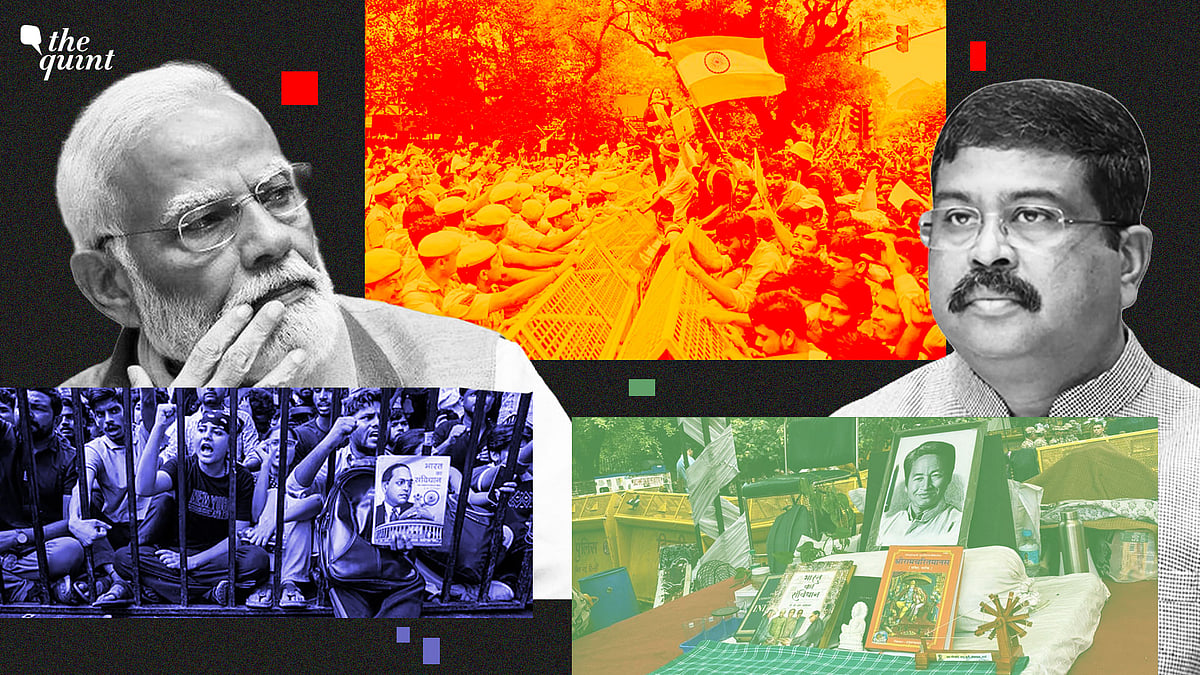
The Modi government wants to contain the students to Jantar Mantar and the Opposition to Parliament.
advertisement
The government "underestimated" the mobilisation at Jantar Mantar over the weekend as well as the crowds that turned up for the march on Monday, 20 July, Bharatiya Janata Party (BJP) sources told The Quint.
However, they maintain that there is "no question of sacking any minister due to street pressure". Many in the government are seeing this as a "regime change" protest, and not one demanding "education reform".
Broadly, people within the government and the BJP are saying three things:
1. 'The CJP is no longer in control of the protest'
"Very few of those who came (on Monday) are NEET students (aspirants). This crowds were brought by Left student bodies, Aam Aadmi Party, and Bhim Army," a BJP functionary told The Quint, adding, "A lot of people were brought from Punjab and West UP".
The source further said that there's "no point" talking to the CJP leadership as they "no longer have control over the protest".
2. 'Protest is bad optics'
According to a report in The Indian Express, "Sources in the BJP said the government decided to meet the protesting students as the situation had escalated on the first day of the Monsoon Session and 'created very bad optics'. Naturally, the government cannot be seen as insensitive to the protesting students".
The decision to deploy Union Health Minister JP Nadda to meet the Cockroach Janta Party (CJP) leaders is being seen as an attempt to address "optics".
3. 'Wary of Opposition'
The government alleges that the protest by Rahul Gandhi and senior Congress leaders was a "breach of protocol" and "a new low".
The government plans to introduce key legislations in the Monsoon Session but it is now concerned that the Opposition may "use the protests to disrupt Parliament".
What Will the Government Do?
Sources say that the government has a two-pronged strategy to handle the protest.
1. Contain the students' protest to Jantar Mantar
The government seems to be fine with the protest so long as it stays restricted to Jantar Mantar. The visuals of thousands of protesters in the Connaught Place area became embarrassing to the government. Connaught Place and adjoining areas saw the harshest lathi-charge and attacks by the police on the protesters.
The government is also said to have planned to communicate to the CJP leadership that they will be held responsbile if the protest gets used by "anti-social elements".
2. Restrict the Opposition to Parliament
The government's main counter to the Opposition has been that it agree to debate the NEET issue in Parliament "instead of protesting on the streets". This is an argument made even by Education Minister Dharmendra Pradhan whose resignation is the main demand of the protesters.
The government hopes that if there's a debate in Parliament, it will get a chance to highlight the "steps it has taken" after the paper leaks, and that it would shift public focus away from the street protest.
In addition to this, the government also may open up a dialogue channel with Sonam Wangchuk, who it sees as a "reasonable" element within the protest and one whose word may count for the protesters.
Concerns Over Long-Term Impact
However, there are concerns within the BJP about the long-term political impact of the protest, especially among younger voters. Privately, party members admit that the impact could be more than the farmers' and anti-CAA protests, where the protesters, predominantly came from communities that were not in favour of the BJP in the first place.
"Youth are more influenced by memes and reels. Anti-government narratives are being amplified there. We are probably not doing enough to take our point of view to them," a BJP leader from Maharashtra told The Quint.
"At some point, we need to engage with this section better. It's not just about this protest," the leader added.
- Access to all paywalled content on site
- Ad-free experience across The Quint
- Early previews of our Special Projects
Published: undefined