
Jantar Mantar: Modi Govt Must Change Its Ways, Not the Protest Venue
Changing venue won't matter. Democracy demands answers from the rulers. Distance is immaterial, writes Ashutosh.
advertisement
The picture of Ashutosh Ranka and Saurav Das climbing over the gates of Jantar Mantar in defiance of the government’s order to change the venue of protest from Jantar Mantar to three other locations is symbolic of the fact that the government is losing control—and is confused about how to deal with people’s anger.
Certainly, people are angry. The anger is due to the government’s apathy to people’s issues and their genuine concerns. The anger is due to the "lies and half-truths" told to the people. The anger is due to the arrogance of the those in power who visualise themselves as omnipotent and above public scrutiny. The anger is due to the way young students, boys and girls have been treated by the government.
This anger is justified. In a democracy, smart governments are expected to manage the anger, not to change the venue where people pour out their anger.
The change is not a solution; change of venue is an admission of defeat, and of guilt, if at all the leadership feels any guilt.
A Historic Centre of Change
Jantar Mantar is historic. It is a symbol of the fact that democracy is alive in India and is bustling with cosmic energy. Before, Jantar Mantar, the Boat Club was the centre of people’s anger and defiance. The country has seen many historical rallies at the Boat Club. It was the favourite venue of Opposition leaders who wanted to ventilate their scorn and contempt for the incumbent government.
It was a favourite venue for the great Kisan neta, Mahendra Singh Tikait. Whenever Tikait felt that the government of the day had not done enough for the farmers, he used to move with his army of supporters from Muzaffarnagar to Delhi and the government used to quake.
During Rajiv Gandhi’s time in 1988 when Tikait stationed himself at the Boat Club lawns between the picturesque India Gate and Rajpath, along with approximately 2 lakh supporters for days, which led to massive disruptions of public life in the heart of the city, it was decided to change the venue for the smooth movement of traffic and larger security reasons.
But it was finally in 1993 that the transition from Boat Club to Jantar Mantar happened. The Boat Club was close to the Parliament and the Central government offices, including the Prime Minister’s Office, and Jantar Mantar was a little away from the glare of the power centre. Till then, Jantar Mantar was only a famous tourist spot.
A Stage for Dissent
When I first came to Delhi in early 1980s, the first place I visited was Jantar Mantar. As described by The Times of India, Jantar Mantar is “an open air astronomical observatory designed to track celestial movements.” I was mesmerised to see this observatory, and was wondering how the time was calculated by the movement of sunlight.
In later years, when I joined journalism, I forgot the observatory as this place became the headquarter of the Janata Dal. This was the time when VP Singh was the prime minister, and major political announcements were made here. During this time, whenever I had to interview or talk to any leader of substance from the Janata Dal, I used to visit the place.
Here, I was told that much before the Janata Dal occupied the building, it was the headquarter of the Congress party before its office moved to 24 Akbar Road.
When I joined the Aam Aadmi Party (AAP) in 2014, Jantar Mantar was a regular place for small rallies, whenever the party felt the need to make noise. I still remember that when the AAP lost all seven seats in the 2014 parliamentary election in Delhi—and its obituary was written by the polarised national media, the party roared back after a massive rally at Jantar Mantar and won 67 Assembly seats out of 70 in 2015.
This was also the place where a farmer died accidentally while climbing a tree during the AAP's rally. I was then sitting in the front row of the stage. Arvind Kejriwal was castigated for being insensitive because he had continued the rally despite the death of a man.
It was at Jantar Mantar that Anna Hazare and Kejriwal were first noticed nationally. Here, Anna sat for an indefinite hunger strike demanding that the Lokpal to be made to fight corruption at high places. Manmohan Singh was the prime minister then.
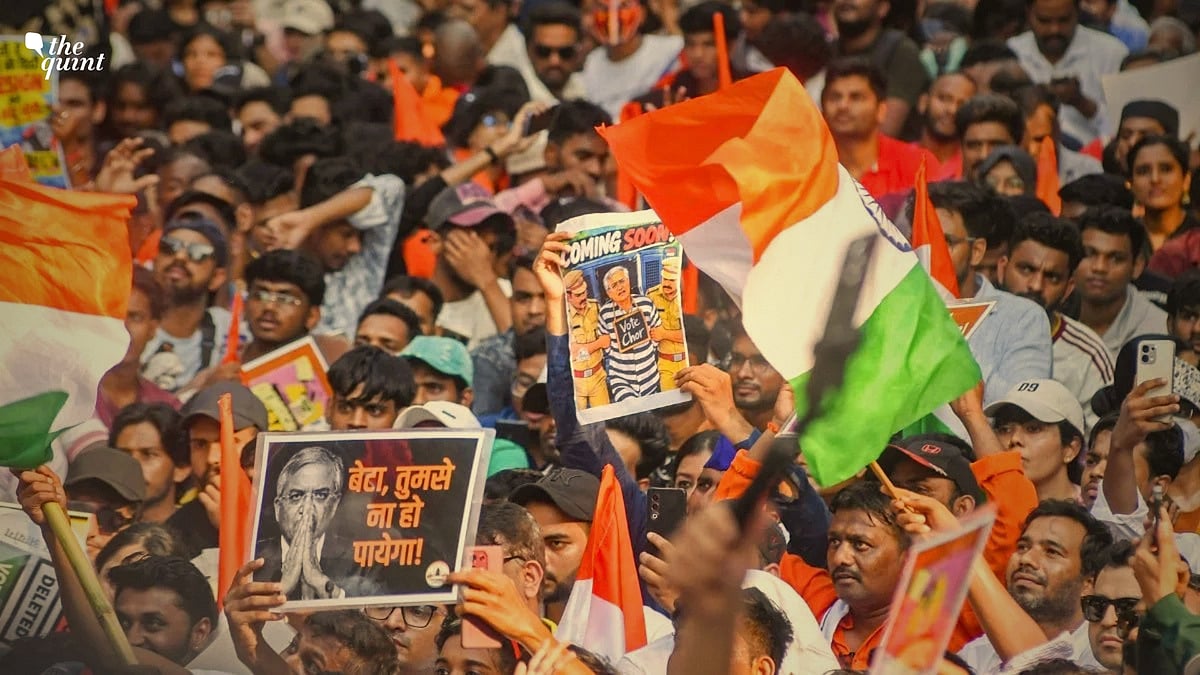
Therefore, it is no wonder that when the Cockroaches assembled at Jantar Mantar for their demand that Dharmendra Pradhan should resign for paper leaks, the Modi government froze, got scared, and unleashed a brutal lathi charge which finally resulted in the resignation of Dharmendra Pradhan.
Is history repeating itself? I do not know as I have no clairvoyance about the future. But I can definitely say that there is a whisper in the air that change is lurking in the shadows and now it depends on the Opposition and how it captures the mood of the people.
Change or Be Changed
It does not matter if Jantar Mantar does not remain a centre of protest in the near future. History remembers that democratic energy can’t be dissipated simply by changing the venue, and keeping it away from the centre of the city. Democracy demands answers from the rulers. Distance is immaterial.
In today’s time when AI defines what we think and decide, when voices of protests do not need national media to create noise, when every individual is a potential reporter, it does not really matter if voices are coming from the centre of the city or from periphery and faraway places.
We are living in a viral age. It takes few seconds for a message to travel to millions of viewers. The government should more focus on solving people’s issues and concerns, instead of changing venues.
The world no longer resides in 2014 when Narendra Modi was seen as a messiah who would change the world. India has moved to 2026 when Rahul Gandhi is not seen as Pappu, rather as the 'new' hope. The old tactics will not work.
Since 20 July, when the government resorted to a brutal lathi charge, people, especially the youth, has stopped being scared of the repressive measures of the government. A similar tactic was used on 10 October, and again it could not scare Gen Z.
The government, which once revelled in its invincibility, has become a pathetic caricature of its own self. It looks rudderless and sterile. A certain paralysis, which had turned the Manmohan Singh government into a vegetative state, has gripped this government too.
The Modi government has to change its style. It has to reinvent itself. It has to reenergise its source of strength. The message is loud and clear—change yourself if you want to survive, changing the venue won’t help.
(The writer is an author, columnist, co-founder of satyahindi.com and former spokesperson of AAP. He tweets at @ashutosh83B.This is an opinion piece and the views expressed above are the author’s own. The Quint neither endorses nor is responsible for the same.)
- Access to all paywalled content on site
- Ad-free experience across The Quint
- Early previews of our Special Projects
Published: undefined