
Beef, Satire, and Slut-Shaming: Influencer Politics Heats up in Pre-Poll Bengal
Are political parties using influencer platforms to normalise a culture of irresponsible public discourse?
advertisement
In today's era, every election unfolds not just on the ground but across social media platforms, where narratives spread faster than rallies. In West Bengal, the significance of these digital spaces has surged, especially for the ruling Trinamool Congress (TMC), which shifted gears after the 2019 Lok Sabha polls by engaging the political consultancy I-PAC to revamp its online strategy. On the other hand, the Bharatiya Janata Party (BJP) was already strong in terms of their online presence.
Social media now amplifies voices of content creators, podcasters, and so-called influencers—a term that often oversimplifies their role as agenda-setters. Even national figures like Prime Minister Narendra Modi embraced this trend, appearing on podcasts before the 2024 Lok Sabha elections to connect with younger audiences.
Beef with Beef
Within a matter of weeks, West Bengal has seen two high-profile controversies involving content creators—episodes that lay bare the increasingly combustible intersection of social media, identity politics, and electoral timing. What might once have remained a minor grievance or a fleeting online spat now mutates rapidly into a public spectacle, amplified by outrage economics and political opportunism.
Chakraborty, who has sizeable following on social media, alleged that he had ordered a mutton steak and consumed it, only for a waiter to return with another dish. When he questioned the second serving, the waiter reportedly informed him that the earlier dish was a beef steak, and the latter mutton.
In a video of the incident that circulated before being taken down, Chakraborty was seen confronting the waiter, Sheikh Nasiruddin, questioning his Muslim identity, and asking whether he would consume pork. While the waiter claimed it was an honest mistake, Chakraborty framed the incident not as a culinary error but as a deliberate affront—asserting that he, a Hindu Brahmin, had been made to consume “Gau Mata”.
The exchange soon snowballed into a police case, with Nasiruddin arrested under Section 299 of the Bharatiya Nyaya Sanhita for allegedly hurting religious sentiments. This occurred despite repeated apologies from the waiter and the restaurant’s admission that the mix-up, if any, was unintentional.
Satire to Slut-Shaming
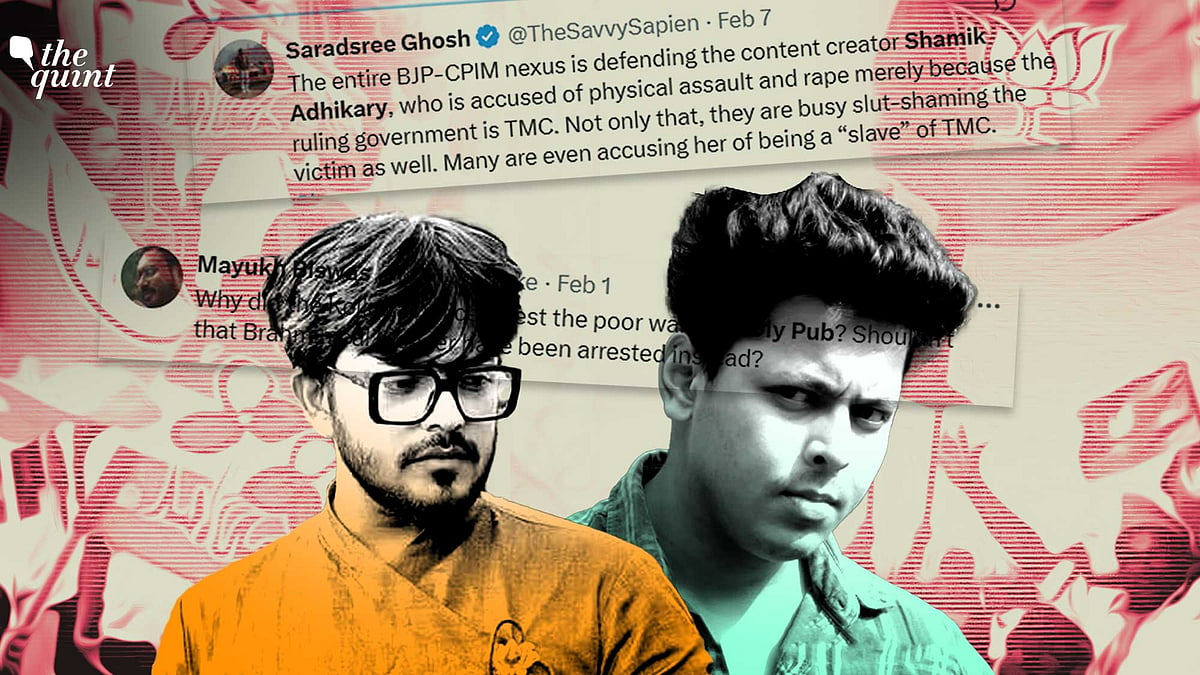
Second, 25-year-old content creator Shamik Adhikary, who goes by the name of 'Nonsane' on social media, found himself in the eye of a storm, days after releasing a sharp political satire, titled in Bengali.
The video culminates in a telling visual: Adhikary standing before an EVM, pausing to look at the button, and then turning his gaze toward the audience. The sequence functions as an unspoken cue—subtly but unmistakably signalling a call for regime change in Bengal. The video exploded in popularity, amassing views in the millions, and prompting Adhikary to appear on multiple podcasts, defending his right to dissent.
However, within days, his 22-year-old girlfriend lodged a complaint alleging he confined her for 20 hours, assaulted her physically, and committed sexual violence. Adhikary was arrested in a midnight raid and remanded to police custody until mid-February, with medical reports confirming injuries on the complainant.
The arrest has since led to massive debates on social media, not just among Nonsane's followers but in the political arena as well. Critics of the influencer and the BJP have alleged a tie-up between the two, especially after creator was backed by the party's IT Cell head Amit Malviya.
Connecting Political Threads
These cases raise a larger questions: are content creators in Bengal, ultimately, being reduced to pawns in pre-election manoeuvres?
Are creators expressing their political will or are they milking political trends?
Or, are political parties strategically leveraging these individuals to expand their reach. Is there an underlying political persuasion driving these controversies?
In both the incidents, the politics moved fast. Following the beef controversy, fringe Hindutva groups predictably seized the incident, staging protests outside the Park Street police station and demanding immediate punitive action. BJP leaders in West Bengal quickly amplified Chakraborty's video, transforming a deleted clip into a viral symbol of Hindu victimhood.
Facing mounting criticism and public scrutiny, Chakraborty eventually withdrew his complaint, even though counter-allegations had already resulted in an FIR against him as well for allegedly inciting communal disharmony.
Nevertheless, Chakraborty's emphasis on the waiter's religion during the confrontation—equating an errant beef serve to forcing pork on Muslims—shifted focus from error to intentional communal affront, prioritising polarisation over resolution.
Similarly, the BJP rallied behind Adhikary post-arrest, labeling it "vendetta" by the TMC to muzzle criticism. The party's official pages as well as leaders like Malviya shared the "Button" video, decrying the midnight detention as a "fabricated FIR" to crush dissent. Independent YouTube channels with massive Bengal followings aggressively covered the satire, interviewing Adhikary within 48 hours to underscore public rights to differing views.
Yet, these portals questioned the complainant's credibility without evidence, dismissing her detailed account despite court-granted custody implying prima facie merit. Even Adhikary's father faced scrutiny from these outlets for admitting to physical abuse on his son's part.
Anti-Incumbeny, Influencer Surge Govt Clampdown
These controversies are also not one-off but part of a larger trend of digital politicisation, especially among certain sections of the youth.
YouTube portals, positioning themselves as news outlets have been focusing on interviews with TMC critics—leaders, activists, lawyers—targeting not Kolkata's urban elite but satellite towns and rural heartlands with massive subscriber bases.
Meanwhile, the Mamata Banerjee administration has also been zealously mirroring its national counterpart's aggression against critics with a near-total clampdown on those who raise uncomfortable questions in popular forums like the legacy or social media.
Historical precedents include the 2012 arrest of a professor, Ambikesh Mahapatra, for sharing an anti-Mamata cartoon, deemed offensive by the party.
The reaction may sometimes be warranted, such as the arrest of influencer Sharmistha Panoli, a 22-year-old law student, for posting communal remarks tied to "Operation Sindoor," targeting Muslims and Pakistan. She faced jail threats before bail, drawing right-wing support accusing the TMC of appeasement.
The TMC has ramped up digital ad spending to counter the BJP's narrative on infiltration and anti-incumbency. These incidents, taken together with other cases involving police intimidation of YouTubers, like Shashank Singh's midnight arrest for critical posts, nevertheless suggest a chilling pattern of muzzling dissent by the TMC.
Unfiltered Content in Electoral Games
While no direct BJP or TMC links tie these portals or creators, and pro-TMC influencers exist too, the surge in targeted anti-TMC content in recent months prompts scrutiny on funding and motives.
Both parties court influencers, but anti-TMC ones gain traction, bringing one to question why one side dominates. Much of this content is targeted at rural followings, amplifying their reach and benefiting the BJP's push against the TMC's welfare model amid governance critiques.
According to multiple sources, political outreach to digital content creators is now taking place from both sides of the aisle. Yet, the more uncomfortable question is not whether these overtures exist, but why one side appears to be receiving far greater acceptance of its alleged offers than the other.
Equally important is the question citizens should be asking: why is this outreach happening at all?
When political actors choose to legitimise such platforms for short-term political gain, they are not merely amplifying a message; they are normalising a culture of irresponsible discourse. Whether this is a calculated risk or a reckless one is a debate that must be had openly. What is beyond dispute is that weaponising unregulated digital outrage may offer immediate dividends, but it corrodes public discourse in ways that are far more difficult to undo.
(Sayantan Ghosh is the author of The Aam Aadmi Party: The Untold Story of a Political Uprising and Its Undoing. He is on X as @sayantan_gh. This is an opinion piece and the views expressed are the author's own. The Quint does not endorse or is responsible for them.)
- Access to all paywalled content on site
- Ad-free experience across The Quint
- Early previews of our Special Projects
Published: undefined