
To Industrialise or Not? That is the Question in Singur
Singur stands like a nemesis for Mamata, a potential ticket for the BJP, and an opportunity lost for the Left.
advertisement
Singur, a small town in the Hooghly district of West Bengal, about 50 kilometers from Kolkata, has acquired a mythical status in the state's political discourse over the years as "the place where it all began".
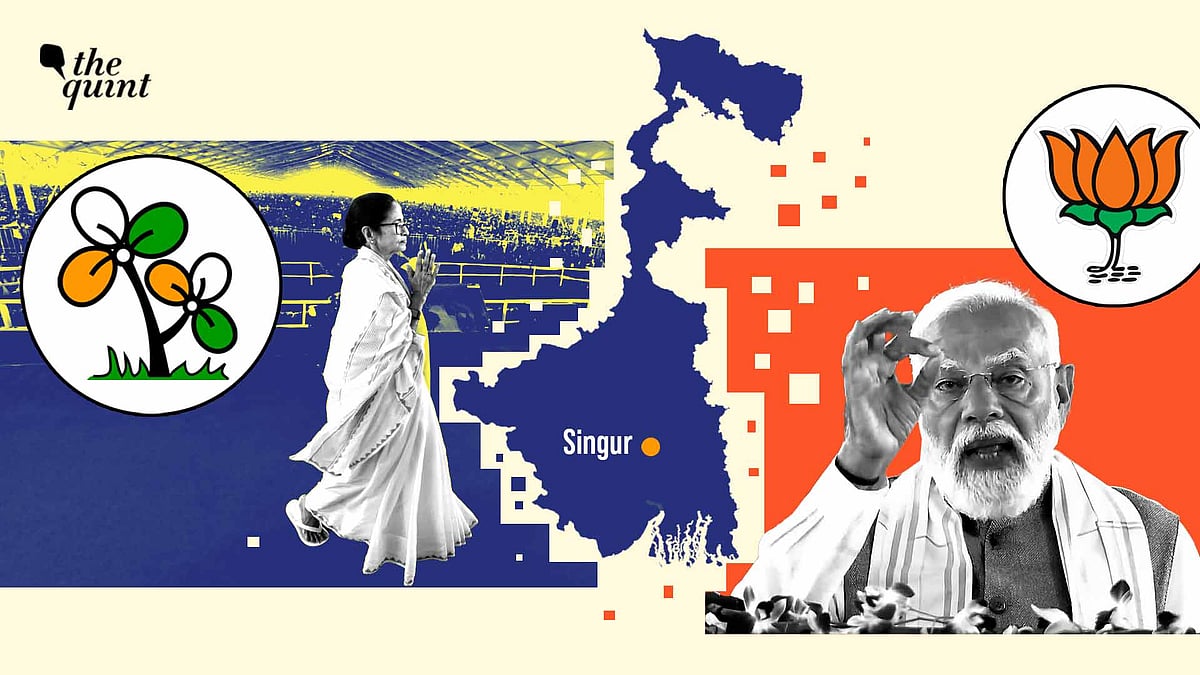
It was in Singur that Mamata Banerjee led her people's movement against the CPI(M), ending the formidable three-decade-long rule of the Left Front, and transforming the state's political language. It isn't, therefore, a surprise that, with the 2026 West Bengal Assembly elections on the anvil, both the Trinamool Congress (TMC) and the Bharatiya Janata Party (BJP) are seemingly engaged in a battle of prestige over Singur.
On 28 January, just 10 days after Prime Minister Narendra Modi addressed a public meeting in Singur in which he announced the launch of several Amrit Bharat Express trains and infrastructure projects worth Rs 830 crore for West Bengal, Chief Minister Banerjee laid out a counter-plan for bringing industry to Singur.
Inaugurating 1,694 projects worth Rs 33,551 crore under the state government, she said,
In Singur, Mamata Banerjee also announced the Ghatal Master Plan to curb the recurring devastation caused by floods in the region. Ghatal MP and actor Dipak 'Dev' Adhikari (right) jubilantly told the media that he had been working for the "master plan" for 10 years—and no one kept their word other than Mamata.
(Photo: PTI)
Mamata also announced development projects in the vicinity of the abandoned Tata Motors' small car factory site, and claimed that these initiatives will generate employment for thousands of local youths.
Earlier, on 18 January, Modi had spoken at the same venue about bringing industry to Singur, and laid out the foundation stone for an extended port gate system and an inland water transport terminal in Hooghly district. According to the PM, the project, spread over 900 acres, will make cargo handling at Kolkata Port efficient.
But for the people of Singur, the mention of “900 acres of land” reopens wounds that are nearly 20 years old, an unhealed trauma marked by shattered dreams and deep frustration.
The Tainted 900 Acres of Singur
Singur had been the turning point of contemporary Bengal politics. It was the Left which traditionally stood for (since Tebhaga Movement 1946-1948) the 'land to the tiller' line. This line continued for decades, and under the Left Front rule from 1977, it became stronger.
"This commitment was reflected in many legislations and administrative decisions like Operation Barga (giving 3/4th crops to the bargadar or the permanent tiller under landowners) or giving the government vested land to the landless farmers etc. Thus, the Left created a solid rural vote-bank in the state. Even when the urban vote shifted, the village was a rock-solid base of the Left," explained political scientist Sibaji Pratim Basu.
After winning the 2006 Assembly elections with 234 seats, the then Left Front government, led by CM Buddhadeb Bhattacharjee, decided to acquire 997 acres of land in Singur for the Tata Group’s Nano small car factory.
According to official records, 13,073 farmers cultivated land in that area. Owners of 702 acres, about 10,852 farmers, were willing to give their land for industrialisation. These farmers were dubbed the "icchuk chashi" (willing) farmers.
But around 2,200 "onicchuk" (unwilling) farmers, who owned 295 acres, rose up in protest, alleging that the government was forcibly taking their land. The movement was originally led by activists like Anuradha Talwar, later joined by Medha Patkar.
Mamata joined later but grabbed both eyeballs and space. Known for her fiesty street-fighting style, she became the face of the opposition movement, creating massive tremors across the country. "Singur made Mamata. In fact, she got her Left-like ideology of anti-acquisition of land from Singur, echoed in the middle of her 'Ma, Maati, Manush' slogan," Basu said. Maati means soil or land.
On 31 August 2016, the Supreme Court (SC) ruled that the Left Front government had illegally acquired land in Singur. Using this verdict, Mamata's government demolished all remaining structures of the Tata factory with dynamite and returned land documents to the farmers.
TMC Not the Most Popular in Singur Today
While the movement led to a change of government in the state, the mood in Singur is more complicated. Like many across Bengal, a large section of Singur's residents believe that Tata’s exit marked the end of the state's industrial and employment prospects.
Sheikh Ziarul Haque, an "icchuk" (willing) farmer from Joymolla village in Singur, claimed to The Quint that industrialisation was the only way forward. One bigha and two kathas of his land were acquired for the Nano factory during the Left government. Though he got his land documents back after the SC verdict, the land is no longer fully cultivable except the portions where no structures were built.
"Almost my entire plot had concrete structures. Even if the buildings were blown up, the piling still remains deep underground. How can anyone farm that land again?” he asked.
It is this sentiment that the BJP appears to be tapping into by choosing Singur for Modi’s rally to announce new infrastructure projects in the district. Speaking to The Quint, BJP Bengal leader and industrialist Shishir Bajoria said it was "CPI(M)'s mistake" to choose such fertile land for setting up heavy industry.
PM Modi in Malda, West Bengal.
(Photo: X)
While Mamata stressed on striking a balance between agrarian and industrial development, Bajoria said if the BJP comes to power, it will bring "large, small, medium, and ancilary industries".
"Industry is a complete package and only large-scale industries can spawn small and medium industries. But, of course, industry does not come out of thin air. It needs land. There has to be a policy of the government to provide land for industry," he added.
Locals, however, don't blame Mamata alone—and don't trust the BJP either.
'We Made a Mistake By Not Giving Our Land'
Subrata Ghosh, a youth from Singur’s Beraberi area, lost one bigha of family land to the project. Along with compensation, he received job training.
“The West Bengal Industrial Development Corporation trained me for employment in auxiliary industries. Tata’s CSR wing also gave computer training to me and four others from our village. Thousands of youths across Singur were trained. But what happened to all that? Everything collapsed,” he told The Quint.
Subrata now works in a private office in Kolkata, earning around Rs 10,000 a month. Subrata's family was among the first to give their land for industry.
This resentment runs deep through almost every part of Singur. Even some farmers who had earlier refused to give land now admit, on condition of anonymity, “We made a mistake by not giving land. Now everything is gone.”
Soumendranath Anjan Bera, a former minister in Buddhadeb Bhattacharjee’s Cabinet, told The Quint while parties are clamouring to bring industry to Singur today, at the time, all forces had united only to discredit the CPI(M).
Explaining the Left Front’s position, Bera added, “The Left government achieved significant growth in agriculture, but industrialisation was also necessary. Along with small industries, heavy industries were needed for employment, and mass employment would mean increase in people's income. Without that, the government’s revenue cannot grow either. Even earlier, when the Congress ruled the state and the Left was in the Opposition, land acquisition for industries like Hindustan Motors or Durgapur was never opposed. What happened in Singur was an unprecedented betrayal of generations of Bengalis.”
He also pointed out,
Rallying Points
On ground, though, questions are being raised about the authenticity of the local participation at these rallies, and their electoral impact. Kolkata-based political analyst Zaad Mahmood called Singur a "symbolic" issue—and not a pressing electoral matter.
Mahmood explained that people keep going back to Singur because it represents the promise of industrialisation in West Bengal, and the success of an anti-land acquisition movement that moved the foundation of the state.
But the optics belie the reality as the underlying current so far ahead of elections has not really been about an economic rejuvenation of West Bengal or the glaring economic crisis.
"The BJP has mainly focused on the issue of illegal immigration from Bangladesh, and has pitched the SIR [Special Intensive Revision] as this massive experiment to weed out illegal Muslim voters. The move, however, has so far backfired," Mahmood said, adding that the TMC was quick to capitalise on the problems people were facing and blame it on the BJP. It has the organisational wherewithal to put up help desks and camps across the state.
Meanwhile, the TMC has been focusing on Mamata's welfare politics, Bengali pride and linguistics, and competitive communalism, as can be seen in her Hindu temple/site-building spree in a bid to keep the votes she seemingly lost due to her Muslim-appeaser image.
With both the BJP and the TMC now jumping on the bandwagon of industrialising Singur, the important thing to ask is, what kind of industry does Singur want and need, and whether Bengal has the infrastructural wherewithal to even handle large industry?
Much of the employment needs in the state are for middle and low-skilled workers, which traditionally requires the setting up of manufacturing industries.
The state government has a stated policy that it is not going to acquire land. For a densely populated state like Bengal, however, big-ticket industrialisation requires land, focused policy, and certain types of infrastructural development. That has not happened in the last 10 years, the analyst noted. In that sense, the industrialisation that Mamata talks about is the growth of micro and small enterprises, which have grown in the past years but do not employ that many people and offer lower wages.
Mahmood also cautioned against getting carried away by numbers, a reference to the investment plans announced in Singur by both Modi and Banerjee.
Highlighting another aspect of the narrative, trade unionist and political observer Basu Acharya said that though the process in which the land acquisition started was faulty, it is now a "proven fact that the flight of TATA was detrimental for West Bengal."
"While it is doubtful how many workers the TATA plant might have employed, the ancillary industries which would have followed suit were likely to have benefited the area."
According to the ‘New Trade Union Initiative’ organiser, as majority of the workforce in India as well as in Bengal is associated with agriculture, tilling the land is more of an emotion than a source of employment.
“The Buddhadeb Bhattacharya government should have dealt with empathy. Instead, the government used brute force to solve the ‘problem’, creating an intangible mess which is still lingering over the state”, he said.
Nevertheless, with the TMC's anti-industry image seemingly discouraging new industries to come to the state and the scope of mass-employment shrinking, the empty field of Singur now stands like a nemesis for Mamata, and an opportunity for the Opposition.
The BJP claims that Singur today has become a symbol of Mamata's failure and proof of how she misled the people. The land, once green, is now barren for agriculture. If it is re-industrialised, would the movement that once rocked the state lose its credibility? Would the TMC survive that?
The Quint reached out to senior TMC leaders for comments, but their responses are as yet awaited.
Another question amid the clamour of industries is about the over 2,000 "onicchuk" farmers who had been at the forefront of the Singur movement, the ones who did not want industry instead of agriculture. The Quint tried speaking with them, but found many reticent or reluctant to speak. Some alleged pressure from the TMC, which had once pioneered their cause, to stay out of the limelight.
The farmers now remain missing from the narrative.
(Anindya Hazra is an independent journalist from West Bengal.)
- Access to all paywalled content on site
- Ad-free experience across The Quint
- Early previews of our Special Projects
Published: undefined