Will Secular Bengal Survive? A Warning, a Lament, or a Requiem
Religiocentrism, hate speech and communal violence are being institutionalised by the BJP in once-secular Bengal.
advertisement
“The festival of Durga Puja was always a time of celebration and cheer for all of us in Bengal,” my friend Farooq told me in Kolkata recently. He added with wistful sadness, “But not this year.”
He said that he was particularly worried about how he would explain to his young son, who loved celebrating the festival with his friends, that this year he would no longer be welcome. And not even safe.
In my recent travels to Kolkata, not just Farooq, many spoke of how dramatically Bengal had metamorphosed in just four months since the Bharatiya Janata Party (BJP) was swept into power in what many consider a dubious election into a land of hate and fear.
“After the BJP conquered Fort Bengal,” a senior lawyer remarked, “its famed traditions of religious and cultural pluralism have so rapidly crumbled."
Stories that had become commonplace across India during the last decade have now become commonplace in Bengal, of school and college friends and colleagues at work suddenly articulating hate against Muslims.
A young Muslim activist said he could not believe the venom that his best friend in university began posting online. “I tried to respond to him with reason and fact,” he said, “and then my friend blocked me.”
Another spoke of men and boys who work out in the same gym suddenly refusing to shake hands after the BJP victory.
Social media accounts in Bengal have begun to bristle with the kinds of hateful fake news that has colonised social media accounts across north and west India for a dozen years.
For instance, that Muslims deliberately spit into food that is served in Muslim eateries. Or that they deliberately produce large numbers of children and “infiltrate” in hordes from Bangladesh with the malign aim to alter the demography of West Bengal to make Muslims the majority in the state.
The faculty and students of the institute did push back against this. This preceded even the change in government.
There is a spurt in new Hindu religious festivals that were so far alien to Bengal marked less by religious devotion and more by belligerent hate.
Ram Navami processions have been the locus of organised hate sloganeering, singing and dancing outside mosques for some years. Observers report that an estimated one lakh Ganesh pandals also appeared around the state this season.
The Avowedly Hindutva Anti-secular State
The tradition of Bengal has been that Durga Puja is a festival not only for people of one faith, but for all people. A popular proverb in Bengali is that religion is private but the festival belongs to everyone. Rabindranath Tagore was among the many who described the Durga Puja festivities as the Sharad Utsav, or the Autumn Festival.
The state government was not far behind. It rejected the “secular” characterisation of the annual landmark of Bengali life as Sharad Utsav.
It declared that it is sacrilege to describe it as an Utsav or Festival; it is a Poojo or Prayer. And it is not the prayer dedicated to Autumn, but to the goddess Durga.
Another interesting tradition of West Bengal, dating back to around 1954, has been for Marxist and socialist formations to erect book stalls adjacent to the puja pandals. This was first initiated by the veteran Communist leader Muzaffar Ahmed and became part of the celebrations in Bengal then.
The chief minister, however, declared that if these book stores display red banners and describe the festivities as Sharad Utsav they will be barred. Only saffron banners and Durga Poojo will be permitted.
Hindutva organisations have been more direct, with open threats to vandalise these book stalls. They characterise the organisers of these stalls as “leftists,” "non-believers” and the most common trope “anti-national.”
The Chief Minister’s Hate Speeches
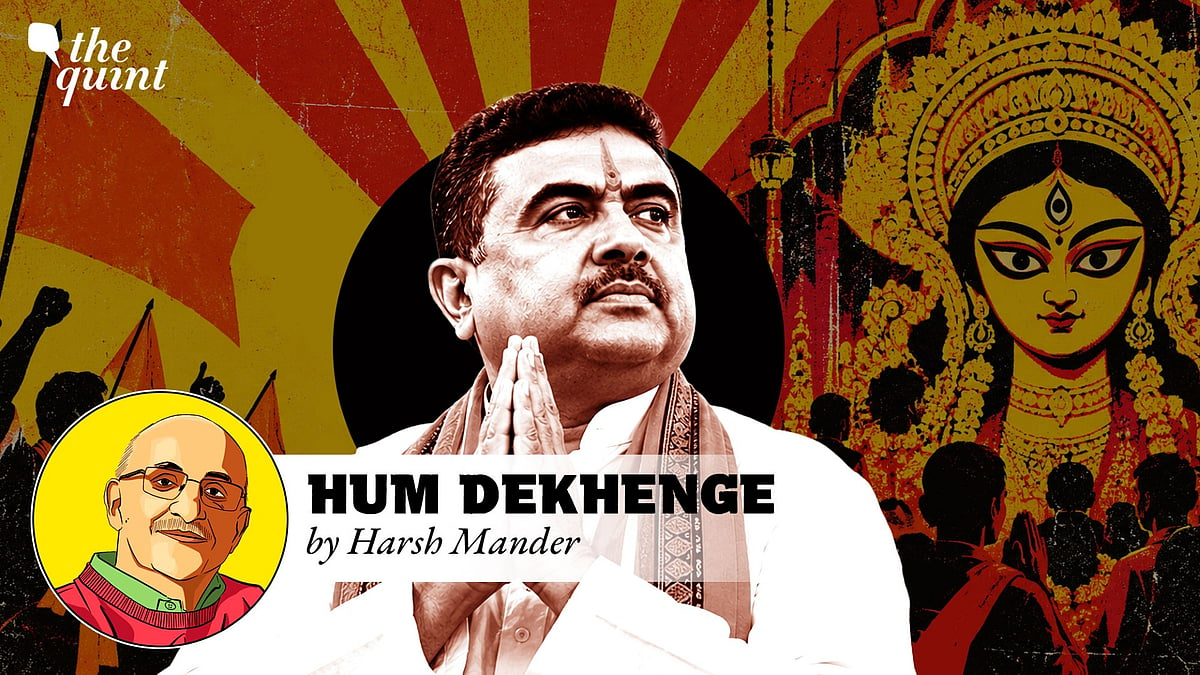
The state government is proudly and demonstratively “anti-secular.” The recent surge in hate speech and violence in West Bengal is not simply a societal phenomenon. The state is explicitly leading the state’s hate campaign.
Kunal Purohit notes that even before his election as chief minister, the public statements of Suvendu Adhikari reveal a systematic pattern targeting the state’s Muslim population — “inciting hate against them, peddling conspiracy theories and advocating their social boycott.”
He chillingly called for “100 crore Hindus” to teach a Gaza-like “lesson” to India’s Muslims. He also disparagingly referred to Muslims as “those Friday people.”
He even propagated fantastical conspiracy theories reminiscent of Nazi Germany against the Jews. Urging people not to consume medicines distributed in health camps organised by Trinamool Congress (TMC), he declared darkly, “We don’t know if these medicines have tablets that can lead to birth control. You should be careful... They want the Hindu population to deplete. They want Hindus to become a minority community, as it happened in Bangladesh.”
The State War Against Madrassas, Mosques, Reservations and Businesses
With a BJP government in power, bulldozers, the renaming of roads and rewriting of history cannot be far behind. Bulldozers rumbled down streets to raze Muslim shrines and properties, including Muslim-owned businesses and hawkers’ small structures.
A 10-member road-renaming committee has been constituted by the state government, and is reportedly examining not just the change of Muslim names, but also roads named after Karl Marx, Lenin and Ho Chi Minh.
In line with other BJP governments, the West Bengal government launched a war against madrassas. In his first four months in office, the chief minister ordered the closing of 252 madrassas and issued show-cause notices to 100 others.
He went further, with a precipitous 62 percent budget cut in minority-affairs and madrassas. He announced plans to open at least 1000 schools run by Vidya Bharati, the educational wing of the Rashtriya Swayamsevak Sangh (RSS), in every municipality and panchayat, but especially in the Muslim majority regions of Murshidabad where he alleged that “anti-national activities occur.”
Despite conscientious objections by Muslims against singing later verses of the national song Vande Mataram, he has made the singing of the song compulsory in all madrassas.
The new government did not just slash welfare benefits for the Muslims of the state. The state government moved equally fast to remove 77 Muslim communities from the backward-classes reservation list.
In one fell swoop, large sections of Bengal’s socially disadvantaged Muslims were denied reservations in education and jobs. Madrassas were also placed under surveillance based on the old trope alleging without basis that madrassas teach terrorism and harbour terrorists.
Ignoring the advice of the Supreme Court, the state government stripped from welfare services like food rations and free housing those whose names were deleted or subject to further scrutiny because of what the Election Commission judged to be “logical discrepancies.”
However, when petitioners sought relief from the Supreme Court, it refused to intervene, asking the petitioners to first approach the High Court.
The state government prohibited cattle slaughter days before Eid al-Adha, casting a shadow of gloom and fear over the festival.
Criminalisation and international border pushings
The South Asia Justice Campaign’s India Persecution Tracker documented 25 killings of Muslims in the first three months of the government, 15 of which were state killings.
Clear profiling of Muslims was visible when the state government used a preventive detention law (popularly called the “Goonda Act”) to detain 14 persons for joining the nationwide protests against the leakage of examination papers. 13 of these persons were of Muslim identity.
Most worrying is the reckless and lawless extra-judicial targeted crushing of citizenship of “unwanted” communities. The model is clearly of Assam, but the scale and cruelty of the processes already even surpass Assam.
The infrastructure of “holding centres” (the new official doublespeak for detention centres) are being established across West Bengal with a focus on border states.
He proudly announced the “deportation” of 4800 persons to Bangladesh in his first month in office.
The catch — as Human Rights Watch reports — is that the deportations are being done outside the framework of law. People are unable to prove their citizenship with vintage records that are often arbitrarily interpreted.
And the undocumented person is thrown into a holding centre and then pushed at gunpoint across the international border with Bangladesh.
The News Coming In From Bengal
Even as I write this, the news coming in from West Bengal is sombre.
On 24 September, two men sporting saffron tilaks on their foreheads assaulted on a Kolkata street three university students from the Aliah University which was earlier the historic Calcutta Mohammedan College entirely without provocation.
The students were identifiably Muslim, in beards, kurta pyjamas and skull caps. They abused them with slurs like jangi jihadis (militant jihadis) and thrashed them severely. The police refused to register an FIR against them or arrest them.
On 4 October, on the outskirts of Siliguri, five Muslim men travelling in a pick-up van were brutally lynched by a mob of villagers, and their van set of fire, alleging that the men were cattle smugglers. Two of them died, and three more are critically injured.
Ahead of Durga Puja, posters by Hindu groups asking devotees to "eat Biryani but only from Hindu shops" have come up.
Will Secular Bengal Survive?
My Muslim friends in Bengal wonder if the Bengal in which they felt such a secure sense of belonging has abandoned them.
Frontline speaks of the “long culture of shared identities, layered histories and mixed rituals” of Bengal. The Bengal indeed of Bonbibi, the forest goddess of the Sundarbans who local people insist is Muslim.
Unlike in southern states, the majority of Muslim Bengalis are farm workers or informal workers who migrate to far corners of the country to earn a living. Saba Naqvi asks, “how will the BJP target, suppress, control Bengal’s large Muslim population, a community woven into the very fabric of the State? Will they hunt them in the fields and farms and forests?
Many believe that the inherent pluralist, humanist secularism of Bengal will overcome the onslaught of the hateful and homogenising ideology of Hindutva.
The Bengal of Lalon Faqir and Kazi Nazrul Islam, their teachings iridescent with their universal humanism and egalitarianism.
Of Swami Vivekanand who spoke in his historic Chicago address of 1898 of his pride to belong to a country that welcomes the persecuted of every religion and nation.
Of Raja Ram Mohan Roy who promoted his ideas of social reform through two publications that he founded: the Bengali Sambad Kaumudi, and Persian Mirat-ul-Akhbar.
Of Rabindranath Tagore who in Gitanjali called for a “heaven of freedom” which is not “broken into fragments” by “narrow domestic walls.”
And of Subhash Bose who envisaged a staunchly secular free India.
But the speed and scale of the descent of Bengal, a state that had the longest surviving elected communist government in the world, into a frontier state of Hindutva triumphalism, has led some to doubt if secular Bengal will survive.
Even more piercingly, they ask if Bengal was ever truly secular, or was this always a romantic image carefully nurtured by the bhadralok, but one that has been revealed to be shallow and brittle.
I am grateful for research support from Sumaiya Fatima and Syed Rubeel Haider Zaidi.
(Harsh Mander is a social activist, writer, and researcher who started the Karwan-e-Mohabbat campaign in solidarity with the victims of communal or religiously motivated violence. This is an opinion piece and the views expressed are the author’s own. The Quint neither endorses nor is responsible for them.)