
'Durga Puja Feels Different': Artists Facing 'Sanatani' Pressure in BJP's Bengal
Many artists still have one or two idols left unsold. "They are likely to go to waste now," they tell The Quint.
advertisement
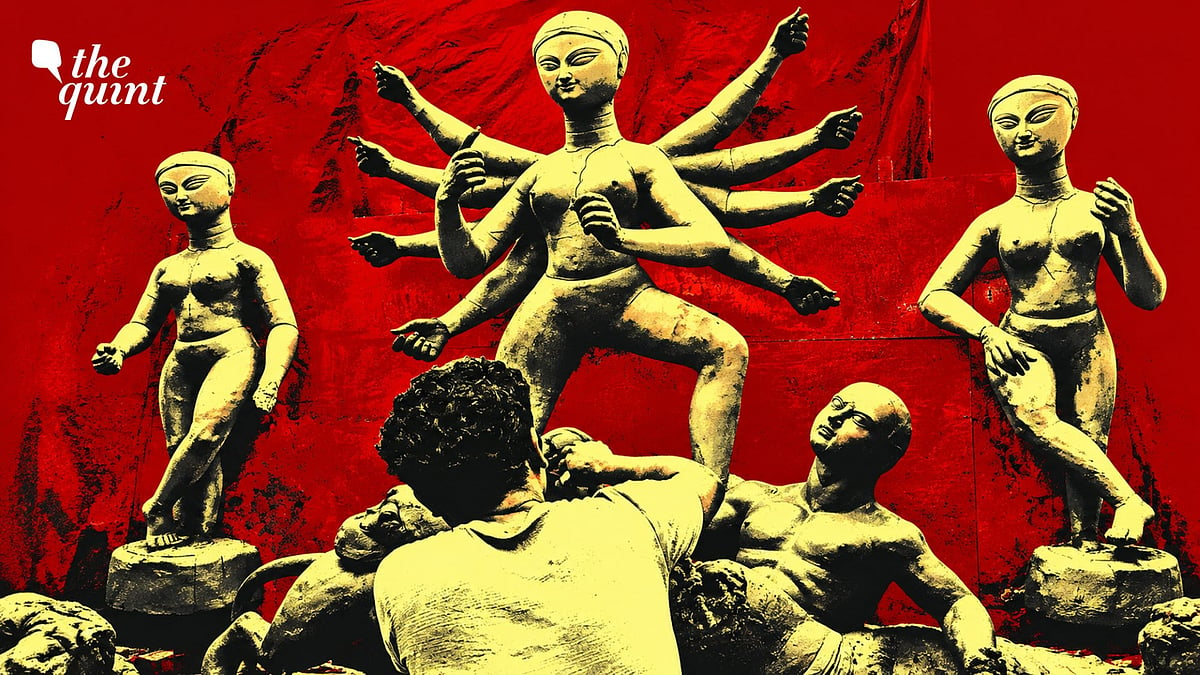
Just days before Mahalaya—which marks the beginning of 10 days of Durga Puja—on Saturday, 10 October, master sculptor Samir Paul sits at his studio in the bylanes of the famous Kumartuli Potters' Lane in Kolkata, swatting away nosy content creators and models coming to take photographs with unfinished idols of the gods and goddesses.
He tells The Quint that Kumartuli becomes a hotspot for photographers around this time of the year. But "Instagrammers this year came with a passionate disregard for their privacy", especially after the local administration scrapped the informal "fee" the artists could earlier charge for any photos or videos.
Having spent 30 years in this profession, Samir feels that this year, Durga Puja feels different—and it isn’t just the unhinged content creators. This year, the business has suffered.
“The TMC [Trinamool Congress] lost elections to the BJP [Bharatiya Janata Party]. As a result, I have sold six idols less than last year,” he says with a chuckle.
Samir Paul inside his workshop.
(Photo: Rakhi Bose/The Quint)
For West Bengal's first Durga Puja under the saffron rule, the number of Durga idols for pandals in Kolkata and its outskirts purportedly fell from 6,500 last year to 5,500 this year, Samir and other artists tell The Quint. Many of them still have one or two idols left unsold. "They are likely to go to waste now," says Sujith Pal, member of Kumartuli Mritshilpi Sanskriti Samity, a trade union representing idol makers in the area.
“Because of a stricter enforcement and guidelines, orders for theme-based idols also dropped sharply this year. We had about 150 theme idols last year; this year there have been around 12-15,” he adds.
Akhil Pal, whose workshop sits across the union office, says he made three theme idols last year. "They tend to be more expensive as they require more time and detailing. This year, I made none," he laments.
Incidentally, artists claim while the sale of Durga idols has gone down, this year's Ganesh festival saw an uptick in the sale of Ganesha idols.
New Rules and 'Guidelines'
Ahead of this year's Durga Puja, authorities tightened alleged "oversight" by the TMC government and clamped down on unauthorised digging along river ecosystems to prevent soil erosion and illegal mining. The Kumartuli union informs that a new SOP required clay suppliers to get an NOC from landowners, submit Aadhaar details, and document exact soil volumes and transport routes before lifting sticky black clay or Ganga mati used to make the idol.
These sudden restrictions halted traditional boat (nauka maati) and lorry deliveries, bringing idol-making to a near standstill for weeks before administrative coordination helped resume regulated shipments via an NOC-backed framework.
Even when it started, the cost of clay/mud went up, raising production costs for the artists.
“What we want is for the government to provide the clay to the artisans, or aid when a crisis occurs. Durga Puja is a UNESCO heritage site. It brings the state as well as its people substantial annual revenue. Many professions and businesses depend entirely on this. We support the government for wanting to systemise the mud-procurement process and reduce illegal activities. But us sculptors cannot end up paying the price for it,” Sujith adds.
Sujith Pal says creativity of Kumartuli artists cannot be bound.
(Photo: Rakhi Bose/The Quint)
Beyond the technical issues, artists claim that sales have also borne the brunt of the state's political and ideological shifts. Makers this year were told, albeit unofficially, to make the idols in the “sabeki”—or the traditional—style, following the rules prescribed in shastras.
These guidelines are not on paper. Instead, they have reflected in the orders that the studios received from clients, especially after "diktats" from Hindutva groups like the Vishwa Hindu Parishad (VHP).
“There was definitely more demand for sabeki-style idols as Puja committees, for one, had less money, and secondly, they wanted to be safe,” Samir says.
Policing Durga
On 26 August, the VHP reportedly held a meeting with several Puja committee members, part of the Forum for Durgotsab that represents the interests of about 500 city- and some state-wide Pujas, as well as priests at the Eastern Zonal Cultural Centre (a venue under the Ministry of Culture), in Kolkata, wherein it gave several “suggestions for preserving the sanctity of Durga Puja”.
These included no "distortion" of idols of Durga or Asura as well as no experimentation in the name of theme. They specifically cited “objectionable” examples from the past, including depiction of Durga as a widow, Durga's 10 hands showing different government schemes, and creating pandals using broken glass or bangles.
An artisan's studio at Kumartuli.
(Photo: Rakhi Bose/The Quint)
As per a Forum for Durgotsab member present at the event, modern or abstract themes that "undermined Sanatani tradition were discouraged", and pandal designs that reflect Hindu heritage were encouraged.
At the Milan Mela meet in Kolkata, Chief Minister Suvendu Adhikari had to publicly apologise for it, stating the agency responsible had been cautioned.
A state government ad depicting Dashabhuja (10-armed) Durga with 11 arms.
(Photo Courtesy: Facebook)
But it didn’t just happen once. At an official Uttar Dinajpur Zilla Parishad event held in Raiganj earlier this month, yet another official poster depicted a distorted image of a Bhagwati-style Durga—this time with nine arms.
“It just goes to show how little these people understand the essence they are claiming to be preserving,” Garga Chatterjee, general secretary of Bangla Pokkho, a Bengali nationalist advocacy group, tells The Quint.
An official poster depicting a distorted image of a Bhagwati-style Durga—this time with nine arms.
(Special Arrangement/The Quint )
Following an uproar against the VHP's diktats, the group's central president Alok Kumar had clarified on 29 August that they were merely "suggestions". He also said they were not enforced by the VHP’s central command. However, in the 7 September meeting with Puja committees at Milan Mela grounds, Adhikari reiterated that idols, pandals, and themes should not "hurt religious sentiments or undermine Sanatani traditions, and that they must reflect the festival's original significance."
The CM also gave a "diktat" against the use of the more secular phrases— "Sarbajanin" and "Sarodotsav" ("for everyone" and "autumn festival")—on banners and posters, insisting that the committees should stick to "Durga Puja".
A South Kolkata Puja committee member, who was part of the Milan Mela meet, tells The Quint that, much like the VHP's "guidelines", the government also said that while theme pujas were "allowed", organisers were asked to “exercise caution."
“There has been some tensions in the area lately. Some of the artisans have been verbally harassed by local groups marauding the area to ensure compliance,” Sujith says, refusing to share any further details. Other artisans The Quint spoke to confirm that there have been incidents of “confrontations”, adding that the groups that accosted the neighbourhood consisted of local crowds who had switched political allegiances.
“Durga Puja for us is not just a work opportunity. It is a festival we are truly devoted to. We are apolitical persons. We should not be heckled,” adds Samir.
A personnel from Shyampukur Police Station, which has jurisdiction over Kumartuli, tells The Quint that apart from some “minor altercations, no major confrontation has taken place in the area ahead of Durga Puja”—and that “security is being maintained through regular patrols, especially in the evenings.”
'Sarbajanin' to Sanatani Themes
BJP leader Shishir Bajodia tells The Quint,
Garga Chatterjee, however, alleges that several Puja committees are operating in an "atmosphere of fear and apprehension this year", and scores of Pujas have faced the axe due to political infighting.
"The TMC structure was distinct. Pujas grew around one political leader or henchman, who rose in stature over the years, rising from parar dada ranks to party leadership," a local committee member from a popular South Kolkata Puja under TMC leader Mala Roy's ward tells The Quint.
With the BJP taking over this set up, the absence of local leaders who knew the neighbourhood has led to a crisis for many Pujas. "Only someone who understands the game can really handle the myriad and highly complex operations required to put up the festival," he adds.
Several established Pujas like the Baghbajar Puja, which is over a 100-year old, could not survive the political shift as new BJP members clashed with TMC-affiliated members for club control.
Garga Chatterjee also points out that amid these "hostile takeovers", a "new type of Durga Puja” was also emerging in Bengal, based on North Indian religious and ritual practices. He calls it the “navratrification” of Durga Puja.
Santosh Mitra Square, under BJP MLA Sajal Ghosh, is celebrating 150 years of Vande Mataram. Ghosh told the media, “This is the soil where Vande Mataram was born, and so we are celebrating it.”
Last year, the pandal had put up an Operation Sindoor-themed show, and before that, it had recreated Ayodhya’s Ram Temple.
The Santosh Mitra Square pandal facade depicts a map of India.
(Photo: Special Arrangement)
The Ruby Crossing pandal is celebrating Adhikari’s biography as the theme, with a documentary on his Nandigram journey, including artwork made out of lentils. Yet another BJP-theme Puja has targeted the Left, with a "Bam Bodh" (Slay Left) theme.
While many committees face cancellation, a new Puja committee, the Kolkata Sanatani Sangh, headed jointly by BJP leader Sanku Deb Panda, got the go-ahead for a theme-based Puja. The pandal is conducting a Varanasi-themed puja this year at Allen Park, Park Street.
Speaking to The Quint, Panda states that the Puja will be a grand mix of "Durgotsav and Shiber Tandob" (Durga festival and tandav dance of Lord Shiva).
"We are bringing Varanasi to Kolkata," he adds.
Renowned theme-maker and artist Sanatan Dinda, who is designing two pandals this year, says that “government diktat or no government diktat, artists must follow their heart.”
Sanatan Dinda giving the finishing touches to Ma Durga ahead of Mahalaya.
(Photo: Special Arrangement/The Quint)
He agrees, however, that there has been growing “pressure” from several quarters to uniformise the image of the goddess.
Another renowned theme-maker, Bhabatosh Sutar, who is designing Telipukur Yuba Sangha’s “Ek Pukur Bhalobasa" (A Pond of Love) this year, has spoken out strongly against the new “Sanatani guidelines”, especially after the VHP’s statements.
- Access to all paywalled content on site
- Ad-free experience across The Quint
- Early previews of our Special Projects
Published: undefined