
Gyanesh Kumar's 'Unusual' Conduct in Bengal: When the Referee Acts Like A Player
The row is only one part of a story. Under Gyanesh Kumar, the ECI repeatedly adopted a tone strikingly unusual.
advertisement
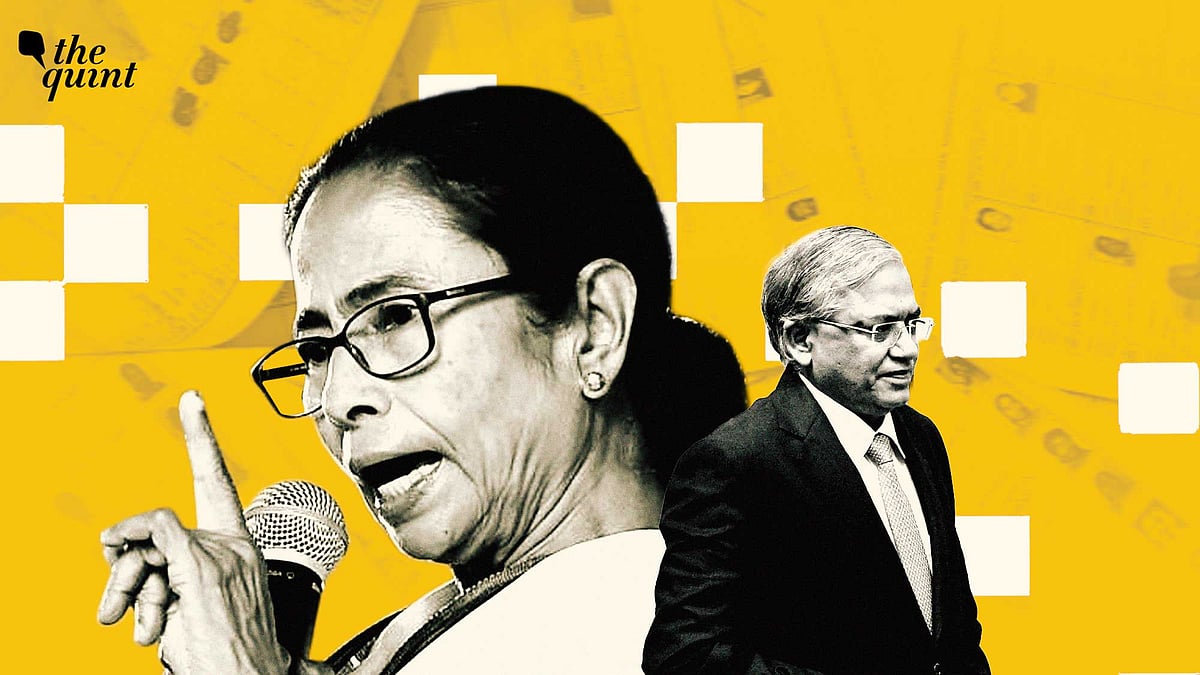
Former West Bengal Chief Minister Mamata Banerjee recently lashed out at Chief Election Commissioner (CEC) Gyanesh Kumar, calling him "Vanish Kumar"—and alleging that he made people's voting rights "vanish".
Speaking in Delhi, the Trinamool Congress (TMC) supremo on 1 October questioned the immunity provision for the CEC under the 2023 law, and stated that the people won't forgive those responsible for taking away their democratic right to vote.
The attack on the CEC sharpens the Serial Intensive Revision (SIR) row in West Bengal at a time when the Election Commission of India (ECI) is facing allegations of being "compromised" in wake of The Indian Express investigative report regarding a rift between the three Elections Commisioners.
The report are especially relevant for West Bengal, where lakhs of voters were denied their right to vote in the Assembly polls held in April. While Bihar and Assam also went to polls following SIR exercises in the respective states, experts have noted that the case in West Bengal was distinct—with mass deletions (91 lakh deleted initially, 27 lakh await rectification); inexplicable additions to SIR process such as "logical discrepancy"; and the fact that the deletions exceeded victory margins in over 150 Assembly seats, fundamentally altering the electoral-playing field.
The state also experienced sudden, mass administrative suspensions, intense public panic, and legal battles in the Supreme Court.
The controversy surrounding the SIR processes, however, is only one part of a larger story.
From Looking for Every Last Voter to Mass Deletor
India's geographical and demographic diversity has always presented an enormous challenge to election administrators.
Journalist Sumit Das, who has closely followed elections in India since 2001, states that the ECI traditionally tried to reach even a single voter in the most remote corner of the country to protect that person's right to vote.
The institutional legacy associated with figures such as Sukumar Sen and TN Seshan helped establish the ECI as an institution that other countries studied. Das believes the controversies surrounding the election body under Gyanesh Kumar have damaged that legacy. At the 9 March all-party meeting convened by the ECI in the presence of Gyanesh Kumar, economist Prasenjit Bose was among the three Congress representatives.
According to Bose, the Congress delegation raised a basic concern: what happens to voters whose cases remain pending when polling takes place? If their cases are not resolved before the election, denying them the vote would be unjust, Bose argued, because they had not been established as non-citizens.
Gyanesh Kumar's response reflected a different approach: even if the ECI could not determine citizenship, it could determine eligibility to vote, and “infiltrators” would not be allowed to vote, Bose said.
But if adjudication itself remained incomplete, another question emerged: Can a citizen effectively be punished before the process determining their status is complete?
That is at the heart of the democratic concern surrounding the SIR.
As Bengal Stood in Queues, CEC Was Visiting Temples
The latest developments justify a recap of the CEC's behaviour in Bengal in the run up to the crucial polls that altered the state's political language and structure, perhaps irriversibly.
For months ahead of polls, and during, people in Bengal were standing in long queues to establish their eligibility as voters. Reports of elderly women reportedly searching through dusty files at their childhood schools in search of documents to prove their own legitimacy went viral.
The TMC, CPI(M), and Congress were raising repeated concerns over the SIR process. It was in this atmosphere that Gyanesh Kumar arrived in Kolkata on 8 March. The next morning, before an all-party meeting, he visited Kalighat temple, offered prayers and posed for photographs. He was entitled to do so as a private citizen.
But the ECI itself then posted photographs of the CEC at the temple on its official social-media accounts.
The caption read: “CEC Shri Gyanesh Kumar visits Kalighat Temple, Kolkata, ahead of the review meetings on poll preparedness for the upcoming West Bengal Assembly Elections 2026.”
The post triggered a debate.
Critics questioned why a constitutional institution in a secular republic was publishing photographs of its head performing a religious ritual, and what the visit had to do with electoral preparedness. The issue was never whether Gyanesh Kumar could visit a temple.
It was about institutional optics. When the head of an election authority visits a place of worship and the institution itself amplifies the images, the question moves beyond personal faith.
It becomes a question of neutrality.
Threats to Ruling Govt
Exactly a month later, on 8 April, the ECI published another unusual post. This time, it explicitly named the TMC and warned the party over alleged past electoral violence.
It declared that Bengal's elections would be: “fear-free, violence-free, intimidation-free, inducement-free, raid-free, booth and source Jamming-free.”
West Bengal does have a long history of political and electoral violence, with allegations involving multiple mainstream parties across different elections.
Preventing that violence is clearly the ECI's job. But the question is different altogether: Should an election authority publicly single out one political party, accuse it of past violence and issue an “ultimatum” weeks before polling? An ECI is supposed to be the referee. A referee publicly warning one team in this language inevitably raises questions about institutional distance.
‘Burnol and Boroline’: When ECI Imitated 'IT Cell'
Four days later, on 12 April, another post appeared from the X account of the Kolkata South District Election Officer, @deokolsouth.
It said: “Intimidators, hooligans, history-sheeters and lumpens beware. Keep sufficient stocks of Burnol and Boroline with you, else the heat will be so severe that you will burn from inside and remember it for a lifetime.”
“Anyone obstructing our mission will be dealt with by the heavy hand of law where even Burnol and Boroline won’t help.”
The language sounded less like official communication and more like a political social-media post. Mamata Banerjee responded by saying those talking about Burnol should be given ice cream so they could cool themselves down.
The post was subsequently deleted amid controversy, with the officer saying it had been misinterpreted.
But the larger question remains: Why was such language being used by an election official at all?
The Kerala Story: Another ‘Clerical Error’
On 21 March, the ECI reportedly sent political parties in Kerala guidelines on disclosure of candidates' criminal antecedents.
The document, however, carried the stamp of the Kerala BJP.
The CPI(M), Congress and others objected. The office of the Kerala Chief Electoral Officer called it a “clerical error”.
Again, mistakes happen.
But when unusual incidents begin accumulating around an institution whose greatest asset is public trust, “clerical error” becomes an insufficient answer to the broader institutional question.
Can all of this simply be dismissed as poor professional judgement?
Was Kalighat a communication mistake? Was naming the TMC an unusually aggressive way of warning against electoral violence?
Was “Burnol-Boroline” merely an ill-advised social-media intervention? And was Kerala simply a clerical error? Or should these incidents be examined together?
The more serious allegation from critics is that, taken together, such conduct could create the perception that the Commission was no longer maintaining the distance expected of a neutral electoral authority.
That is an allegation, not an established fact.
But perceptions matter enormously for an institution whose legitimacy depends on trust.
Doubling Down After Polls
The atmosphere became even more contentious after the election.
Bangla Pokkho general secretary Garga Chatterjee was booked over a Facebook post, alleging irregularities in vote counting and was subsequently jailed after the results were announced.
Chatterjee told The Quint that Bengal had witnessed “multiple unprecedented things” during the election.
He alleged that millions of bona fide Bengali citizens, mostly Hindu Bengalis, had been removed from the electoral roll; that Bangla Pokkho's Bengali New Year rally had been stopped; and that central paramilitary forces had been deployed on an unprecedented scale.
“Bangla Pokkho's Bengali New Year rally was not permitted, something that only pre-1971 Pakistan administration has ever done in East Pakistan,” he said.
He also alleged EVM anomalies and counting fraud, and said his arrest followed his social-media posts alleging EVM fraud.
“It felt like Bengal was not having an election, it was experiencing an invasion,” he said.
These are Chatterjee's allegations and remain his claims unless independently established.
But the episode adds another question to the debate: how much room does the electoral system leave for citizens to challenge it?
The Problem of the Partial Refree
Political parties have accused one another of “vote looting” for decades.
Professor Niloy Kumar Saha, who has researched India's first election and its first CEC, Sukumar Sen, places the present controversy in a much longer historical context.
According to Saha, the credibility of India's democratic system rests substantially on public confidence in the ECI's neutrality.
India's first general election was hardly free of problems. There were political conflicts, disputes and concerns about bogus voting. With around 80 percent of the electorate being illiterate at the time, symbols were introduced to make voting accessible, while indelible ink was introduced to tackle electoral malpractice.
Election authorities have also faced allegations of negligence, bias and failure. That part is not new.
Yet, Saha argues, the ECI of that era maintained an institutional distance from partisan political language.
He says that while questions have been raised about the Commission at different points in India's history, he does not recall an ECI making as many overtly political-sounding statements as the present one.
If the institution responsible for protecting the vote begins to be perceived as taking sides, the damage goes beyond one election or one political party. Democracy does not depend only on people being allowed to vote.
It depends on people believing that their vote will count, that the electoral roll is fair, that the counting process is credible, and that the institution supervising the entire process is genuinely neutral.
The ECI does not have to please every political party. It does, however, have to convince every voter that it belongs to none of them.
And that is why the controversy surrounding Gyanesh Kumar's ECI is bigger than SIR, bigger than the Kalighat photograph, bigger than “Burnol and Boroline”, and bigger than one election.
The real question is not who won the election. It is whether the institution conducting it preserved enough distance from politics for the losing side—and the voters—to continue believing in the referee.
(Soumo Mondal is an independent journalist writing on news and politics from Kolkata, West Bengal. This is an opinion piece and the views expressed are the author's own. The Quint does not endorse or is responsible for them.)
- Access to all paywalled content on site
- Ad-free experience across The Quint
- Early previews of our Special Projects
Published: undefined