
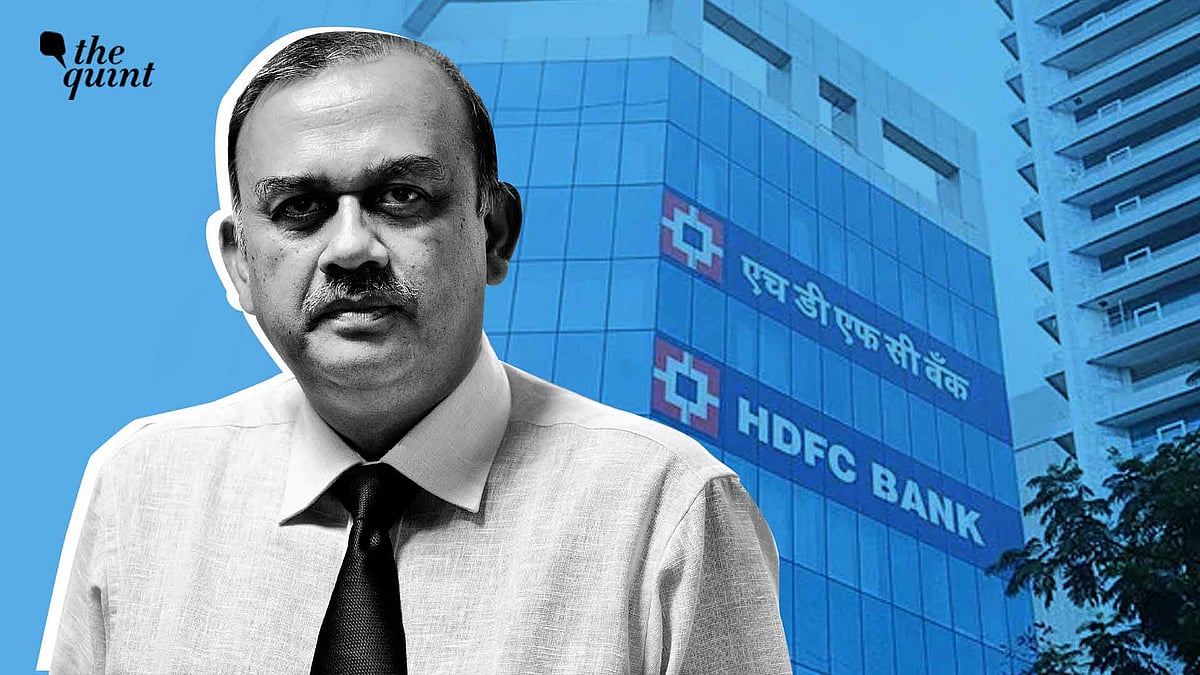
Atanu Chakraborty's Exit From HDFC Bank Raises Doubts About His Own 'Ethics'
A legal review has found no evidence to support concerns raised by the former HDFC chairman, Reuters reported.
advertisement
(A legal review found no evidence to support concerns raised by former HDFC Chariman Atanu Chakraborty, Reuters reported on 26 June 2026. This article has been republished in light of that development. It was originally published on 23 March.)
Atanu Chakraborty, a retired IAS officer of the Gujarat cadre, succeeded me as Economic Affairs Secretary in July 2019.
While Axis Bank and ICICI Bank had retired IAS officers as part-time chairpersons for many years—HDFC Bank, which mostly had retired central bankers as part-time chairpersons, barring one retired IAS officer—appointed Chakraborty as part-time chairperson and independent director in May 2021.
After nearly five years, Chakraborty tendered his resignation on 18 March (dated 17 March, receipted at 3:12 pm on 18 March).
He further said: "I confirm that there are no other material reasons for my resignation."
Chakraborty has sought to array his "personal values and ethics" as the core corporate governance issue, though he hasn't spelt out these "personal values and ethics". His allusion to "certain happenings and practices" within the bank is again without specifying—or even hinting—about these "happenings and practices".
Is it fair for a part-time, non-executive, independent director to invoke "personal values and ethics"—without even spelling out the grounds for resignation—despite the potential for significant damage to shareholder value?
There are also many associated questions. Why was he appointed chairperson of HDFC Bank? Why has he resigned? Should he be asked to explain "happenings and practices" and "personal values and ethics"? And if he fails to do so, should he remain a fit and proper person for a directorship?
An Appointment Without Banking Credentials
HDFC Bank was a subsidiary of HDFC Ltd, almost always headed by veteran banker Deepak Parekh.
When HDFC Ltd decided to merge with HDFC Bank in July 2023, Parekh decided—also because he was past the age limit prescribed for a scheduled bank by the Reserve Bank of India (RBI)—to hang his boots and not to have any position in HDFC Bank. Atanu Chakraborty continued as part-time chairperson of the merged HDFC Bank.
Before Chakraborty was appointed HDFC Bank’s part-time chairperson in May 2021, Shyamala Gopinath, a respected retired deputy governor of the RBI, headed it. She could have continued for some more time, or another retired governor or deputy governor of the RBI could have been appointed its part-time chairperson.
Chakraborty had no experience of banking, banking policy-making, or banking regulation. His stint in the Department of Economic Affairs was also quite short.
Parekh has not publicly spoken about why he was chosen. His relationship with the ruling Bharatiya Janata Party (BJP) establishment in Delhi after 2014 was not very smooth.
My sense is that Parekh picked Atanu Chakraborty (from Gujarat cadre, who was at one point in time Principal Secretary, Finance with the then Chief Minister Narendra Modi, and had created a public impression of being close) to build bridges with the government and the RBI, especially to implement his project of merging HDFC Ltd and HDFC Bank.
He perhaps did not know Chakraborty well.
Decision-Maker Image at the Core
Atanu Chakraborty wants to be seen as the decision-maker.
During the one-year overlap I had with him in 2018-19 in the Ministry of Finance (he was Secretary, Department of Investment and Public Asset Management), there were quite a few instances of such behaviour.
REC Ltd was a stronger company to takeover PFC Ltd when the government decided to merge them. Atanu Chakraborty decided otherwise. He convinced the then Finance Minister Arun Jaitley to approve the transaction. I went to Jaitley twice not to get that transaction done (as the price the government was getting did not compensate for even the good dividend yield from REC Ltd).
Jaitley agreed and approved my proposal. Chakraborty got it reversed. Now, after seven years, PFC is being merged with REC—and the government might pay more than it received for keeping its stake above 50 percent in the merged company.
There were many other matters, including bringing down the stakes of LIC and State Bank of India (SBI) to the regulatory limits in UTI Mutual Fund, where a British company, T Rowe Price Group, wanted to retain higher stake.
The Confusion Has To Be Explained
Atanu Chakraborty has assaulted HDFC Bank’s good standing and image in national and international markets by making vague assertions of "not in congruence of my personal values and ethics". Likewise, his wild and vague allegations of "certain happenings and practices" within the bank observed by him over two years has caused considerable damage.
To any objective observer, these mutterings are not illuminating. HDFC Bank executives have publicly stated that they are baffled.
No chairperson or director of a bank, or for that matter any company, has any business to bring "personal values and ethics" into the boardroom. What matters is corporate governance values and ethics.
Chakraborty must explain what corporate values and ethics did HDFC Bank, or its board members, violate. He should also explain what "happenings and practices" were observed by him over the last two years that were irregular or adversely affected the bank's and the shareholders' interests. Did these relate to lending, investment, regulatory compliance, or something else?
Why Did He Resign?
Atanu Chakraborty stated, in the same breath, that there were no other material reasons for his resignation. In his responses to journalists' questions, he has sought to dispose of the entire episode as "nothing worth discussion" and "it’s quite routine".
This is too casual and disingenuous. He cannot be allowed to get away with it.
The RBI was quite quick to accept his resignation. The RBI has also issued a statement categorically stating that "there were no material concerns on record as regard its conduct or governance". The apex bank was also prompt in appointing Keki Mistry as interim chairperson.
It is clear that the RBI sees no merit in Atanu Chakraborty’s wild and vague assertions. It seems his conduct is less ethical and value-based.
He wanted to create a sensation and send some message to the powers that be about creating difficulties for HDFC Bank. His conduct and allegations as well as his personal values and ethics need to be enquired into—and the truth found out.
In the meantime, as the RBI has said, I don’t think anyone should have any concerns or misgivings about HDFC Bank on the basis of his casual and unthoughtful allegations.
(Subhash Chandra Garg is the Chief Policy Advisor, SUBHANJALI, and Former Finance and Economic Affairs Secretary, Government of India. He's the author of many books, including 'The $10 Trillion Dream Dented, 'We Also Make Policy', and 'Explanation and Commentary on Budget 2025-26'. This is an opinion piece, and the views expressed above are the author’s own. The Quint neither endorses nor is responsible for the same.)
- Access to all paywalled content on site
- Ad-free experience across The Quint
- Early previews of our Special Projects
Published: 23 Mar 2026,10:24 AM IST