
Behind BJP’s Name-Change Politics in Bengal, a Search for Hindutva Icons
The BJP has renamed a road after Gopal Mukherjee, a man associated with the 1:10 formula of retaliatory killings.
advertisement
Shakespeare famously asked, "What's in a name?". The Bharatiya Janata Party's (BJP) politics of renaming in West Bengal (as elsewhere) seems to suggest the exact opposite: everything lies in the name, historical facts matter little.
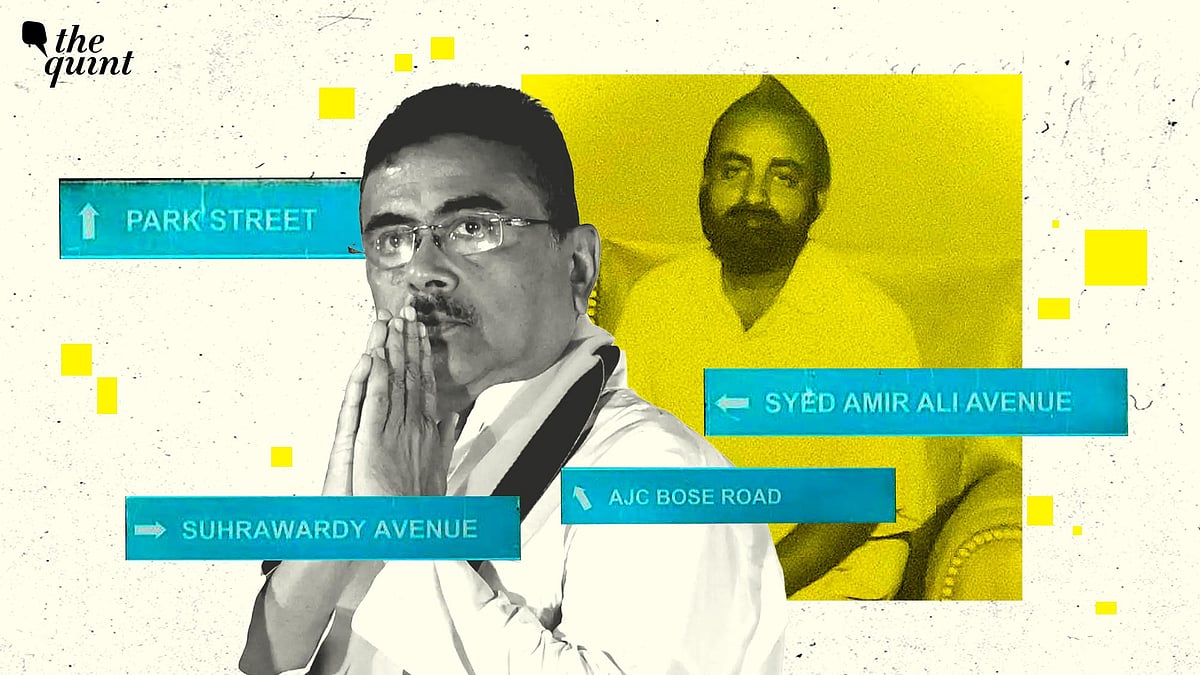
The road stretching from Kolkata's most well-known Muslim neighbourhood, Park Circus, to Kasai Para Lane has been renamed from Suhrawardy Avenue to Gopal Mukherjee Road. Welcoming the Kolkata Municipal Corporation's decision to rename the road on West Bengal Day, Chief Minister Suvendu Adhikari shared the official notification on Facebook, calling it a "historic correction".
Clearly, Adhikari's references to "Partition" and "bloodshed" point towards Huseyn Shaheed Suhrawardy, the last Premier of undivided Bengal, during whose tenure the Great Calcutta Killings of 1946 took place. In contrast, Gopal Mukherjee, better known as 'Gopal Patha', is remembered either as the protector of Hindus during those riots or as a perpetrator of anti-Muslim massacres, depending on one's historical perspective.
Yet, historical records complicate this narrative. Contrary to popular belief, this road was not originally named after Huseyn Shaheed Suhrawardy. It was named after Sir Hassan Suhrawardy, the Vice-Chancellor of the University of Calcutta.
Municipal records tell an even more nuanced story. On 8 March 1933, the Kolkata Municipal Corporation proposed naming the newly constructed road from Park Circus to Kasai Para Lane as Surawardy Avenue, largely because Sir Hassan Suhrawardy's residence stood on that road.
But historian Ajit Kumar Basu, in his book Kolkatar Rajpath: Samaje O Sanskritite, notes that Councillor Shailendranath Mukhopadhyay had actually proposed naming the road after Maulana Obaidullah Suhrawardy.
Gopal Patha's Rise
More fascinating than this confusion over the Suhrawardy name is the story of Gopal Patha himself—his extraordinary journey from a young revolutionary to Kolkata's uncrowned underworld king.
The First World War had just begun. Bengal's revolutionary underground saw the global conflict as an opportunity to challenge the British rule. On 26 August 1914, the famous Rodda Company Arms Heist took place, one of the most audacious revolutionary operations in colonial India. Among its principal architects was revolutionary Anukul Chandra Mukherjee, who happened to be Gopal Patha's paternal uncle. At the time of the heist, Gopal was barely a year old.
He grew up surrounded by revolutionaries. As a young boy, he was reportedly used as a secret courier by members of the underground movement.
By 1928, several clandestine revolutionary organisations had begun regrouping within the Congress under the leadership of the young, aggressively secular Subhas Chandra Bose. That year, the Congress session was held at Park Circus Maidan in Kolkata. Motilal Nehru presided over the session, while Subhas Bose, dressed in military uniform, was ceremonially welcomed by a volunteer corps. It was at this very session that Bose was elected president of the Bengal Youth Congress.
Mahatma Gandhi, however, famously mocked the grand spectacle as a "circus."
Gopal Patha's Mixed Legacy
In 1942, Gandhi launched the Quit India Movement, calling upon Indians to intensify the struggle against British rule. Around the same time, Subhas Bose, broadcasting over radio from abroad, urged revolutionaries to carry out widespread sabotage against the colonial administration.
The revolutionary upsurge of 1942 gradually lost momentum. Then came the devastating Bengal Famine of 1943, and in August 1945 came reports that Subhas Bose had died in the Taihoku plane crash. With his disappearance, the secular and democratic political vision nurtured earlier by Chittaranjan Das, Sarat Chandra Bose, and Subhas Bose itself began to weaken. The absence of Subhas Bose also demoralised many young revolutionaries.
At the same time, AK Fazlul Huq's anti-communal, peasant-oriented politics steadily lost ground to the communal mobilisation of the Muslim League.
It was in this political vacuum that Syama Prasad Mookerjee found an opportunity to expand his influence.
However, with the simultaneous rise of Muslim League communalism and Subhas Bose's disappearance, Syama Prasad found the space to consolidate his politics. In a Bengal that had once witnessed the massacre of the Bargis, gymnasiums suddenly began displaying portraits of Shivaji. The political focus was gradually shifting away from anti-colonial nationalism towards anti-Muslim mobilisation.
However, there is no historical evidence suggesting that Gopal Patha ever had any organisational relationship with Syama Prasad or the Hindu Mahasabha.
On 16 August 1946, the Muslim League's Direct Action Day triggered one of the bloodiest communal riots in Bengal's history. For the first two days, hired criminal gangs—many of them Pathans and non-Bengali musclemen allegedly mobilised by the Muslim League—unleashed widespread violence across Kolkata.
According to several accounts, he instructed his followers that for every Hindu killed, 10 Muslims should be killed in retaliation. Brutality was answered with even greater brutality. Alongside armed Hindu gangs from outside Bengal, Gopal's Bengali Hindu associates participated in large-scale killings of Muslims.
Yet, the historical record is more complicated than the simplified narratives that dominate political discourse today. Contemporary accounts suggest that Gopal and his men mainly targeted the Pathan and non-Bengali criminal gangs responsible for the earlier violence, as well as poor Bengali Muslims living outside his own locality. At the same time, he is also said to have protected many Muslim families living within his own neighbourhood.
In an interview with the BBC, Gopal Mukherjee himself refused to describe himself as anti-Muslim.
In Search of Hindutva Icons in Bengal
After 15 August 1947, the political context had fundamentally changed. India was now independent. There was no longer a British Empire to fight, nor a Muslim League government in Bengal to resist.
It was during this period that Dr Bidhan Chandra Roy, Congress leader and later Chief Minister of West Bengal, allegedly began employing Gopal's network for political purposes. Gopal Patha gradually acquired a reputation as one of the principal operators behind election-related intimidation and booth capturing.
The years following Partition also witnessed the arrival of large numbers of Hindu refugees from East Pakistan, now Bangladesh. Many occupied vacant land owned by wealthy landlords to build makeshift settlements. These refugee movements were often organised and supported by the Communist Party. Ironically, one of Gopal's principal assignments was to violently evict these Hindu refugee settlements.
Historical accounts also suggest that when the anti-Bengali movement gathered momentum in Assam, the Bidhan Chandra Roy government dispatched Gopal's men there on special assignments.
According to Sourav Guha's book Alo Andharir Gopal Patha, Gopal was arrested several times between 1950 and 1951 on charges ranging from kidnapping and bank robbery to jewellery theft. Although he was repeatedly released for lack of evidence, many believed that he enjoyed political protection from the Congress establishment led by Bidhan Chandra Roy.
It is equally important to note what Gopal Patha never became. He never founded or led a Hindutva organisation.
Ironically, one of his closest associates, Ram Chatterjee, would later be transformed from a street strongman into a minister in the Left Front government under Jyoti Basu.
So, why is the BJP choosing to elevate a man whose political journey ran from revolutionary courier to Congress-backed strongman and gangster into an icon today?
The answer may lie in a simple political reality: unlike Bengal's towering figures such as Subhas Chandra Bose or Rabindranath Tagore, Hindutva politics possesses few historical icons of its own in Bengal.
As a result, it selectively appropriates one chapter from Gopal Mukherjee's long and complex life—his alleged 1:10 retaliatory formula against Muslims—while ignoring everything else that defined his political journey.
The debate over the Partition of Bengal reached its decisive moment on 20 June 1947, when the Bengal Legislative Assembly voted on whether the province should be divided.
Among the Hindu legislators, 58 members voted in favour of Partition. Of them, 56 belonged to the Congress and its associates, two were Communists, and only one represented the Hindu Mahasabha—Syama Prasad Mookerjee.
Yet, despite the overwhelming support for Partition coming from Congress legislators, Hindutva politics today credits Syama Prasad almost exclusively for the creation of West Bengal.
Rewriting Partition
For decades, Bengal's literary, theatrical, and cinematic traditions have portrayed Partition as one of the greatest tragedies in the region's history. The BJP's decision to celebrate 20 June as West Bengal Day transforms that tragedy into a political celebration. Unsurprisingly, neither the Trinamool Congress nor the Left parties in West Bengal have accepted this observance.
The day effectively established a religion-based theory of nationhood in place of the widely accepted academic understanding of nationhood based on language and culture.
It is, therefore, symbolically significant that a road has been renamed after Gopal Mukherjee—a man forever associated, fairly or unfairly, with the infamous 1:10 formula of retaliatory killings—on the very anniversary of Bengal's Partition.
Nor does this appear to be an isolated act.
Soon after assuming office following the 4 May election victory, an allegedly BJP-affiliated mob renamed Siraj Udyan in Barasat, named after Bengal's last independent Nawab Siraj ud-Daulah, as Shivaji Udyan.
Those who had celebrated the disruption of Eid prayers on Kolkata's Red Road because traffic remained blocked for an hour also witnessed the same road being closed for an entire week for International Yoga Day celebrations.
Before the election, the Opposition had warned that a BJP government would gradually attempt to redefine Bengal's cultural, political and social consciousness. Barely weeks into office, the government appears determined to prove those apprehensions correct—slowly but steadily, through a series of symbolic interventions that seek to force a departure from Bengal's own historical memory, political imagination, and value system.
(Soumo Mondal is an indepenent journalist and researcher from Kolkata, West Bengal. This is an opinion piece and the views expressed are the author's own. The Quint does not endorse or is responsible for them.)
- Access to all paywalled content on site
- Ad-free experience across The Quint
- Early previews of our Special Projects
Published: undefined