Delhi's New Protest Sites: The Politics of Pushing Dissent Out of Sight
Relocating designated protest grounds burdens protesters with sustaining their movement, writes Navina Jafa.
advertisement
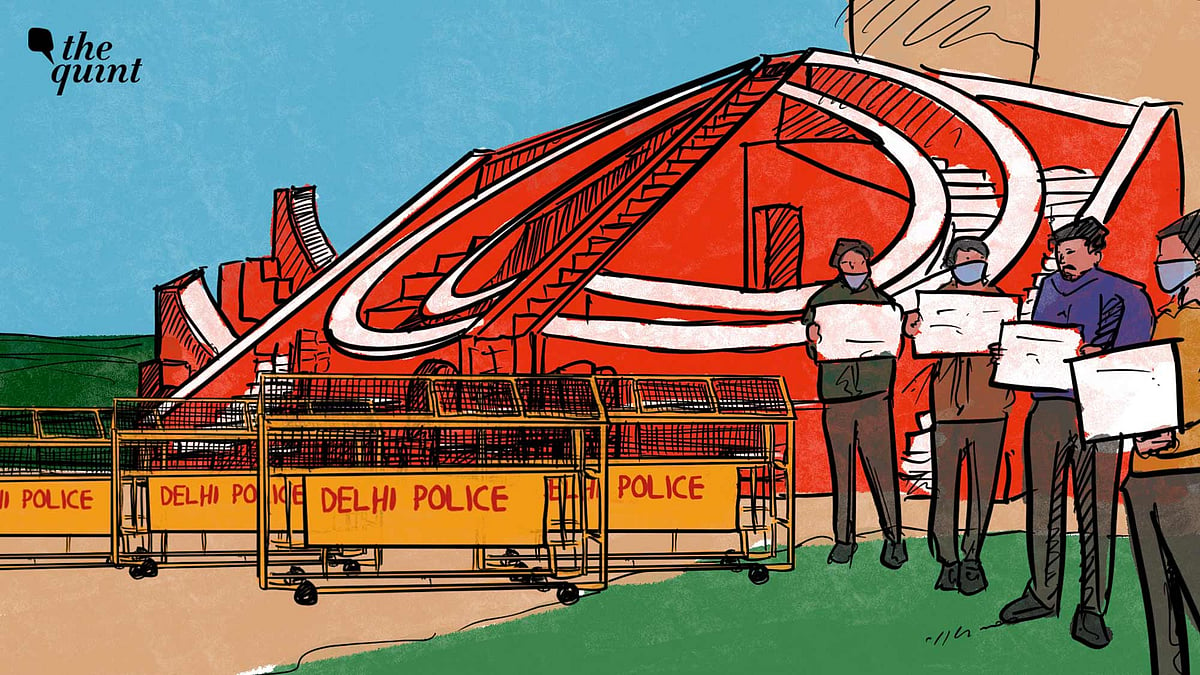
In Delhi, India’s power capital, the dispensation is responding to citizens’ anger by relocating their protest ritual—a theatre of democratic legitimacy—from Jantar Mantar to Ramlila Ground, Burari Ground, and East Delhi’s CBD Ground.
It is creating distance between citizens and authority while presenting that distance as accommodation. Designating new sites aims to weaken the revolt while slyly preserving its outward form, giving citizens a venue for their questions, and power breathing room to leave them unanswered.
The social contract, founded on mutual trust between the ruler and the people, weakens without dialogue and accountability, creating an existential crisis for democracy. The released news reports attribute the decision to a Ministry of Home Affairs committee’s recommendations without clearly explaining why Jantar Mantar is unsuitable. Administrative endorsement substitutes for public justification, letting authority decide where citizens may appear and how comfortably it can avoid them.
Ritual action transforms any space. Through political protests, spaces acquire democratic meaning as citizens gather, slogans return, and strangers recognise themselves as a public. Repeated assemblies root the ground in historical memory, while Jantar Mantar’s proximity to government institutions brings that memory within uncomfortable reach of power.
The authorities play on reasons such as crowd management, traffic, and security, yet without clear justification, they become respectable language for exclusion. A capital accustomed to official motorcades suddenly discovers an intolerable obstruction in citizens demanding answers.
This manoeuvre turns public inconvenience into a tool of divide-and-rule, pitting travellers against protesters as rival claimants to the road. The authority controlling access presents itself as an innocent referee, turning frustration into resentment between citizens while shielding its decisions from scrutiny.
Power is changing the ground beneath the democratic encounter, offering dissent an address while distancing itself from the obligation to answer.
The Creature Citizens: Moving the Ground, Enlarging the Protest
Changing the protest site takes on a darker meaning alongside the insect metaphors associated with the Chief Justice of India. Young, educated, and unemployed protesters enter a vocabulary of nuisance, making their removal seem like a public service.
The cockroach symbolises filth and infestation, while the fly suggests irritation and something to be driven away. This language makes displacement easier to justify, turning citizens demanding answers into a disturbance to be pushed towards the margins of the power capital.
The larger grounds, although farther from power, offer room for more people, banners, and slogans. Protesters can reclaim infestation as an image of growing numbers, spreading across the space intended to contain them. Insect imagery can give non-violent protest a sharp, satirical language, with banners filling the gathering and memes carrying its message beyond Delhi. The protest ritual gains both physical space and a wider audience, turning an insult into a way to make dissent visible.
Authority changes the address, only to find the unwanted presence occupying a larger ground.
Measuring Time, Distance and Resilience
When the gates of Jantar Mantar slammed shut on 10-11 October, the river spilt over its banks, finding new channels through the capital's concrete veins. The revolt expanded.
Relocating designated protest grounds burdens protesters with sustaining their movement, while potentially widening its reach. Distance exacts a toll in money, time, and energy. A larger venue may hold a growing movement, but the journey may scatter an exhausted one.
Jantar Mantar takes its name from a historic observatory whose instruments measure time. However, the protest ground's longest shadow falls across the halls of power. The pulse of a people does not wait at a designated threshold. Wherever voices entwine in shared defiance, a nameless crowd catches fire and becomes a public; that spark of recognition cannot be locked away.
Here rises the image of Lanka, Ravana's fortified kingdom, the arrogant king in the Indian epic Ramayana. Golden walls and guarded battlements may shield a throne from scrutiny, but they cannot settle the contest between arrogance and accountability. Power may stretch the road to the palace as far as it pleases; the question still waits outside the gate.
One designated venue, Ramlila Ground, also hosts Ramayana dramatisations for Dussehra, the festival celebrating Rama's victory over Ravana. If those celebrations make the ground unavailable for protest, the irony sharpens: the stage condemns arrogance while citizens demanding accountability wait outside.
The defeat of arrogance proceeds on schedule, while its political reckoning awaits a vacancy.
As displaced gatherings take root elsewhere, a grievance pushed to the margins may enter the mainstream. The government gains quiet around one address while risking a movement with many.
Yet, finding new ground also means sustaining non-violent resistance under intimidation. 10-11 October brought restrictions and detentions; reports of confrontations raised questions about how protesters were treated.
One answering blow can turn a demand for accountability into a televised threat to public order. The force that preceded it may vanish from the frame, while the authority accused of violence reappears as the guardian of peace.
This is protest's harder trial. Resisting force without letting retaliation surrender its purpose. A movement seeking to grow must keep its grievance visible, rather than supply the image through which it can be dismissed.
The fist waits for another fist to make its violence respectable. A disciplined refusal leaves it alone beneath the public gaze.
Space, Witness and Defiance
To reclaim democracy is to reclaim the space in which citizens can question power. The protest ritual gives that claim a living form: citizens gather, repeat their demands, and refuse to let displacement be mistaken for consent.
In this season of Devi, the mother goddess honoured during the nine-day festival of Navaratri, women give the gathering a particular moral charge. Reports of assaults against them expose the fracture between worship and citizenship. The goddess receives garlands in stone and clay; the living woman must struggle to be heard.
Relocation tests that strength. But ground intended to isolate dissent can bring it into dissent with new neighbours, witnesses, and participants. The opportunity lies not in distance itself, but in making that distance yield a larger public.
As more hands hold cameras, the lens carries voice and image beyond the field, recording the enlarged gathering, its demands and the response. What authority pushes to the margins can return to the centre of attention. Verified documentation exposes intimidation; satire, online and on the ground, strips power of its public-service costume. One demands accountability; the other makes evasion harder.
Non-violent discipline must keep the grievance visible, refusing to let retaliation take the frame. The dandelion in Suzanne Collins’s novel The Hunger Games offers an image of hope grounded in survival. Its travelling seeds extend that metaphor: displacement need not have the final word. Dissent can take root elsewhere through care, resourcefulness, and the patient work of drawing others into dissent circle.
This is how the protest ritual can reclaim democratic space: a field becomes a gathering; a gathering becomes a public; the lens carries its testimony beyond the barricade.
Power may lengthen the road to its gates. Let each new site bring more citizens into the demand for answers. Let power retreat behind Lanka’s walls, the fortified stronghold of the arrogant king Ravana in the Ramayana.
Let the gathering grow beyond them. No wall is high enough to turn a people’s demand into consent.
(Dr Navina Jafa is Vice President, Centre for New Perspectives. She can be reached @navinajafa. This is an opinion piece and the views expressed are the author’s own. The Quint neither endorses nor is responsible for the same.)