Kolkata Stampede: Did BJP’s Political Priorities Come Before Public Safety?
Did the BJP's efforts towards creating a 'Sanatani' Durga Puja detract from prevailing crowd and safety management?
advertisement
In Kolkata, Durga Puja and crowds are inseparable. The festival draws people from across West Bengal, transforming the city into a vast public celebration of lights, pandals, new clothes, music and the excitement of pandal-hopping. The crowds are not an inconvenience to be tolerated; they are part of what makes Durga Puja what it is.
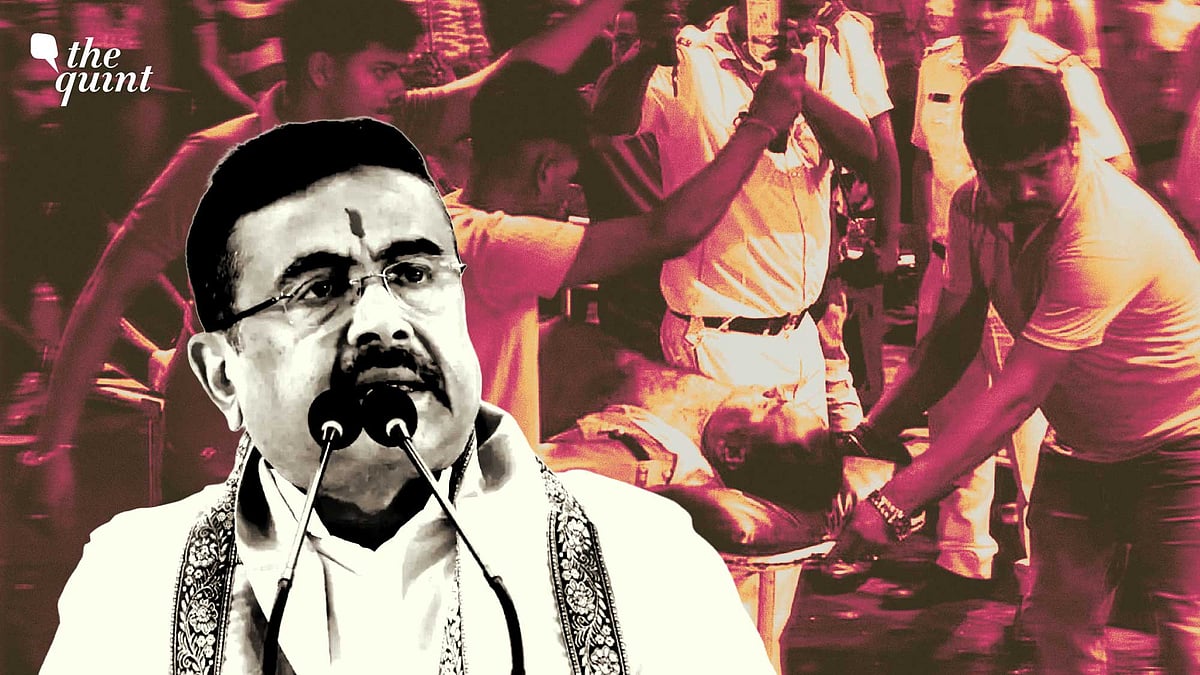
But they also demand careful planning, adequate police deployment, and an administration prepared for emergencies. At Chorbagan Sarbojanin Durga Puja in North Kolkata, that responsibility came under devastating scrutiny when a stampede on 17 October killed 19 people and injured several others.
A festival associated with joy became a tragedy, raising serious questions about the priorities and preparedness of the Suvendu Adhikari-led Bharatiya Janata Party (BJP) government.
Accountability cannot stop with the immediate organisers. When thousands of people are expected to visit pandals during a festival, crowd management, emergency exits, trained volunteers and police deployment are matters of public safety.
BJP’s Political Priorities?
There is also a political question that cannot be separated from this failure of administration. During Durga Puja, when the police should have been concentrating on crowd management, the government and civic authorities were embroiled in a controversy over Left bookstalls. In Jadavpur, a bulldozer was reportedly brought to remove a CPI(M) bookstall, prompting resistance from Left supporters. Similar disputes and allegations of vandalism emerged elsewhere.
The controversy was further sharpened by Adhikari’s criticism of Left bookstalls, even as BJP state president Shamik Bhattacharya denied that the party was responsible for the alleged vandalism.
The question, therefore, is about political priorities.
There are also questions about the reported sidelining of experienced Puja organisers over their perceived proximity to the previous Trinamool Congress (TMC) government. These allegations deserve scrutiny, not assumption. But when 19 people lose their lives, the government cannot escape questions about whether political considerations were allowed to overshadow public safety.
Serious Questions Over Crowd Management
The Chorbagan pandal sits in a neighbourhood of narrow lanes. Radha Madhab Saha Lane and adjoining bylanes have always constrained movement. Police accounts and eyewitness descriptions indicate that barricades had already been breached on previous days.
When rain arrived around 7.30 pm, people surged for shelter. Volunteers reportedly dropped control ropes. A public-address announcement, later described by investigators as panic-inducing and unverified, warned of imminent structural collapse and ordered immediate evacuation. The result was a crush at the limited exits.
The subsequent decision to recall nine experienced IPS officers with prior Durga Puja crowd-management records only after the deaths is itself evidence that the initial deployment fell short of what the known scale required.
An investigation must establish whether organisers sought additional manpower and whether the local police station anticipated the surge that a “Shera Shera” award-winning pandal was likely to attract.
The Devi Paksha Decision and Crowd Concentration
Mahalaya, observed on 10 October this year, marks a significant transition in Bengal’s autumn calendar. It falls on Sarva Pitri Amavasya, the final day of Pitri Paksha, when families remember their ancestors through rituals such as Shraddha and Tarpan.
In Bengal, however, Mahalaya carries another meaning. It signals the arrival of Maa Durga. The pre-dawn broadcast of Mahishasura Mardini, the painting of the goddess’s eyes and the growing anticipation of pandal-hopping make it the unofficial beginning of Durga Puja, even though the formal festivities begin later.
For years, successive governments in Bengal recognised this cultural reality. Under Mamata Banerjee, many Puja committees were allowed to open their pandals on Mahalaya or even earlier. This helped distribute the enormous crowds over a longer period, easing some of the pressure on Kolkata’s narrow streets, particularly in north Kolkata.
The consequences of that decision deserve scrutiny after the Chorbagan stampede. Heavy rain drove visitors towards the already crowded pandal, triggering a deadly surge. Reports subsequently pointed to narrow lanes, inadequate exits and failures in crowd management. The investigation must establish the precise causes and fix responsibility.
Yet the larger administrative question cannot be ignored. Kolkata’s Durga Puja crowds are entirely predictable. The government knows how many people visit the major pandals and how quickly the situation can become dangerous when rain forces thousands to seek shelter. Religious traditions deserve respect, but interpreting the calendar is a political choice when it determines how a city manages its biggest public festival.
At Chorbagan, 19 people paid the price for failures that now demand answers.
Politics Surrounding Durga Puja
Durga Puja has always carried political overtones in Bengal, but this year’s edition saw an unusually rapid assertion of new authority. Within months of assuming power, the BJP facilitated or encouraged new committees in places that had not previously hosted large public pujas.
Allen Park on Park Street, long associated with Christmas celebrations, hosted its first Durga Puja under a Sanatani Sangha whose office-bearers include BJP functionaries.
There is nothing objectionable in new celebrations. The difficulty arises when large structures are erected in dense commercial areas without demonstrated prior experience in traffic, entry-exit design, or emergency response.
Safety protocols appear to have been secondary in several instances. When a tragedy occurs under such conditions, the claim that responsibility rests solely with local organisers becomes harder to sustain.
Taking Political Control of Durga Puja Committees
Chorbagan is not an isolated case. The previous committee, long associated with Jayanta Banerjee, who had managed the puja for decades and was linked to TMC circles, resigned en masse in mid-July 2026. A new committee took over, chaired by Jorasanko BJP MLA Bijoy Ojha, with the party’s North Kolkata district president as chief advisor and Debdeep Adhikari, nephew of the Chief Minister, listed as chief patron.
The Chief Minister inaugurated the pandal and described it as a Sanatani puja. Similar shifts occurred at other clubs, while some experienced organisers, such as the leadership at Santosh Mitra Square under BJP MLA Sajal Ghosh, retained continuity.
The BJP had time after May to assert influence gradually. Choosing rapid political capture instead placed inexperienced hands in charge of high-footfall sites. The administration cannot claim surprise when the results of that choice appear in the form of missing evacuation plans and inadequate on-site control.
Compensation Is Not Accountability
Adhikari has announced compensation of Rs 25 lakh and a government job for the next of kin of each deceased, Rs 5 lakh for the injured, and an inquiry into the Chorbagan stampede. He has blamed organiser negligence and the panic announcement, while arrests have followed.
These measures cannot substitute for an impartial investigation. CCTV footage, police deployment, emergency response times, VIP movements and prior communication between organisers and the police must be examined independently. A judicial inquiry, as Adhikari has indicated he will seek, could help establish responsibility without allowing political narratives to determine the findings.
The stampede has already prompted temporary closures of prominent pandals and the return of experienced officers. But crisis management after a tragedy is different from preventing one.
These are questions that demand evidence, not convenient political explanations.
Durga Puja will continue to draw millions to Kolkata. The test for Adhikari’s government is whether it learns from Chorbagan or treats the deaths as an isolated failure of organisers.
The families who lost their loved ones deserve more than compensation and promises. They deserve an investigation that establishes what went wrong, who was responsible and what must change to prevent another tragedy.
(Sayantan Ghosh is the author of two books, Battleground Bengal and The Aam Aadmi Party, and teaches at St. Xavier’s College (Autonomous), Kolkata. This is an opinion piece and the views expressed are the author's own. The Quint does not endorse or is responsible for them.)