
US Supreme Court Brings a Breather from Tariffs, but Trump Remains at Large
Indian goods should now be levied a 10% tariff as surcharge in addition to 3.5% original tariff while entering US.
advertisement
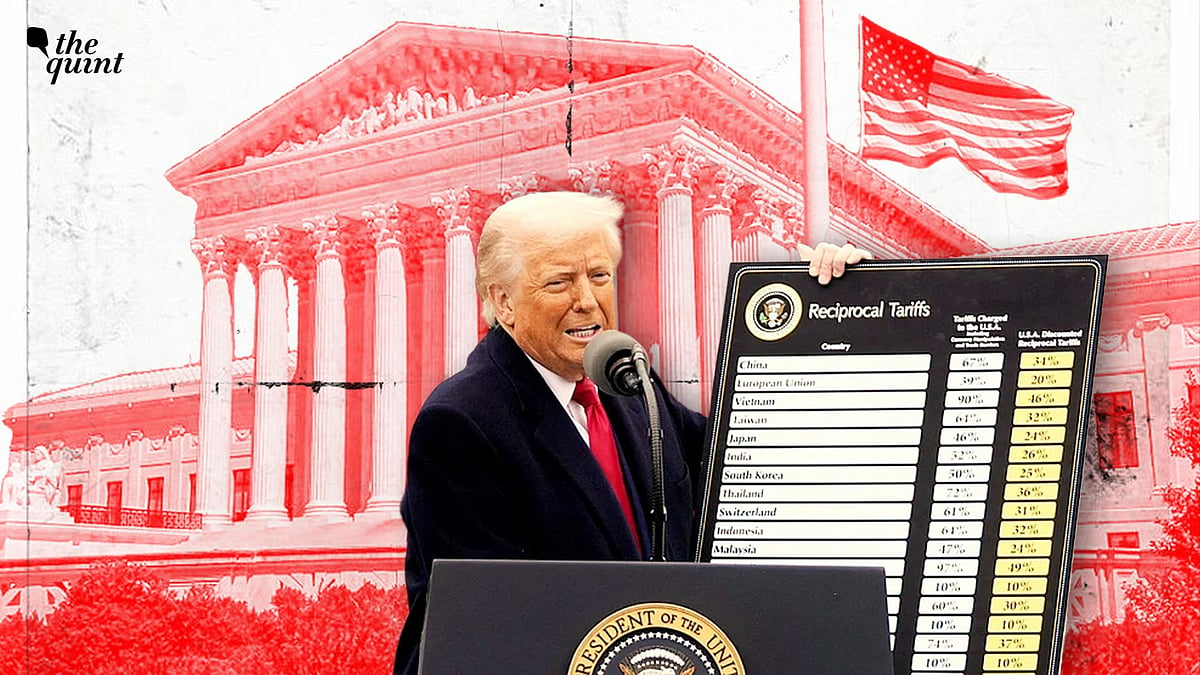
On 20 February, the United States Supreme Court ruled on the issue of whether the American President had the power to impose tariffs on foreign goods under the country’s International Emergency Economic Powers (IEEPA) Act of 1977.
Unlike his predecessors, President Donald Trump had invoked this Act to create the entire structure of wilful imposition of tariffs on foreign imports since 5 April.
The Trump-Supreme Court Showdown
Three days earlier, according to a White House Fact Sheet, he had held that “...foreign trade and economic practices have created a national emergency, and his order imposes responsive tariffs to strengthen the international economic position of the United States and protect American workers”.
Following this finding, Trump formally proclaimed:
In light of this determination, Trump invoked the IEEPA to impose tariffs. In a 6-3 decision, the Court stated as per the words of Chief Justice John Roberts, “We claim no special competence in matters of economics or foreign affairs. We claim only, as we must, the limited role assigned to us by Article III of the Constitution. Fulfilling that role, we hold that IEEPA does not authorise the President to impose tariffs”.
Article III of the Constitution confers the judicial power on the Courts and judicial power extends to the interpretation of US laws in cases before the Courts.
With this decision, the Court gave Trump the greatest shock he has received till now in this term. The hearing of the case challenging Trump’s action had concluded over five months ago, and Trump was worried by what the judges would decide. Till now they had leaned in his favour, giving him greater immunity and upholding his immigration policies, but this case went to the heart of his desire to bend the world to his will.
Trump had stacked the Court with conservative judges, which had resulted in conservative judges' strength increasing to six in a Court of nine. Would the conservative majority hold? Many, including this writer, felt it would, because at stake was the President’s emergency powers.
In the IEEPA, it found that Congress had not delegated the power of taxation (that is, tariffs) to the President. A dissenting judge, however, noted that other Acts gave that power but with constraints.
As expected, Trump reacted with fury against the judges who had delivered the majority decision. He called them a disgrace and questioned their motives.
However, any speculation if he would observe the Court decision was put to rest by the evening on 20 February itself. He ordered that his orders under the IEEPA “shall no longer be in effect” and the tariffs under it “as soon as practicable, shall no longer be collected”.
This shows the strength of US institutions, especially of the Courts. Even a President as powerful as Trump has no choice but to bend before their decision. This decision also demonstrates that the US Supreme Court does not compromise on the country’s foundational doctrine of separation of powers.
Roads Ahead for Trump
While Trump has been thwarted in imposing tariffs under the IEEPA, he can take recourse to other Acts of Congress. However, these impose constraints that Trump had claimed IEEPA did not.
On 20 February itself, Trump imposed, through a Proclamation under Section 122 of the Trade Act of 1974, an across the board surcharge 10 percent tariff on all countries for a period of 150 days. A substantial number of goods, including those of everyday use were exempted from this surcharge tariff.
Trump gave the following rationale:
Under section 122, a tariff can be imposed for only 150 days. This section has never been invoked so far. Hence, it is possible that its imposition through the Proclamation will be tested in the Courts. In any event it's temporary. Trump may seek to have the 150 days period extended but that will require a bruising Congressional process which the Republicans may wish to avoid in an election year; midterm elections are due in November.
He has used this section against China, but it is difficult to use it on a global basis. Trump can also take recourse to section 232 of the Trade Act of 1962 to impose tariffs on national security grounds but it would also not be easy to justify them globally. Besides, his administration has to give him recommendations about the national security risk posed by a product being imported from a particular country.
A Breather for the World
Certainly, now all foreign states will heave a sigh of relief because they would know that Trump, despite his rails and rants, will not be in a position that he was to hitherto impose tariffs. '
That does not mean that he would not have the instruments to harm other countries in myriad other ways by denying technologies or products or using the power and influence of the US to pressure other countries to gang up against a particular state.
This is a grey area but, generally, the authority of the President prevails. For the time being the US has clarified that their exports will also attract a tariff at 10 percent even if the agreements had imposed a higher rate.
Trump has also said that the agreement of India to accept 18 percent duty on Indian goods in exchange for zero percent duty on US exports to India will continue. The fact is that this understanding was part of the Framework of an interim agreement which has not been finalised.
There are reports that the government will wait and watch to see how matters proceed. This is the right approach. Of course, the US will pressure and bring in extraneous issues but it would be prudent to wait till matters get clarified
(The writer is a former Secretary [West], Ministry of External Affairs. He can be reached @VivekKatju. This is an opinion piece, and the views expressed above are the author’s own. The Quint neither endorses nor is responsible for the same.)
- Access to all paywalled content on site
- Ad-free experience across The Quint
- Early previews of our Special Projects
Published: undefined