
As BJP’s Delimitation Push Backfires, Brand Modi Reveals Fault Lines
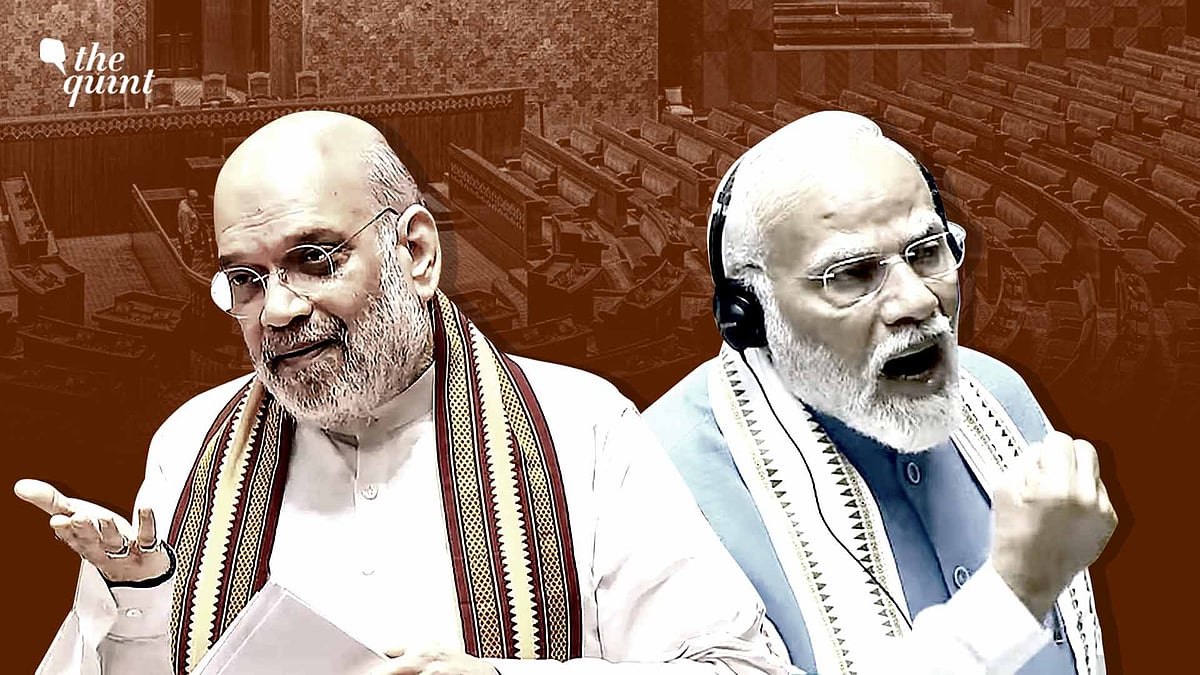
Amit Shah couldn’t deliver in the end, leaving his image as the BJP's 'Chanakya' in focus, writes Manish Anand.
advertisement
The Bharatiya Janata Party (BJP)’s delimitation push through a Constitution Amendment to women’s reservation came with a gust of brazenness.
Until Friday, 17 April, the Narendra Modi government had been invincible in Parliament. That had birthed the party’s slogan: ‘Modi hai to mumkin hai.” That slogan has now arguably lost the shrill.
Aims and Objectives: Shaking Up Indian Politics
The BJP’s image of being a 24X7X365 election machinery is well-known. The 2024 Lok Sabha election verdict had sent the party’s strategists back to the war room. The loss of its own majority in the Lok Sabha was read as a signal that the Brand Modi is losing appeal. Union Minister for Home Affairs Amit Shah’s narrative to the party workers that the BJP will remain invincible till 2047—and even beyond—faced a sharp scrutiny.
The 25-year freeze on delimitation, extended last in 2001, was up for renewal in 2026. Another extension risked portraying Prime Minister Narendra Modi as a status-quoist.
For the BJP, Modi “doesn’t postpone today’s challenges to the future dates.” The script was ready. The BJP strategists believed that post-delimitation, the party’s electoral turf will gain an edge to assure winnability.
Icing on the Cake: Women Voters and West Bengal
If the delimitation was at the core of the BJP’s 2029 script, cementing the core constituency of women voters came as a compelling pull.
In Jharkhand, Hemant Soren riding on a women support base trumped BJP’s “ghuspaithiya” narrative. But the BJP was also wary of the limits of doles-based women outreach. A larger narrative suitably came in the form of women’s reservation expedited on an earlier date than letting it hand in uncertainty of Census 2026 and the subsequent delimitation.
The West Bengal Assembly elections further brought an immediacy to executing the script—that too in the middle of electioneering. Chief Minister Mamata Banerjee’s appeal among women voters continues to make the BJP leaders sceptical of winning the state. But winning West Bengal has become excessively crucial for the BJP, in line with the Rashtriya Swayamsevak Sangh (RSS)’s current focus on border areas and demography.
Amit Shah: BJP’s ‘Chanakya’ Faces Scrutiny
Amit Shah is widely believed to be the chief strategist of the BJP. The party credits him for smooth sailing of contentious legislations in the past like the Jammu and Kashmir Reorganisation that removed Article 370 for all practical purposes, and criminalising the triple talaq practices among the Muslims, seen as a precursor to the BJP’s bid for the Uniform Civil Code (UCC).
He faced a humongous task in re-asserting the slogan of “Modi hai to mumkin hai” in pushing the Bills. Two-thirds majority required support of 360 MPs. This would not have been possible without the support of a section of the Opposition. Shah couldn’t deliver in the end. That leaves his image as the “Chanakya” of the BJP in the spotlight, more within his party.
Political Missteps or Calculations Gone Wrong?
The BJP strategists believed that Mamata Banerjee will not risk defeating the Bills. Women voters are key to the Trinamool Congress' winning streaks in West Bengal. The BJP also believed that the Congress will come onboard as had been the case in 2023. Prime Minister Modi sent letters to the Opposition to argue the case for women’s reservation at the earliest.
But overconfidence sinks many plots.
The BJP erred in anticipating that the Special Intensive Revision (SIR) in West Bengal and the Election Commission of India's overdrive in the state had pushed Mamata Banerjee beyond the point of normal parliamentary relations. Nishikant Dubey’s out of the blue attack on Biju Patnaik had made Naveen Patnaik extremely angry. The BJP-Congress ties are already in the abyss, backdropped with another Dubey-led move, a substantive motion against Rahul Gandhi in the Lok Sabha.
The 2027 Hurdle Before 2029
If the Women’s Reservation Bill, along with the delimitation package, had gained parliamentary nod, the BJP would have hit the street on a high for the major 2027 electoral challenges.
On the call of Modi to identify 200 next generation leaders who can come to Parliament, the BJP had largely focussed in the last 18 months in grooming women leaders. The party’s blitzkrieg would have been unleashed across the country, and specifically in states headed for polls in 2027.
If the BJP has high stakes in Assam and West Bengal in 2026, the saffron outfit has major electoral challenges lined up in 2027. Uttar Pradesh, Uttarakhand, Goa, and Gujarat are the party’s own turf.
The “Modi hai to mumkin hai” slogan could have sharpened the appeal of Brand Modi in the state elections. But the Lok Sabha setback has now sent the BJP back to the war room with a new challenge—how to salvage the situation. The immediate answer from the BJP to the question is to dominate the optics—dub the Opposition "anti-women".
(The author is a senior Delhi-based journalist who has reported affairs of the BJP and Parliament for over two decades for India’s leading English dailies. This is an opinion piece and the views expressed are the author's own. The Quint does not endorse or is responsible for them.)
- Access to all paywalled content on site
- Ad-free experience across The Quint
- Early previews of our Special Projects
Published: undefined