Bo French and MAGA’s Anti-Indian Bigotry Are Disjointed From America’s Realities
Murali Kamma writes on the ironies of Republicans picking on students of South Asian descent in the United States.
advertisement
Popular culture, with its broad appeal, could be America’s last bastion of soft power today. This is especially true of movies and music. Beyond that, unfortunately, America’s reputation is much diminished.
This year, a Pew survey of 36 nations found that 37% had a favourable view of the US, with 57% expressing an unfavourable view. Only 35% think America contributes to stability and global peace. In 2022, 83% of Canadians saw the US as a reliable partner. Now it’s 35%.
As for American universities—which were “standing all,” to quote CB Bhattacharya from a VIGIL podcast—it’s sobering to see foreign students turning away from them, thanks to Trump 2.0’s self-defeating policies. Among Indian students, the drop in interest is so steep that they seem to have run away.
Prof. Bhattacharya, who teaches business at the University of Pittsburgh, pointed out that his institution lost $170 million due to funding cuts. As he put it in the podcast, “We’re losing scientists, we’re losing teachers, we’re losing students... to other parts of the world.”
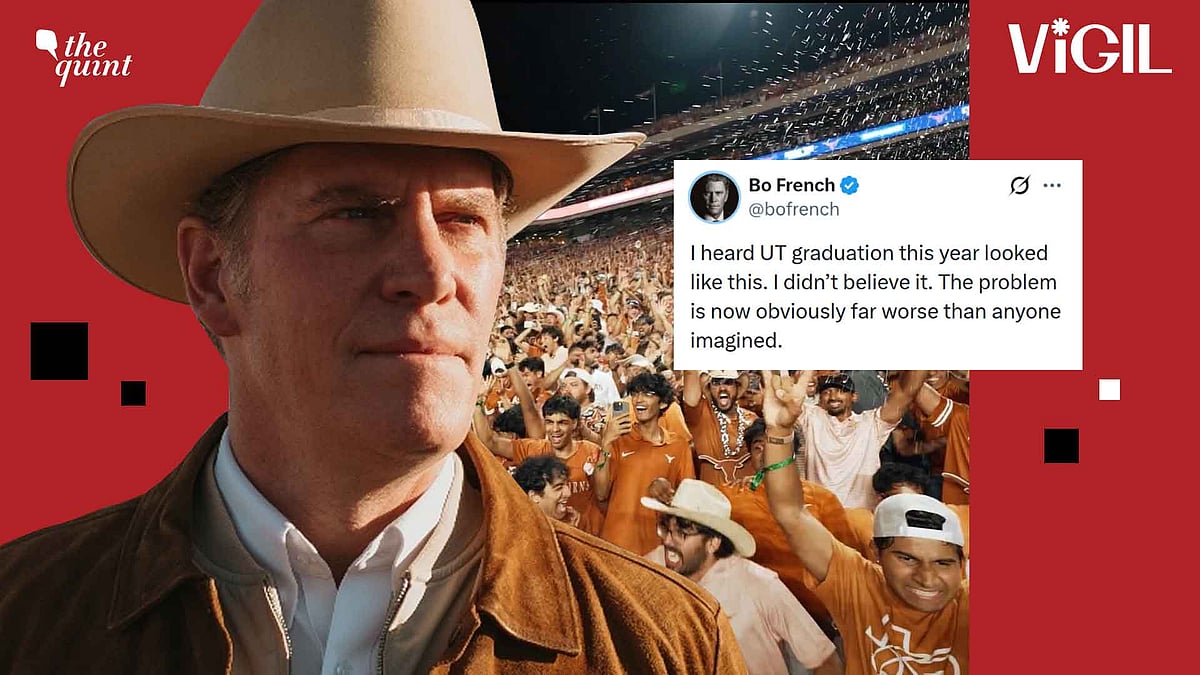
Given these trends, it’s ironic that Bo French, in a widely covered social media outburst, picked on students of South Asian descent at the flagship University of Texas at Austin. How did college football become a political football in the American South, where the sport is a religion?
To recap, when UT Austin’s Texas Longhorns, in a remarkable comeback, defeated the higher ranked Ohio State Buckeyes by just one point, the massive stadium in Austin erupted. But French, though a Texan, wasn’t pleased when he saw a group of Indian American students (whose picture he also posted) join in the cheering of their team’s improbable victory.
“I heard UT graduation this year looked like this,” he wrote. “I didn’t believe it. The problem is now obviously far worse than imagined.”
Although the image made his meaning clear, French’s post wouldn’t have gained much traction if he had been a random bigot. Bigotry is rife, both on and off social media. But Bo French is the Republican nominee for Texas Railroad Commissioner, a powerful position providing jurisdiction over energy policy. He is heavily favoured to win in the midterms this November.
French’s post echoed the fear, shared by many on the right, that whites are being displaced by non-whites. Those who embrace the conspiratorial Great Replacement theory argue that immigration is a deliberate strategy to reduce the power and influence of white Americans.
But, in fact, before the Immigration and Nationality Act of 1965, national-origin quotas had kept non-white immigrants out of the US for four decades. And even as that system ended, legislators were convinced that European immigrants would remain the primary beneficiaries of the new law. Otherwise, they wouldn’t have included the family reunification provision.
French, responding to the condemnation of his post, claimed that he was only drawing attention to an issue by asking: Do we “prioritize” foreigners or Americans? That only made things worse, because French—perhaps unwittingly—was doubling down on his bigotry.
Reassuringly, many Republicans distanced themselves from French. When a red state like Texas is in play, as it seems to be in the midterms, the last thing they need is more negative publicity. Already, as Trump 2.0 lurches from one crisis to another, the Republican brand has taken a big hit. It’s a critical moment for MAGA. Despite the bravado on display, they’re worried behind the scenes—not only about the immediate future but about MAGA’s long-term prospects.
“Indian Americans are participating fully in U.S. life, generally know English, and have high intermarriage rates,” stated National Review in a recent editorial. “Unless the test of assimilation is being white, they’re doing it.” But that stance now represents the Old Right, and National Review is no longer seen as the standard bearer of American conservatism.
For the New Right, it has never been about assimilation, no matter what they say. It’s about “displacement”—and seeing non-white immigrant success as a threat to white dominance. They live in a zero-sum world of winners and losers. When Indian American kids become Spelling Bee champions, they’re not filled with admiration. They’re alarmed.
The French episode revealed—yet again—how divided the country has become and how the New Right is consumed by demographic change. And yet, their clarion call (“It’s immigration, stupid!”) is not helping Trump 2.0 anymore. Competence counts, even for cults led by charismatic leaders. Bread and butter issues (“It’s the economy, stupid!”) still count.
There are two ways to think of America. The first, which emphasizes ideals rather than identity, is the true source of the country’s strength and appeal. “We are a nation born of ideals, not bloodlines,” the outgoing US Representative Raja Krishnamoorthi noted recently.
This hierarchy makes no sense, even if we, for the sake of argument, stick to the descendants of European immigrants who came to the US in successive waves over a long period. How do we make distinctions between the 18th and 19th centuries, not to mention the 20th and 21st centuries, when the population is so mixed up? Also, where does that leave the descendants of enslaved people and inhabitants who predated European settlers? It’s absurd.
Another problem with ancestor worship is that we tend to romanticize the past and fail to distinguish good ancestors from ancestors who were awful. Ultimately, we have more in common with our contemporaries, regardless of their ancestry, than our own ancestors.
That’s what made America’s founding principles so revolutionary. We found a new, more civilized way to think of ourselves. Of course, the journey has been far from perfect. The principles enshrined in the Declaration of Independence and the US Constitution can seem abstract, given the harsh realities of life. But the ideals—Equality, Liberty, Rights, Opportunity, and Democracy—matter. The idea of America also means that such ideals are within reach.