
Chinese Dog, Indian Problem: Galgotias Chaos at AI Summit Reveals Deeper Rots
The Galgotias imbroglio highlights the gap in India's tech aspirations and educational realities.
advertisement
Just as India’s high profile Artificial Intelligence (AI) Impact Summit 2026, billed as a flagship event of the Global South, recovered from the organisational glitches of its 16 February inauguration and everything seemed to be going well, it was hit by a major embarrassment.
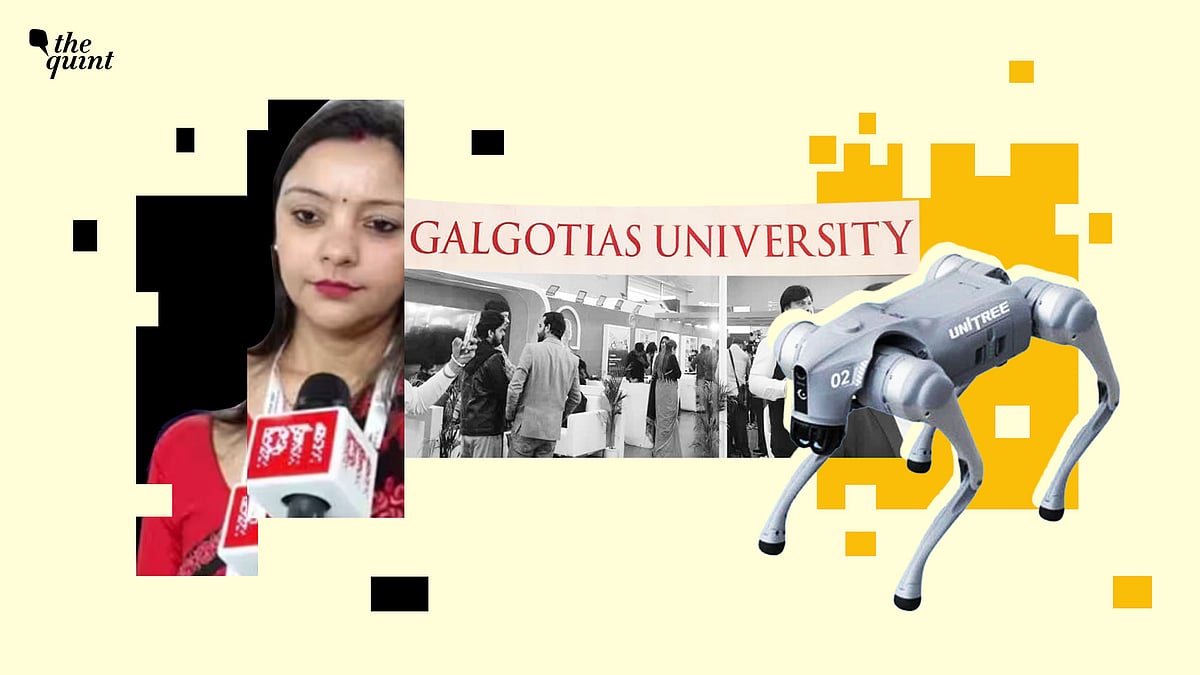
The Galgotias University was found to have displayed on its large stall a China-made, commercially available robotic dog, the Unitree Go2, and even claimed it was named ‘Orion’, developed by the university’s Centre of Excellence.
The matter, however, didn’t end there—the university came under fresh criticism on a separate claim that its staff and students had built a soccer drone, which turned out to be South Korea’s Striker V3 ARF, even as its “thermocol AI plane” drew online jeers.
Overall, this imbroglio overshadowed the good projects displayed at the Summit.
Innovation Sans Education
The imbroglio raises serious questions. In an information age, where internet, knowledge bases, social media tools, and AI-empowered algorithms enable near-instant fact-checking, it is imperative that every design/endeavour at a prestigious, internationally pegged summit be validated as fit-for-display, and our institutions should have demonstrated credibility, preparedness, and global standards.
So, did the university and/or the officials think they could get away with this? If the officials were misled by the university, why did the former not exercise due diligence?
Was there no realisation that a single such mistake could undermine credibility? Even the most benign defense fails to explain why the university displayed or was allowed to display, deliberately or inadvertently, a Chinese-made system at the India-led summit (a social media (deleted later) by Union IT Minister Ashwini Vaishnaw had carried a picture of ‘Orion’).
Overall, the mess seems emblematic of systemic flaws in our education system and socio-political environment.
The problem is multi-fold. The National Education Policy (NEP) and skilling programs notwithstanding, our education system and curriculum are archaic; prioritise attendance, rote, mere literacy and written assignments over contemporary education, innovative thinking and skilling for the future. Several reports (eg, National Employability Report Engineers Annual Report 2019; 2022 study by Infosys; India Skills Report-2024; Economic Survey-2024; etc) have detailed that majority of our engineers are not employable, particularly in the information technology sector as they lack the requisite skills.
While we have a plethora of colleges and universities, the quality of education, especially in private colleges is unbalanced on account of low funding for Research and Development (R&D), poor facilities, adverse teacher-to-student ratio and outdated curriculum.
Of immense concern is the paucity of good faculty—while the sponsors can construct world-class buildings, how does one get world-class faculty in same timeframes? Besides, the traditional ‘learn first, work later’ approach doesn’t work in world where technological change is exponential and often revolutionary (and not always evolutionary) in nature, and requires fast adoption in curriculum, teaching methodologies and skilling for innovation.
Politicising Knowledge and Syllabi
The educational construct is further aggravated by the politicisation of curriculum as well as of the institutions of higher education—this undermines institutional autonomy, inhibits critical inquiry and intellectual freedom, and imposes cultural control.
It also seems that some universities are quietly emulating the government’s tendency to propound and hype fake achievements and thereby treating "innovation" like a marketing campaign rather than a scientific pursuit, while burying academic integrity.
There is no realisation that historically, almost all improvement, innovation and invention have stemmed from critiques, often severe, from so-called ‘rebels’ who weren’t satisfied with the prevalent conditions. When an objective history of this era is written in future, it will likely record that the most damage to India’s progress was done by those who viciously trolled anyone who offered a critique of the existing situation or rendered a suggestion for betterment or sought improvement.
A Leader's Dharma
Above all, we need leaders who can set abiding personal examples, as opposed to manufactured ones.
In the armed forces, good officers tend to be guided by three main precepts:
The prayer taught to every cadet in the National Defence Academy, central to which is the commitment to choose the "harder right over the "easier wrong"; this invokes divine guidance to maintain physical, mental, and moral strength in service to our Nation.
They must lead by personal example—one’s conduct must be exemplary in every domain of activity as otherwise, the troops won’t follow that officer into the “jaws of death”.
Third, the unwritten concept of ‘noblesse oblige’, which translates loosely as “if you are nobility (and ordained to govern), then you have serious obligations to your people”—and in democracies, politicians and bureaucrats are that nobility (“raj dharma”).
It is such principles which has ensured that the Indian Armed Forces delivered, fully, on every challenge. However, this paradigm is not limited to the armed forces—even at the national level, the populace looks at leaders as role-models and for inspiration. And given human propensity to opt for the “easier wrong”, it is imperative that leaders set that ‘exemplary conduct’ example, lest the populace choose to emulate those who are cunning, manipulative, and regressive.
In sum, an improved, evolved, tech-orientated education and skilling system bereft of ideological/mythological narratives and hegemonies, in conjunction with a socio-political environment which encourages free speech and critique, has the capacity to unlock India’s true talent potential.
(The author is a retired Brigadier from the Indian Army. This is an opinion piece and the views expressed above are the author’s own. The Quint neither endorses nor is responsible for the same.)
- Access to all paywalled content on site
- Ad-free experience across The Quint
- Early previews of our Special Projects
Published: undefined