
RN Ravi’s Transfer from TN to Bengal: How BJP Killed Two Birds With One Stone
By removing RN Ravi, the BJP is possibly trying to take some steam out of the DMK’s anti-BJP campaign.
advertisement
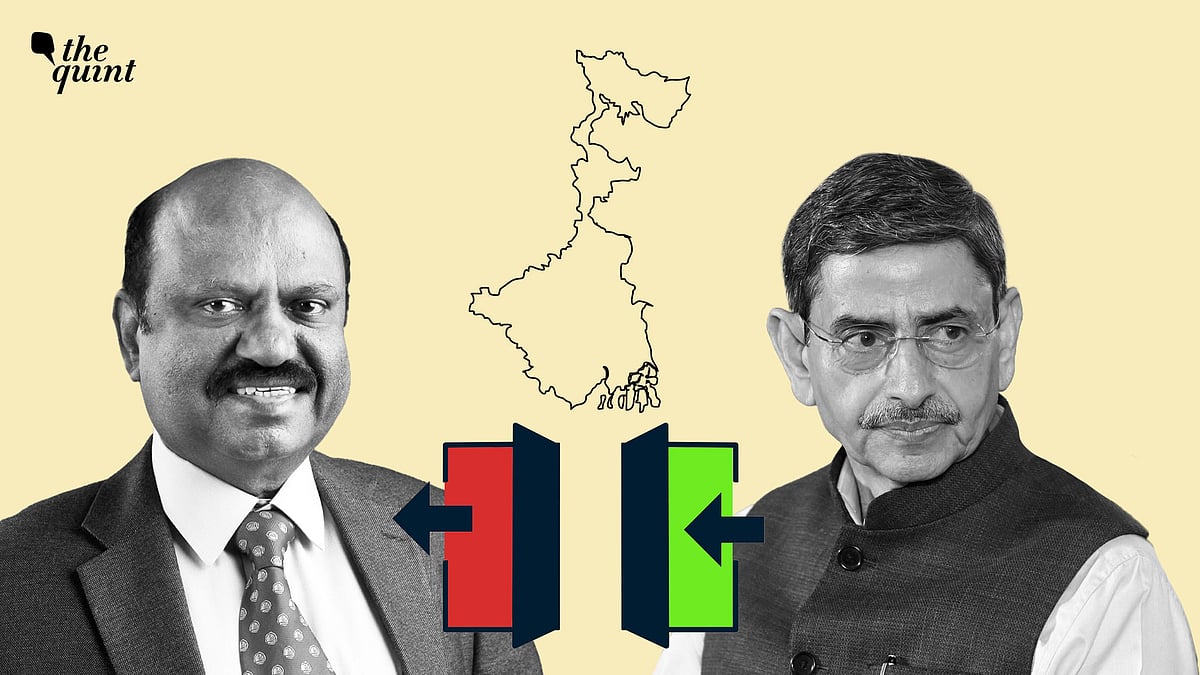
Governor RN Ravi’s transfer from Tamil Nadu to West Bengal triggered different reactions in the two states. In the former, leaders of the ruling party, Dravida Munnetra Kazhagam (DMK), were pleasantly surprised. They had been demanding his removal for a long time and, of late, had started to use his presence in the state to fuel pro-Dravidian sentiments and polarisation.
In the latter, the ruling party, Trinamool Congress (TMC), was shocked. A Governor known for coming to frequent conflict with federal principles and norms is being sent at the crucial hour of uncertainty over the controversial voter roll revision—it was reason enough to immediately trigger the fears of ill motive on the part of the Union government.
Two Transfers, Two Reactions
Tamil Nadu Chief Minister and DMK president MK Stalin sarcastically said that they actually wanted Ravi to stay because his anti-people actions were helping the DMK more than hurting. Ravi had assumed office as Tamil Nadu’s 26th Governor in September 2021.
“We’ll miss you, Ravi!” tweeted Tamil Nadu minister TRB Rajaa. MP P Wilson echoed Rajaa, saying the DMK was losing a ‘star campaigner’ in the upcoming elections.
“Thiru RN Ravi was a constant reminder of the Bharatiya Janata Party (BJP)'s intentions with Tamil Nadu,” Wilson wrote. Wilson also added a word of caution for the TMC:
West Bengal Chief Minister Mamata Banerjee was not amused. In a post on X, she wrote that she is “shocked and deeply concerned” by the sudden news of Bengal Governor CV Ananda Bose’s resignation.
It is based on that resignation that Ravi was transferred to Bose’s place. Bose, too, had his share of confrontations with the Banerjee government, but not to the extent of what his predecessor, Jagdeep Dhankhar, had before the latter became the Vice President of India.
Banerjee wrote that while she did not know the reasons behind Bose’s resignation, “the prevailing circumstances” prompted her to suspect foul play.
“I would not be surprised if the Governor has been subjected to some pressure from the Union Home Minister to serve certain political interests on the eve of the forthcoming State Assembly elections,” she said.
She was anguished because Home Minister Amit Shah did not consult her prior to the appointment of the new Governor. “Such actions undermine the spirit of the Constitution of India and strike at the very foundation of our federal structure,” she alleged.
Turbulent TN Tenure & DMK's 'Anti-Dravidian' Rhetoric
It is Ravi’s track record as the TN Governor that keeps Bengal’s ruling party worried. Ravi walked out of the Assembly without reading the customary speech prepared by the DMK government, arguing the speech’s content had ‘inaccuracies’. In his presence, portions of the Tamil Anthem were dropped at a Central government event.
He even unilaterally dismissed minister V Senthil Balaji—who was in judicial custody following an arrest by the Enforcement Directorate (ED)—from the Cabinet on his own. This triggered a massive controversy and brought forth constitutional questions over his authority—can a Governor remove a minister without the Chief Minister’s advice? He subsequently put the dismissal order in abeyance late the same night.
He even called British missionary-turned-linguist Robert Caldwell’s 1856 publication, A Comparative Grammar of the Dravidian or South-Indian Family of Languages, a “fake book.” This book has played a pivotal role behind the recognition of Dravidian identity.
Tamil Nadu political observers argue that Ravi’s own actions necessitated his exit from Tamil Nadu ahead of the Assembly elections.
Several Chennai-based journalists told The Quint that there had been a buzz over the past couple of months that Ravi might be removed. They say, DMK managed to turn Ravi into a villain, used his actions to garner sympathy, and had been largely successful in that.
According to MC Rajan, a Chennai-based senior journalist, Ravi had become more of a liability for the state BJP than an asset. By removing him, the BJP is possibly trying to take some steam out of the DMK’s anti-BJP campaign.
(RSS refers to the Rashtriya Swayamsevak Sangh, the ideological-organisational parent of the BJP.)
The BJP likely also wanted to tone down the anti-Dravidian rhetoric that the party had been pursuing in Tamil Nadu over the past four-five years. Last year, the party replaced state unit chief Kuppusamy Annamalai, who had emerged as a stringent critic of Dravidian politics and ideology.
DMK spokesperson Constandine Ravindran said Ravi was transferred because there was nothing that the BJP could gain from him in Tamil Nadu, whereas there remains scope for his use in Bengal.
“The contest in Bengal is tighter than in Tamil Nadu. The BJP is likely fancying using him in unconstitutional ways,” Ravindran argued. “Besides, even though he acted like the BJP’s state unit chief during his tenure here, it actually backfired.”
Ravi’s transfer, thus, appears to be BJP’s bid to kill two birds with one stone—have him removed from where he was becoming a burden and place him where he might become an asset.
Fears of President's Rule in Bengal After Bose's Exit
In Bengal, Ravi’s appointment triggered suspicion of ill motives because the prospect of the imposition of President’ Rule is being discussed over the past few weeks, especially since the matter of verifying voter list screenings went to the Calcutta High Court.
On 24 February, the High Court informed the Supreme Court that examining documents of voters placed under logical discrepancy and unmapped categories—a whopping 50 lakh cases—would take 80 days.
The tenure of the current government ends on 7 May. There might be scope for imposing President’s Rule—which gives the Centre direct control of a state—if the new government is not formed before the end of the tenure. For the new government to be formed before the end of the tenure, the elections must be completed by April.
The TMC, the Left parties, and the Congress have all said that the election cannot be conducted without including every eligible voter wrongfully deleted or kept under adjudication.
A senior leader of Bengal Congress, who did not want to be named, argued that since the Election Commission is considering conducting the elections in one or two phases—quite in contrast to previous practices of conducting the Lok Sabha and Assembly elections in the state in six to seven phases—there is still time for conducting the election on time after solving the voter list fiasco. “However, an air of uncertainty remains.”
Besides, there are apprehensions that deletions through the Special Intensive Revision (SIR) may upset equations in many seats, especially those where winning margins were less than 10,000 votes. “It is these sort of uncertainties that make the role of the Governor crucial,” said a TMC minister.
Later, in a Facebook post, Ghosh wrote, “His sentiments were so hurt that he did not visit Raj Bhavan. Mrs Bose went there to pack their things.”
Incidentally, Bose had registered as a voter of West Bengal. He told journalists at the airport that he will be back in Kolkata to cast his vote.
Asked whether he was pressured to resign, Bose refused to divulge at present. The time for making the reason public had not come yet, he said. “A rule of any game is that one needs to know when to stop. I got a chance to take a call. I used that opportunity to resign,” he told the media.
(Snigdhendu Bhattacharya is a journalist who writes on politics, history, culture, environment, and climate change. He has authored books on leftwing insurgency and Hindu nationalism. This is an opinion piece. The views expressed above are the author's own. The Quint neither endorses nor is responsible for the same.)
- Access to all paywalled content on site
- Ad-free experience across The Quint
- Early previews of our Special Projects
Published: undefined