
ADVERTISEMENTREMOVE AD

The Limits of Hunger Strikes in Modi's India

Sonam Wangchuk's hunger strike has not built the momentum needed to make the government nervous, writes Ashutosh.

Published
story-hero-img
i
Aa
Aa
Small
Aa
Medium
Aa
Large

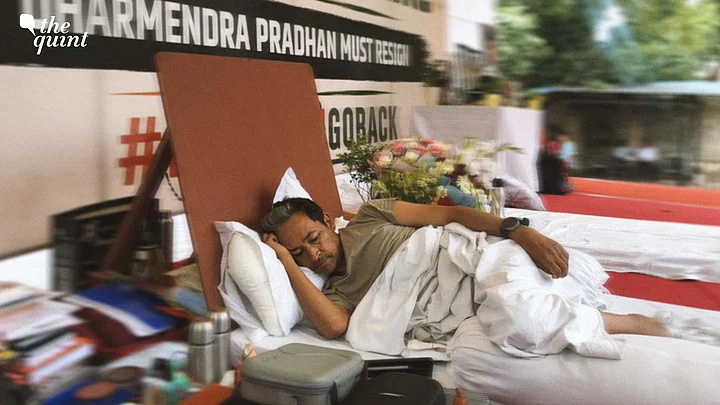
Why is Sonam Wangchuk wasting his time and physical energy? If he thinks that the Modi government will accede to his demand and that Education Minister Dharmendra Pradhan will resign, then he is definitely living in a fool's paradise. He is not only going to disappoint himself, his supporters and well-wishers, but also those who question his integrity and commitment to the nation. 

Wangchuk’s presence at Jantar Mantar has definitely given the Cockroach Janta Party’s (CJP) agitation for the minister's removal a moral aura. CJP, which suddenly drew the nation's attention, garnered more than 2 crore supporters on its satirical Instagram page. This page was created by US-based Abhijit Dipke in response to the Chief Justice of India calling unemployed youths of the country 'cockroaches' and 'parasites'. 

Undoubtedly, it was a disgraceful comment. Though, as an afterthought, the Chief Justice did try to take back the words, it was too late. His comment outraged the nation's conscience. People were aghast, perplexed, disgusted, and heartbroken. The CJP was a paper rebellion of insulted souls who had not only been denied jobs but also been ridiculed by the highest seat of justice. 

But to imagine that the insulted collective wisdom of the youth would turn into a real rebellion, shake the foundations of the State, and force the government to bend forward and backwards was expecting too much. Dipke probably imagined he would be the new Anna Hazare and the new Arvind Kejriwal, but he was grossly mistaken, and it is now proving to be a big disappointment.
ADVERTISEMENTREMOVE AD

India has changed dramatically since 2014. It is no longer the democratic system we once knew. Manmohan Singh’s government was a democratic government; it felt responsible to the people of India through the Parliament. It was its constitutional duty to take cognisance of the democratic, non-violent agitation, and it was this constitutional impulse that on both the occasions when Anna Hazare sat on indefinite hunger strike—at Jantar Mantar and Ramlila Maidan—the Manmohan Singh government not only listened to their calls, but also tried to engage with Anna Hazare and his team to find a solution to the crisis.

After Jantar Mantar, a committee was formed to discuss a Lokpal Bill and its modalities. After Ramlila Maidan, the Parliament passed a resolution promising to roll out the Lokpal Bill to fight corruption.

From Anna Hazare to Modi's India

But can the same be expected from the Modi government? No way! No chance! It is asking for the moon!

A democratic government respects democratic movements and seeks to find a way out or engage with them to understand the people's pain and anguish. The Modi government, by nature, is not democratic; it lacks a constitutional impulse for democratic means.

When farmers sat on a dharna to demand the withdrawal of the three farm laws, it used every trick in the book to discredit and dislodge them. Farmers had to sit for more than a year, weathering extreme heat, cold and rain, to make the government realise that the farmers’ movement would politically damage the ruling Bharatiya Janata Party (BJP), and that it would withdraw the farm laws.

The same could have been done in the first week of agitation, but it was not, because it was against their grain. The concern was not the plight of the farmers but the political cost-benefit analysis of the movement, and once it reached the conclusion that the party’s electoral fortune would be adversely affected, it acted. This was in contrast to environmentalist GD Agarwal being left to die after 112 days of hunger strike for the cleaning of the Ganga. The government did not take notice as the cleaning of the river wasn't electorally damaging for the party.

Why the Movement Failed to Build Momentum

Cockroach agitation piqued people's curiosity. But it failed to become a serious movement, even though the issue directly impacts the country's youth and their future. It almost seems that they are oblivious to the hunger strike.

One serious reason could be the lack of strong leadership and a structured organisation. Another could be almost no media support, especially mainstream TV channels. Anna Hazare’s movement, for that matter, was blessed with those two attributes.

Sonam Wangchuk is an international personality, but it seems that before sitting on an indefinite hunger strike, he did not do the required homework. No wonder he is now struggling for both support and impact. 

If he had planned in advance, spoken to top leaders of the Opposition, and big personalities of civil society and media, the colour of the movement would have been different. At first, no big leader visited him. Now that his health has started to deteriorate, the leaders of political parties are issuing statements in his favour, but it is too late. The CJP’s agitation and Wangchuk’s hunger strike have not been able to build the momentum to make the government nervous.

There is apprehension in the principal Opposition party, the Congress, that the CJP is trying to hijack their issue. The Congress, led by Rahul Gandhi, has been aggressive on the issue of paper leaks. Its student wing, the National Students' Union of India (NSUI), and the Youth Congress, were hitting the streets and organising protests across major cities in North India, starting from Rajasthan. Rahul Gandhi himself visited Kota, a major centre for aspiring youths and students preparing for competitive exams, and interacted with students there. He has plans to go to other cities, too.

The government played a crooked game by granting permission for a protest at Jantar Mantar to Dipke once he landed at Delhi airport. Here is a government that has gone out of its way to accommodate his request, and senior police officers were so magnanimous that they went to the airport to give him permission then and there.

This is the government that does not allow even a few people to assemble at Jantar Mantar.

This incident raised suspicions among the Opposition about whether the CJP was a government creation. Wangchuk’s presence gave some credibility to the CJP, but the damage was done. 

Now I have strong doubts that the government will oblige Wangchuk and grant him a dignified exit. Similarly, the Opposition will pay lip service, may sympathise with him, but it seems unlikely that it will help them earn some brownie points in the eyes of youths, students, and the middle class. It is also not as large-hearted as Wangchuk and Dipke might have imagined in their mind castles.

(Ashutosh is co-founder of SatyaHindi and a former member of AAP. This is an opinion piece and the views expressed are the author’s own. The Quint neither endorses nor is responsible for them.)

Speaking truth to power requires allies like you.
Become a Member
Monthly
6-Monthly
Annual
Check Member Benefits
×
×