'Can't Hail 2 Dissenting ECs As Heroes': Yogendra Yadav Talks the 'Gyanesh Game'
"If you are silent, you are endorsing what's being said in your presence," says Yogendra Yadav about the ECs.
advertisement
"We are looking at illegality and constitutional fraud," says Yogendra Yadav. He is responding to The Indian Express's report that two of India's three Election Commissioners objected in writing to decisions taken during the Special Intensive Revision (SIR) of electoral rolls.
The report and its follow-ups suggest that decisions the law leaves to local electoral officers were being made at the Election Commission's headquarters in Delhi. Even so, Yadav won't call the two dissenters heroes. They sat silently beside CEC Gyanesh Kumar at press conference after press conference, and two elections went by before anything was put on paper.
"If you are silent, you are endorsing what's being said in your presence."
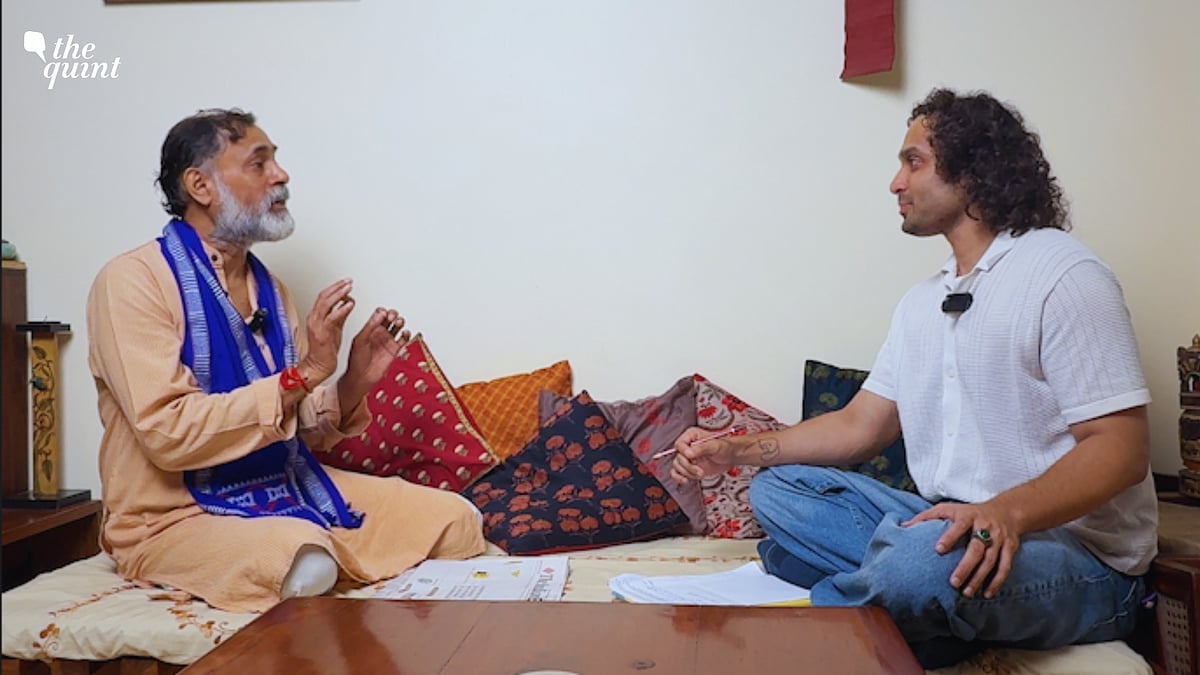
On Badi Badi Baatein, he tells Eshwar about bizarre deletions he has seen on the ground, the 2023 law that shields Election Commissioners, the Speaker blocking an impeachment motion, and "Noida media." He also explains why he believes the street is now the only route left.
Some of the highlights of this report that has come: two election commissioners out of three severely objected to decisions related to SIR. Voter roll control has allegedly shifted to Election Commission headquarters. Software has overridden decisions by EROs from states. Voter regulation requirements were allegedly changed without amending rules—the whole requirement of details of your parents and your grandparents. SIR deletions could potentially affect future generations' enrollments—is something that the two dissenting Election Commissioners have categorically pointed out. How did you decode these highlights yesterday when they came out?
These are very, very unusual things. What we are looking at is not a normal case of institutional disagreements, which is what the Election Commission's press release wants to make it out to be. "Arey, differences to hote hain..." There are two important things in what we have discovered yesterday, affirmed more by Indian Express's follow-up reports today: We are looking at illegality and constitutional fraud. Let me tell you why. The objections that the two Election Commissioners have put in paper — and something which the EC's press release has not denied — Indian Express says 14 letters were written by them. What do you normally expect in a denial press release? "Bogus, fabricated, all lies, nothing of that kind happened." Election Commission doesn't say any of these, which is to say they admit that, yes, everything cited by Indian Express was true.
So let's assume that these are true. What the Election Commissioners are saying is not simply "I was not consulted, I'm not involved," etc. They are saying that there are two things which are illegal. What is illegal? Form 6, which is for a person to become a new voter, which has been changed, for which Election Commission does not have the legal power. The power resides with the government, which in turn has to place this in the Parliament because this is driven by the rules — these are statutory rules. Election Commission cannot change statutory rules. Now, the Election Commissioners are saying this is illegal. That's the important thing. Even if one of them were to say so, it's a very serious matter that it is illegal.
So, The Indian Express's disclosure, which is a follow-up report on Goa — a more detailed report — says that the Supreme Court ordered that certain cases must be reviewed in Goa. The local authorities reviewed it and found that 97 cases needed to be corrected back. There was no provision for them to do so. So the officer who is legally entitled, required, authorized, and mandated by law to make changes could not make those changes. So the officer is writing to Election Commission saying, "Baba, this is a Supreme Court order"—because they must be afraid (unko apna darr lag raha hoga na meri jaan jayegi). So he's writing to the Election Commission, "Allow me to make changes." Nothing is allowed; those 97 voters remain out. It's not just 97 voters.
What it proves categorically is that the final decisions about inclusions and deletions were being taken by Election Commission in Delhi, not by the authority which was legally required to. This should not surprise us because in Bengal, if you recall — I think The Quint had also done a follow-up — so many EROs were saying notices are being issued in my name without my knowledge. So this scandal was sort of there. And I said constitutional fraud. What is constitutional fraud? Mr. Vivek Joshi, according to this report, is writing to say for the last one year, Election Commission meetings have no agenda and have no minutes. A constitutional authority.
Two Election Commissioners for the past over one year—these are the same Election Commissioners who sat beside Mr. Gyanesh Kumar. Press conference after press conference, especially after Mr. Rahul Gandhi's press conferences when they were specifically organized as a rebuttal to his press conferences, they have sat and they have unequivocally defended it. If you are, as an Election Commissioner, going to the extent of calling it illegal, not one of them spoke up, and two elections have taken place ever since the SIR process, in Bihar and Bengal. What kind of shadow does that cast on elections like these? And what does it tell us about the two Election Commissioners who have dissented?
These two Election Commissioners themselves do not come out in a shining light, no matter what the newspapers might say. My simple questions would be, please remember the backdrop. These are handpicked officers of the regime against which the leader of opposition had given a dissent. Please remember that they were appointed at a moment of extreme controversy. Mr. Arun Goel was strangely removed. He was not removed, he disappeared from the Election Commission suddenly. So you know when Mr. Joshi is being appointed, when Mr. Sandhu is appointed, they know which institution they are being appointed to. They sat in that press conference against Rahul Gandhi; they didn't speak anything. They sat like statues there, but mouna sammathi lakshanam, as they say. If you are silent, you are endorsing what's being said in your presence. And one of the worst vulgarities from any constitutional institution are being practiced there. It's a cringeworthy press conference that's being done in your presence; you're sitting there. Then elections happen.
My simple question is, if two of them who are aware of law, who know that the two of them are in majority, who know that they constitute the Election Commission and Mr. Gyanesh is in minority, did they requisition a meeting of the Commission, as they should? Did they say the meeting shall have the following agenda, as they should? And in that meeting, did they therefore say "We are in majority, we are taking the following decisions, and these illegalities that you've committed, we are annulling those illegalities," as they should? And in case they asked for a meeting and it was never held, did they write to the President of India, which they should? And if they did not do so, is it conscience, or is it protecting your skin? Because you know that something illegal is being done, you know that 5 or 10 years later someone can catch you, you want to leave a paper trail that will defend you. I'm afraid, to me, it looks like that. If something else comes out, I'll revise my opinion.
Do you think Mr. Gyanesh Kumar is trying to monopolize the Election Commission of India?
Of course he is. The question is, what allows him to do so? What allows, to my mind, is the varadahasta, as they say, aashirwaad from outside. And where the aashirwaad comes from is no surprise. He has served Mr. Shah; he was in his ministry. And he's presumed to have aashirwaad from the Mahamanav himself. And just in case, you know, you want to look at other things, Gyanesh Kumar's daughter is DM in Noida. Allahabad High Court fines her 5 lakh rupees, and no less than Mukul Rohatgi is there, Solicitor General of India is there to defend a DM who has been given a penalty! Ever heard of it? All the DMs in this country would want to have Solicitor General as their advocate! This is not constitutionality; it's a personal protection. It's a jugalbandi. And honestly, after that great press conference, the only thing left for Mr. Gyanesh Kumar was to go to BJP office, have a nice saffron patta, and get a ticket.
The one where he said, "Kya matao beheno ki..."
Haan, "Matao..." and "Rahul Gandhi, I challenge him! He should give affidavit!" Arey, do you want to give political speeches? Go and take BJP's ticket, fight election, give these speeches! Who are you as a constitutional authority to do these things? Honestly, this was one of the lowest days, and these two gentlemen were sitting there.
You have constantly been raising a voice against the SIR process and you are also working on the ground with people who have been left out of voter lists. What are some of the bizarre deletions that you have seen on the ground?
The worst, of course, was Bengal: 27 lakh persons being deleted. All of them had documents. One of them, his fault was his father's name was Iftikharul. This man has Aadhaar card, PAN card, and Indian passport. Father's name is Iftikarul. In 2002, his father's name was spelled as Iftik Harul, with a space between K and H. Because of which, he's been deleted from the voters list. This is what the Election Commission is doing. So I honestly almost felt happy when many of these VIPs were deleted in Delhi, because Dilli ooncha sunti hai. Unless a flood reaches Delhi, it never happened. This bulldozer has been going on in this country for the last year or so. More than 10 crore people have been deleted. And it doesn't matter in this country; the media doesn't take notice of it till it begins to hit their own. So because in the last round it was Delhi, Mumbai, and Bengaluru—the three power centers of this country—that's why it's in news...
There is a basti where more than 600 voters exist. The people are there; they have filled enumeration form, they have a copy of those enumeration forms, they have a receipt that they gave it to the Election Commission, and their names were deleted because the basti is officially unauthorized. Who is the Election Commission to decide whether something is authorized or not? That's a job for Delhi Municipal Corporation.
And someone who lives in an unauthorized, illegal structure has every right to vote. Someone who sleeps on the street has every right to vote. There are laws in this country to defend someone who sleeps on the street. Who are you, the Election Commission, to ask these questions?
But the three Election Commissioners can't be, because they got that law in 2023 which protects them while they are in the position and even after they have retired.
Doesn't that give away the game? December 2023, you bring out this law. 2024 election is full of strange things that are happening, and thereafter it's a flood date of all these things. But please do remember, it's law; it is not the Constitution of India. And the law has not been tested for its constitutionality. And if in future the Supreme Court of India may, you never know, decide to read the Constitution. Sometimes they do. So if they read the Constitution, and they might say, who gives them legal immunity from criminal acts? No one enjoys criminal immunity. Even the Prime Minister of India does not enjoy immunity from any conduct. Who gives them immunity? It's an absolutely unconstitutional law; it should be thrown out in the dustbin. I do hope someone will throw them in the dustbin, these laws. And then these people will stand a trial as any official and as any citizen should.
But then the opposition tried; they tried the impeachment route which obviously again has too many processes which lie so lopsided with the government and the control of it. So you had the numbers to move an impeachment motion against Mr. Gyanesh Kumar in the previous session of the Parliament, but it wasn't admitted by the Speaker.
That is the scandal. That the impeachment motion will not finally be accepted is a given because the BJP will not get their man impeached. But that the Speaker does not allow impeachment to be discussed in the Parliament, that is another scandal. How can you prevent a discussion? You have the requisite numbers, they have given. Follow the proceeding, and finally, of course, you have the majority, defeat the motion. But how can you prevent a discussion on this? And when these things happen, I'm afraid the signal that you are sending is: nothing can happen in the courts, no discussion is possible in the Parliament, where do you go? Streets.
So unfortunately, the message that this entire establishment is sending to the people of India who want to protect the Constitution, who want to defend democracy, who want to preserve the sacred right of the citizen to vote is: go and protest on the streets, we'll listen to you only then. Is that a fair signal?
How do you look at the BJP's unequivocal support for Gyanesh Kumar? Every time a scandal hits the Election Commission, there is a series of press conferences and debates where the spokespersons are very much vocally protecting the Election Commission and Mr. Gyanesh Kumar. Do you think it comes from a place where they need to protect people's idea and faith in a robust election system, or it is whatever we have discussed so far?
Does it surprise you in the jugalbandi? So Election Commission does something weird; it's not Election Commission that defends itself, Election Commission sends things through sources—a press release signed by a deputy director. Why don't you bring these three fellows in the press conference and let people like you go and ask them questions?
And BJP spokespersons are jumping, which only reinforces popular impression that they are in jugalbandi.
But you know, there's one thing, if you noticed, one or two BJP Godi media, should I say, bosses have started distancing themselves from Mr. Gyanesh Kumar. Yesterday that happened. Find it out.
Why should I have to get any details of my parents or grandparents to be considered a voter of India, especially from an era when digitization was not that robust, paperwork was not that robust? Like you said, there are so many of the privileged people who found their names to not be in SIR, and their problems get solved immediately. Where do people from the jhuggi-jhopris, from the rural places whose names do not make it to the lists, where do they find those details to go and get themselves registered?
To be absolutely fair to the Election Commission as an institution, that Election Commission did not invent it. This comes from amendments made to the Citizenship Act of India, which were made decades ago. Earlier, you were a citizen of India. If you were born in India and you are living in India, you were a citizen. Then two amendments came.
One amendment that said if you were born after 1987, then you have to also prove that one of your parents is an Indian citizen. Second amendment said if you're born after 2004, then you have to prove that one of your parents is a citizen and another is not an illegal migrant. This is not invented by Election Commission. Very odd changes in India's citizenship law. But these are citizenship laws.
The difference is that in the past, Election Commission did not take it upon itself to implement this citizenship law. This implementation was to be done by Home Ministry, for the simple reason that in India, no one has been given a citizenship certificate. So, actually, Sonia Gandhi must have a citizenship certificate, Jean Drèze has a citizenship certificate. I have no citizenship certificate. In a country where people have never been given a certificate, you cannot demand it from them. And if you link it to the electoral exercise, it would lead to disenfranchisement. Election Commission never did that. For the first time, Election Commission has taken upon itself this business of checking citizenship by a law which was made some 20 years ago. They have suddenly become the custodian of that, which they had no business to.
There is the 2023 law which prevents any criminal action, any legal action being taken against any of the Election Commissioners. The opposition tried the impeachment route, that didn't work out because the procedures are very lopsided in favor of the government—not just this government, any government next comes to power. Tomorrow, if any of the opposition parties are to appoint their Prime Minister, the opposition has to form a coalition, they will have absolute power on choosing the Election Commissioner of India. Supreme Court has refused to entertain certain petitions. Even the criminality clause was challenged in the Supreme Court; the Supreme Court said it stays for now. What is the way out of this for opposition parties, for civil society, for citizens of India?
In the last instance, who defends the republic? Look at the world history. Whenever fundamentals of a country are challenged, its foundational principles are challenged, can you rely upon bureaucracy to protect it? Normally not, because the challenge actually happens via the bureaucracy. Uh, do you expect the political leadership, the executive to do so? No, because the assault is actually done by the executive. Do you expect judiciary to do so? One should, but by and large, historically, judiciaries have crumbled, uh, faced with that larger challenge. So in the last instance, the custodian of the republic is the public. That is, unfortunately, the only route which is now being left open. To my mind, the time is ripe for a nationwide 'Save Democracy, Save Voter, Save Constitution' campaign on the streets, in a peaceful, in a Gandhian, in a constitutional manner.
And do you think the opposition parties will be able to lead it? Should they lead it?
I don't know who would lead it. Someone should lead it, it should happen. And everyone in this country, irrespective of their parties... and I would want people from, supporters of BJP and RSS also to think about it. Do... is this the country they want to inherit? Is this the country they want their children to inherit? You know? So I want this entire country to join in a campaign like this. We are waiting. The time is right now for a nationwide campaign.