
A Night at Jantar Mantar: Cockroaches Refused to Leave, Govt Refused to Escalate
The Cockroach Janta Party has escalated matters. The government refuses to. Who will blink first?
advertisement
At about 4:15 pm on Saturday, 20 June, about three hours after the second demonstration of the Cockroach Janta Party (CJP) began in Delhi, Abhijeet Dipke made an unprecedented announcement.
For about three hours before this announcement, the protest looked like any other the CJP has been organising across various cities for the past two weeks. The media presence was leaner compared to the first demonstration in Delhi on 6 June, and so was the turnout. Many familiar faces showed up for the second time.
But by declaring an indefinite sit-in and refusing to leave until Union Education Minister Dharmendra Pradhan resigned, CJP leader Abhijeet Dipke raised the stakes – something many supporters and observers had argued the movement needed to do.
(Photo: Deeksha Sinha/The Quint)
While one expected the situation to escalate into the usual cycle of use of force and detentions, what followed after 5:00 pm was a carefully managed standoff that stretched late into the night, which yet again exposed the limits of the CJP's mobilisation and the administration's reluctance to turn the protest into a bigger spectacle than it already is.
Both Sides Came Prepared
The first indication that the 20 June demonstration would be more organised than the previous one came at the entrance to Jantar Mantar itself.
A scanning machine had been installed and attendees were being asked to show identification before entering. Near the main stage, a separate enclosure had been set up for media personnel. Throughout the day, volunteers moved through the crowd distributing water and snacks.
(Photo: Deeksha Sinha/The Quint)
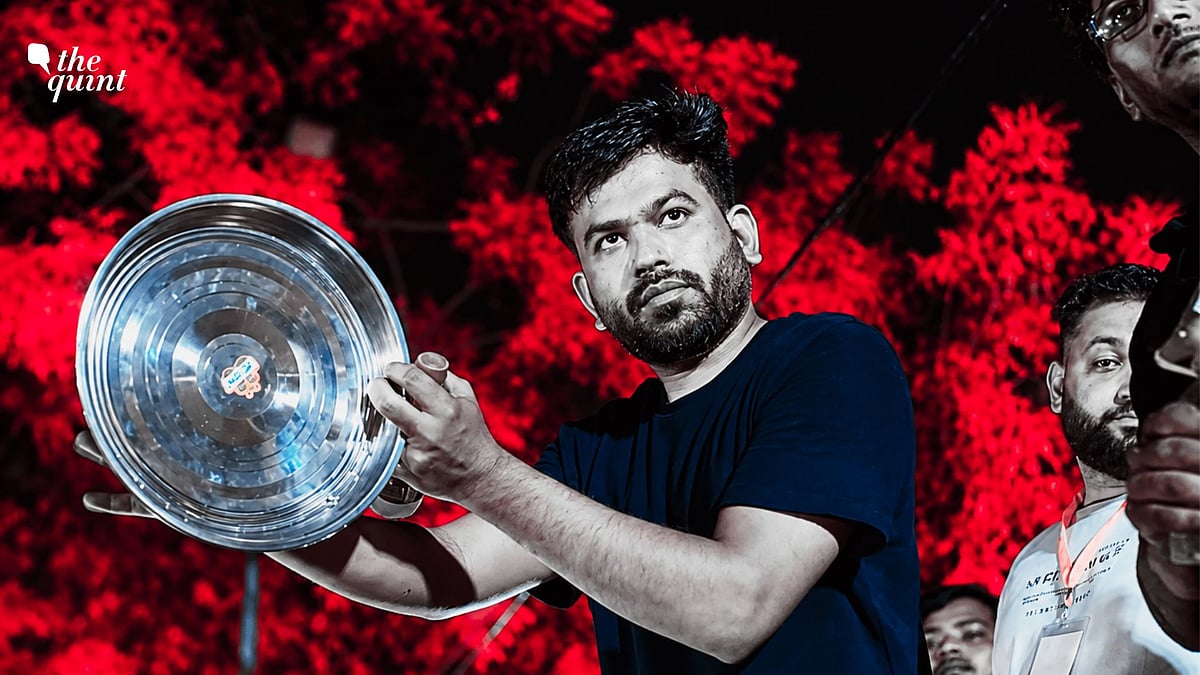
The theme of the day was the 'thaali'. A day before the demonstration, Dipke had called upon supporters to bring plates and utensils to bang, a reference to Prime Minister Narendra Modi's call during the COVID-19 pandemic.
"During the COVID-19 pandemic, a new kind of science was invented. They said bang thaalis so that the virus goes away. Let's bang thaalis now so that Pradhan goes away," Dipke said from the stage, prompting loud cheers and a chorus of steel plates striking the ground.
Like the 6 June protest, the crowd largely comprised student activists, volunteers, content creators, media personnel, and members of student organisations such as like Students' Federation of India (SFI) and All India Students' Association (AISA)
For much of the afternoon, there was little to suggest the day would unfold differently from the demonstrations the CJP had been organising over the previous two weeks. The movement had consistently stressed that it would remain within the bounds of the law. Dipke's announcement of an indefinite sit-in changed the air.
A Calculated Tug of War
When Dipke declared the extension of the protest, he called upon CJP supporters and students in other cities, as well as parents, teachers, and students from across Delhi, to reach Jantar Mantar by 6 pm.
"I am appealing to all the cockroaches, and parents and teachers from Delhi to come and join us at Jantar Mantar. We will stay put for as long as we can, but we will not be able to pull this off unless we have your support," Dipke said.
Closer to 5:00 pm, the first signs of pushback began to emerge. Police personnel repeatedly announced that protesters would have to vacate the premises. CJP volunteers and supporters, meanwhile, moved closer to the main stage, forming a tighter circle around Dipke as he continued appealing to the police to extend permission for the sit-in.
(Photo: Deeksha Sinha/The Quint)
CJP spokesperson Saurav Das, meanwhile, held several rounds of discussions with police officials. By 6:00 pm, electricity connections to the protest site had been suspended and protesters alleged that the entry of food and water had also been blocked.
By then, most of the ordinary protesters had already left. Dipke's call for Delhiites to join the demonstration failed to surge the numbers. On the contrary, they only dwindled.
Taking the microphone once again, Dipke directly appealed to the police personnel present.
"Sir, I appeal to you to let water be allowed inside at least. Would you block access to water if these were your children?"
Soon after, a notice declaring the protest illegal was put up by the Delhi Police.
By 7:30 pm, repeated attempts by CJP leaders to secure permission for an extended sit-in had failed.
(Photo: Deeksha Sinha/The Quint)
By 9:00 pm, around 100 protesters and several media personnel remained at the site, still waiting to see whether the demonstration would be forcibly ended. The crowd had shrunk further, comprising a handful of CJP volunteers, members of student organisations like SFI, AISA, Jawaharlal Nehru University Student's Union (JNUSU), and media personnel.
Yet, conversations with police personnel through the evening suggested that the use of force was unlikely. After several hours, electricity was restored. Access to food and water resumed. The movement of media personnel and members of the public in and out of the site also became largely unrestricted.
By midnight, those who remained were dancing to songs from 'Rang De Basanti'. By 1:30 am, Dipke asked those present to get some sleep, saying there was a "long struggle ahead".
Escalated Challenges
The CJP protest has entered a new phase. Dipke spent most of the early hours of 21 June appealing to supporters from other states to travel to Delhi and join the sit-in at Jantar Mantar.
For nearly two weeks, the BJP has largely avoided direct confrontation with the movement. Senior party leaders have mostly stayed away from the issue. RSS spokesperson Sunil Ambedkar has described the protesting youth as "patriotic", a story that was
There has also been little sign of the kind of aggressive political as well as online pushback that often accompanies movements perceived as a serious threat. The events at Jantar Mantar on 20 June appeared consistent with that approach.
(Photo: Deeksha Sinha/The Quint)
Critics of the CJP have long argued that the movement would have to raise the stakes if it hoped to force a political response. By declaring an indefinite sit-in in the national capital, it has attempted to do exactly that. Yet after several rounds of protests across cities, including two in Delhi, the question confronting the movement remains largely unchanged.
The conviction of those turning up at demonstrations cannot be denied. But to what extent can stakes be raised if on-ground mobilisation continues to remain a challenge?
- Access to all paywalled content on site
- Ad-free experience across The Quint
- Early previews of our Special Projects
Published: undefined