
Cockroach Janta Party’s Protest in Delhi: Strong Debut but No Clear Strategy Yet
Cockroach Janta Party’s first protest drew hundreds and vivid symbolism, but ended politely on schedule.
advertisement
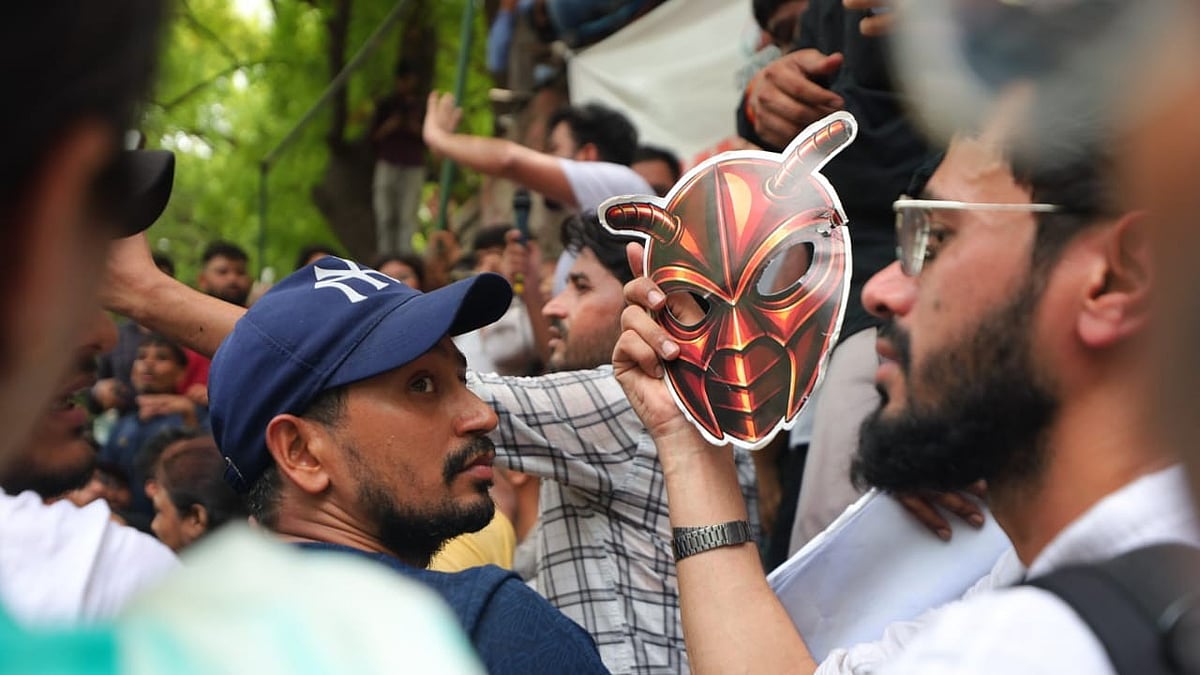
On the morning of Saturday, 6 June, Jantar Mantar in Delhi looked, for a moment, like a Hindi film set. Young men and women in cockroach masks threaded through the crowd, carrying flowers. Placards demanding resignation of Education Minister Dharmendra Pradhan were everywhere. There were big barricades and massive police and security presence.
This was the Cockroach Janta Party's first public protest, and while there are many ways in which one can describe it, forgettable is not one of them.
The crowd was several hundred strong, bolstered by student outfits such as AISA (All India Students' Association) who had mobilised their networks in the days preceding the protest.
There was genuine anger in the crowd, and genuine solidarity.
But by late-afternoon, the protest was winding down. The mics had gone quiet, the student union leaders were filtering away, and the crowd was dispersing in the easy, unhurried manner of people who know they have somewhere else to be.
The CJP then announced that the protest was over for the day and next course of action will shortly be announced.
CJP Founder Abhijeet Dipke addressed those who had gathered.
(Photo: The Quint)
A Protest That Wrapped Up On Schedule
The most uncomfortable question the CJP's organisers must answer is that if your demand is that a cabinet minister resign, why did your protest end before he had finished his Saturday evening?
Ministerial resignations do not happen because a crowd gathered for a few hours and then went home. They happen if the cost of not resigning becomes too high to bear. That cost is built through sustained, visible, inconvenient pressure. A protest that wraps up on schedule, causes no disruption to the normal rhythms of governance, and generates no lingering discomfort is, from the government's point of view, the easiest possible form of dissent to absorb.
The Farmers' Protest of 2020-21 is the clearest recent example of how this works. Hundreds of thousands of farmers came to Delhi's borders and stayed, through winter, through heat, through lathicharge and legal challenge, and through the deaths of over 700 people. They camped at Singhu, Tikri, and Ghazipur borders for over a year.
For thirteen months, the government could not make them go away, and eventually, it was forced to repeal the three farm laws they had come to oppose.
A protester hold up a copy of the Indian constitution.
(Photo: The Quint)
But the question of what kind of protest you are running cannot be deferred forever. If the movement is serious about Dharmendra Pradhan's resignation, even a small, rotating indefinite sit-in would have said something very different from a protest that dissolved before dinner.
Too Polite for Its Own Good
The CJP's organisers had done their paperwork. The required permissions had been obtained. Delhi Police's guidelines for assembly at Jantar Mantar were followed carefully. There was a designated area, a designated time, a designated end.
Everything was, in the official sense, correct.
Allowing the protests to run smoothly then, perhaps, was a calibrated response from the administration and the government.
The point, however is this: the Constitution, under Article 19, guarantees every citizen the right to assemble peacefully and without arms. The administrative requirements that govern protests at Jantar Mantar, the permissions, the timelines, the cordoned space, are rules set by the state, not rights granted by the Constitution.
They are instruments of control. There is nothing wrong with following them. But when a movement follows them so faithfully that it never once makes those in power uncomfortable, it has, in effect, handed the government the keys to its own containment.
When the Supreme Court intervened at Shaheen Bagh, the protesters engaged with the legal process even as they refused to leave. When farmers were challenged in court, they responded with careful legal arguments. Being peaceful and being inconvenient are not opposites. A demonstration that is easy to ignore will be ignored.
Promise Without a Plan
The CJP drew several hundred people to its first protest, brought together student unions, named a specific target, and did all of this with enough imagination to put cockroach masks and flowers in the same frame. This is no small feat by any standard.
One key demand of CJP is resignation of Education Minister Dharmendra Pradhan.
(Photo: The Quint)
But history offers warnings about what happens to movements that catch fire briefly and then burn out.
The CJP's first protest ended too soon. Its speakers needed more fire. Its strategy needs more ambition. These are not fatal flaws in a movement this young but they are real, and worth saying aloud, because movements that cannot see their own weaknesses do not tend to last long enough to fix them.
The young people in cockroach masks who filled Jantar Mantar on Saturday deserve to be taken seriously. Whether their movement is prepared to take itself seriously enough, to plan better, to stay longer, to be willing to cause genuine discomfort, is a question only they can answer.
- Access to all paywalled content on site
- Ad-free experience across The Quint
- Early previews of our Special Projects
Published: undefined