
CJP's Success Will Come Down to 1 Factor; it's Not Dharmendra Pradhan
There is anger among the youth. CJP's main challenge is to convert it into political change.
advertisement
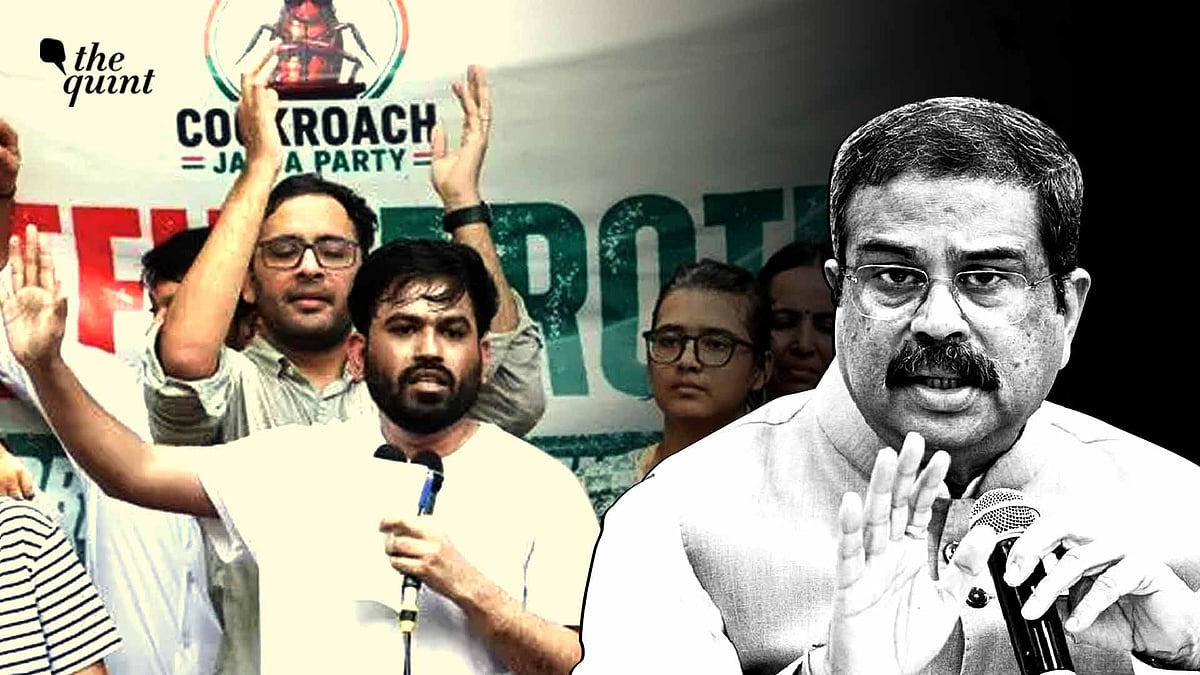
The Cockroach Janta Party has intensified its agitation demanding education minister Dharmendra Pradhan's resignation. After holding public meetings across different cities, they have now launched a sit-in protest at Delhi's Jantar Mantar.
However, this piece will argue that the CJP's political success won't eventually be decided by what happens to Pradhan.
So what will decide the CJP's success? We'll come to that in a bit. First, the education minister.
Why Dharmendra Pradhan isn't a Factor
No doubt, Dharmendra Pradhan is a perfect target for any outfit that opposes the government at the moment. Being the education minister, he is being held responsible for the alleged paper leak of the NEET-UG Examination and the flaws in the CBSE's On Screen Marking System, among other complaints.
According to CVoter's survey from the last week of May, 45 percent people hold the education minister solely responsible for the NEET-UG paper leak. Among those between 18 to 34 years, it is over 50 percent. The other options given were "NTA", "coaching centre networks", "students and parents looking for leaked paper" and "All of the above".
But it's not just the recent leaks.
Earlier this year, Pradhan had become a target for upper caste groups and students because the UGC rules on caste-based discrimination.
This earned him the ire of even sections within the pro-BJP ecosystem. One right wing influencer Ajeet Bharti even put out a video recommending that Pradhan be removed "physically".
There are two possibilities here. The BJP would want to give CJP a tactical win so that it emerges as a force that can add to the competition in the Opposition space.
Second, the BJP wouldn't want to appear weak and give even a small win to any Opposition force.
In either case, Pradhan's fate is entirely in the hands of PM Modi and Amit Shah. It cannot be a marker of the CJP's success or failure.
So What Will Decide CJP's Success?
Only one thing will decide whether CJP is a success or a failure: the extent to which they can turn one particular section away from the BJP for the 2029 Lok Sabha elections. These are young voters who voted for BJP in 2024 and voters hailing from pro-BJP families who will be casting their first vote in 2029. They could vote for anyone: the Congress, AAP, any other Opposition party or the CJP should it choose to form a party. But the CJP's success will be shaped by their ability to wean this vote away from the BJP.
This may sound simple enough, but it isn't.
Anger over paper leaks and education scams seldom shapes elections. Even a scam as big as the Vyapam Scam didn't really dent the BJP's dominance in Madhya Pradesh. Even when the BJP lost in 2018, agrarian woes and caste polarisation played a far more important role than the Vyapam scam.
Forget leaks, even unemployment doesn't shape electoral outcomes. Inflation does, agrarian distress does, but not unemployment. In some cases, unemployment creates conditions for caste-based reservation agitations such as the quota stirs by Jats, Marathas and Patidars. But the unemployed seldom mobilise at a large scale, cutting across community lines.
So not everyone who is upset about paper leaks will vote against the government three years later.
There is Dissatisfaction Among the Youth
Except the recent Bengal Assembly election, the BJP has tended to be comparatively less popular among younger voters (18-25 years) as compared to older voters. This is a trend from the last three years. Older voters tend to be much more pro-BJP.
For instance, only 32 percent of people above 55 years solely blamed the education minister for the NEET mess, compared to 51 percent among the 18-24 years age group and 57 percent among the 25-34 years age group, according to the CVoter survey.
In the 25-34 years age group, it was 25 percent "very hopeful", 6 percent "somewhat hopeful", 13 percent "somewhat anxious" and 48 percent "very anxious".
In contrast, in the 55+ age group, 42 percent replied "very hopeful", 11 percent "somewhat hopeful", 12 percent "somewhat anxious" and 19 percent "very anxious". Remember, this is how they think the youth feels, not how they are feeling themselves. In all likelihood, the sentiment would have been even more positive among this age group.
Even on an issue unrelated to education, younger voters tend to show more dissatisfaction with the government.
According to CVoter's survey on India's resonse to the US killing of Indian sailors, 54 percent respondents in the 18-24 age group said "India should have responded more strongly" as opposed to 33.5 percent who said the government's response was appropriate. Contrast this with those above 55 years of age: 48.4 percent said India's response was appropriate while 42.5 percent said it should have been stronger.
What Does This Mean for CJP?
PM Modi and Amit Shah take youth centered mobilisation very seriously and they will do anything to ensure that it doesn't harm the BJP electorally. Read this article on how they have used a combination of four strategies: crush, co-opt, divide and delegitimise against anyone with the potential to mobilise the youth, from Hardik Patel in Gujarat to the anti-CAA protesters in Assam as well as elements within Opposition parties. Their overall aim is to make the youth conclude that there is no option except for the BJP.
This is the gap that the CJP will need to fill.
Can it convert the youth's anger into intent for political change?
Can they sustain the mobilisation for the next three years?
Or will they end up like one of the many moments we have seen in the past 12 years, of sporadic events that gave hope to anti-BJP forces without leading to any substantial change?
One of the BJP's main successes under PM Modi and Amit Shah has been its ability to convert floating voters to committed voters and committed voters into "vote influencers" for the party. "Vote influencer" means someone who isn't a member of the BJP but tries to influence others in favour of the party, by pushing its message offline or online.
Now, this is not to say that the burden of defeating the BJP lies with the CJP alone. It lies with the Opposition parties, especially the largest among them, the Congress.
The problem for the Opposition is that while they succeeded to a great extent in 2024 in uniting the anti-BJP vote through the INDIA alliance and the 'save the Constitution campaign', they had only limited success in weaning away BJP voters. The biggest vote-share shifts of over 10 percentage points happened in states like Himachal Pradesh and Uttarakhand where the BJP had peaked in 2019 due to the Pulwama attack and Balakot strike.
To turn youth dissatisfaction into intent for change, the CJP would need a sustained mobilisation over the next three years. The CJP has certain advantages, being a campaign with its roots in satire. It grabs attention and has bursts of virality. It is difficult for the government to suppress. Political parties with concrete ambitions and protest movements with a fixed set of demands also have an element of predictability to them. A campaign based on satire doesn't have many of those restrictions. The trick for the CJP is to retain the innovation and unpredictability that made it viral in the first place.
Put simply, they have to be more 'cockroach', less 'party'.
- Access to all paywalled content on site
- Ad-free experience across The Quint
- Early previews of our Special Projects
Published: undefined