
Mob Attacks, Then Rustications: Kolkata Campuses Face Brunt of Saffron Politics
As violence becomes a regular occurence, many say there's a playbook at work across Bengal's "progressive" campuses.
advertisement
Debnath (name changed), a student at Kolkata's Presidency University, was sifting through books at a makeshift bookstall near the campus late 18 November evening when he felt a commotion rise.
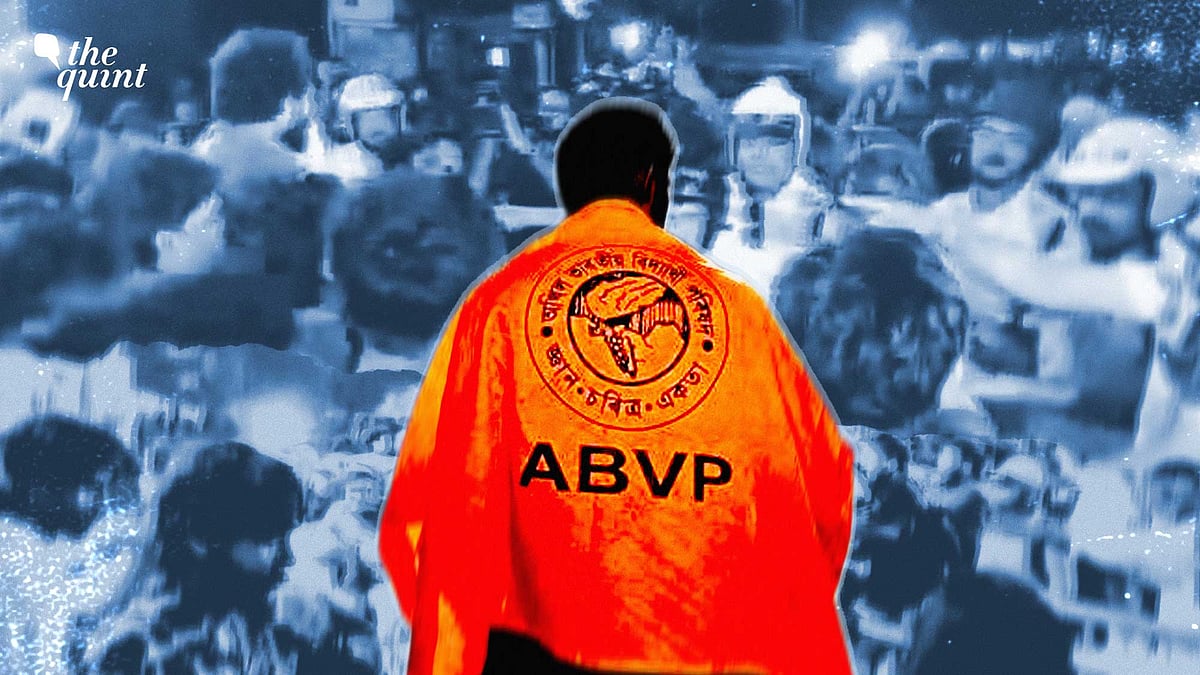
Scores of members of the Akhil Bharatiya Vidyarthi Parishad (ABVP)—the purported student wing of the Bharatiya Janata Party (BJP) and the Rashtriya Swayamsevak Sangh (RSS)—appeared carrying flags and began attacking the bookstall.
The said bookstall was put up by the Student Federation of India (SFI) at College Street. “ABVP members were lobbing 'chocolate bombs', bricks and eggs at the bookstalls. Eventually, someone hurled a lit-up crude bomb, probably a Diwali leftover,” Debnath recalled to The Quint.
Students like Debnath have been cautious since the expulsion of two women students from Presidency University’s Sociology Department for allegedly writing on a political poster by the ABVP.
“The authorities are increasingly leaning toward the ABVP and targeting students of other political or even apolitical moorings,” he added.
On the same night, violence was unfolding just a few kilometres away at the state-run Kolkata Medical College (KMC). A mob—consisting of ABVP members, among others—was allegedly attacking the campus and vandalising property. At least eight students, who did not wish to be identified, sustained injuries.
In the past year, especially since the BJP came to power in May 2026, colleges and universties in Kolkata and other parts of West Bengal, have undergone a drastic change. With political violence becoming a regular occurence, many say there's a playbook at work across the state's "progressive" campuses.
As Olivia Banerjee, a post-graduate scholar at Presidency University, said,
The difference perhaps is that the weight of the government is now fully behind the right-wing student ecosystem.
Medical Students Under Scanner
Days after violent clashes between Left groups and ABVP members on the Jadavpur University (JU) campus in August made national headlines, Chief Minister Suvendu Adhikari made his stance clear at a rally organised outside the university gates. Lauding the ABVP for their "good work across universities in India like Jawaharlal Nehru University", he said, "JU is still left... this too shall be done."
The CM also led a rally, including troops of Naga sadhus outside the JU gates, in defence of Hindu samaj (society) and "sanatani" pride.
It's not surprising then that the JU incident was only the first in a series of similar violent episodes that have followed since at SRFTI (Satyajit Ray Film & Television Institute), Presidency University, and now KMC.
On 18 October, a day after a stampede broke out at a Durga Puja pandal in Chorbagan, leaving at least 21 people dead, junior doctors and interns at KMC held a press conference. Speaking to the media, they alleged shortages of essential supplies at the college hospital—including drugs like tranexamic acid (that helps stop active bleeding), syringes, and clot vials. They also questioned why critically injured victims were transferred to a private facility after initially being brought to KMC's emergency ward.
"There were around 13 victims brought here," an intern, who was on duty that night, told The Quint.
On an average day, three interns are posted in the general emergency ward, and two each at orthopaedics emergency and surgery emergency. "That day we had more than 40 interns in general emergency to treat patients. Interns of all departments—be it from psychiatry or surgery, orthopaedics or general emergency—everyone came to the aid of the patients," he said.
The press conference by interns and junior doctors was called to raise exactly these concerns. However, they allege that instead of addressing the issues, the authorities clamped down on them.
In the coming days, eight junior doctors received show-cause notices. The notices, signed by the college principal, alleged that the interns were absent from their assigned duties and questioned them on why they spoke to the media without following prescribed rules.
The order also cited an inquiry committee report which reportedly said that tranexamic acid was available on that day in the emergency ward.
A month after the press conference, the standoff between students and college authorities escalated further on the night of 18 November when junior doctors were allegedly assaulted by a mob, consisting of persons from ABVP, the RSS, and National Medicos Organisation (NMO), the latter having links with the RSS.
According to eyewitnesses, interns had gheraoed the principal's office, demanding withdrawal of the show-cause notices. Around 7:30-8:30 pm, around 70-80 alleged outsiders entered through Gate 1 and smashed windows of the administrative building.
Rashi Nanguli, an intern at KMC, was on duty when she got a call from her co-interns, informing her of the situation.
Naguli and other students approached the principal's office and told him about the mob outside. “We told him the students were under attack, and requested him to stand with us. But he reacted casually, saying he had informed the police, and that there was nothing more he could do.”
Another intern Shaswata, who's a member of the KMC Union, echoed Naguli, alleging that the principal remained "non-committal".
When The Quint reached out to the principal, he refused to comment. Denying the allegations in a press conference the next day, ABVP alleged that Left students attacked its unit secretary Apurba Roy and damaged the principal's chamber.
A suo motu case was filed by Kolkata Police at Bowbazar Police Station, however no arrests have yet been made. Besides, five persons, including three KMC interns, received summon notices under the Bharatiya Nagarik Suraksha Sanhita (BNSS) to appear at the station, including three KMC interns. Police have withheld the identities of the other two individuals and their potential links to the ABVP.
Meanwhile, Health Minister Sharadwat Mukherjee has ordered a three-member inquiry committee to look into the incident.
CM Adhikari, too, said his government is "watching", and that they "will not tolerate hooliganism in hospital".
Rustications in Presidency, SRFTI
In the face of growing Hindutva influence on college and university campuses, students of Presidency University marched in protest on 13 October, only to face a similar crackdown.
Less than a month later, at least two women students were expelled from the university on 6 November for writing “rapist" and "casteist" on an ABVP recruitment poster, pasted on campus. The poster also bore an image of Swami Vivekananda.
The students, who run an academic-political collective called Rerouting the Field, working toward simplifying academic jargon, alleged that the reason for writing the expletives was "rooted in the ABVP’s rhetoric of violence on campus".
“Since the BJP's electoral win in May, they have become extremely assertive. Those who dissent against them, our comrades and other students, now face regular threats of violence, including rape threats,” Olivia, who's one of the two expelled scholars, told The Quint.
The other student, who wished to remain anonynmous, said she had not even written on the poster but was just standing nearby.
According to Olivia's account published in The Telegraph last year, a student associated with the ABVP from outside the campus attended a general body meeting of Presidency students on 25 December. During the meeting, he argued that Muslim faculty members should not teach at the institution due to its origins as a "Hindu college," and reportedly made further communal remarks when confronted by attendees.
"We objected to it. Since then, some of us have been their target," Olivia claimed. She further adds:
When contacted, the Presidency administration refused to comment on the matter. Sources within staff, however, confirm that "action has been taken as a disciplinary measure, and not to target anyone individually."
In a similar vein, students of the SRFTI have been on protest for nearly two months following "violent clashes" between students and members of the Akhil Bharatiya Grahak Panchayat, a right-wing consumer forum with links to the RSS, on 27 September.
For students like Nachiket Shashikant Pawar, originally from Thane, Maharashtra, the ongoing protests against “saffronisation of campus spaces” and for freedom of speech and dissent have come at a personal cost. Six of the protesting students, including Pawar, have been rusticated for two semesters.
Another student, Shubham Waydande, now faces an FIR for violence and vandalism, following a complaint lodged by the SRFTI administration. Waydande was summoned to Panchasayar police station and issued a notice to cooperate with the investigation.
"We are working with the administration regarding incidents of violence on campus," a Panchashayar police official told The Quint. When asked about the complaints by students against mob violence, the cop said, "Yes, we are looking into all aspects."
Speaking to The Quint, SRFTI Vice Chancellor Santosh Ajmera stated that the administration has taken action based on recommendations from the Dean Council, to protect the safety of the varsity’s 500-strong students.
On 16 October, the administration issued a notice ordering students to empty the campus and hostel premises within 24 hours for an “extended” off till 13 November.
“We declared a one-month-long holiday for Durga Puja and Diwali combined," Ajmera said. In previous years, the institute has remained closed for about a week or so during Durga Puja, and then again for 3-4 days on Diwali. Even then, the campus remained open as many outstation students did not wish to travel back.
Outstation students who spoke to The Quint said that such an “eviction notice” has been extremely distressing for the students and their families.
While on "leave", several students, including Meghraj Oraon, a student who sustained injuries to his back during the right-wing violence on campus, was among those sent a show-cause notice by the administration.
"It is a joke that those who got injured are now being investigated based on complaints from the other side," Oraon, who has not returned to campus yet, said.
Students further allege that the administration, led by Ajmera, is using the police to “intimidate students” despite the peaceful nature of protests. Ajmera instead told The Quint that the police had been deployed on campus after a recent "mashal march", wherein students walked with firelit torches to call for the VC's resignation and revocation of action against students.
“The administration doesn’t have anything against the peaceful protest. We have clarified this multiple times. But intimidation of this kind where around 50 students with torches are marching, and carrying out targeted sloganeering late in the evening, especially in the residential area where faculty and staff are living, is completely unacceptable,” he said.
Students like Pawar, however, offer a contrarian point of view.
Changing Campus Politics
SFI West Bengal State Secretary Debanjan De told The Quint that the decline in education under the Trinamool Congress (TMC) has been aggravated under the Adhikari-led BJP government.
“Earlier, union rooms were turned into hangouts for criminals. The BJP has continued the same culture. Campus violence has spread, and its brutality has intensified. The CM himself is threatening to capture campuses in 'two minutes'. Meanwhile, ABVP leaders have been appointed to the governing bodies of 380 colleges without any elections,” he said.
De further alleged that SFI members across campuses in West Bengal were facing physical attacks and administrative bias.
However, he added that the BJP's rise to power and the subsequent escalation in attacks had triggered greater student polarisation, helping the SFI expand its organisational presence. He said the organisation had established new units in nearly 100 institutions across the state.
Swadhin Haldar, the ABVP's Kolkata Secretary, rejected all of De's allegations, saying:
Apart from Adhikari, his party members and leaders have at times spoken in two voices about the issue.
BJP leaders like Shamik Bhattacharya and Swapan Dasgupta in October crtiticised the attack on bookstalls during Durga Puja. Dasgupta even spoke against targeting of universities like JU. Bhattacharya had also said at the time that ABVP was not the BJP's students' wing.
According to a journalist who has covered education for 15 years, the BJP believes that the syllabuses under both the Left and TMC regimes produced "ideological Naxals". It now wants to overhaul the course materials.
"While the TMC-era curriculum had plenty of room for criticism, it was relatively inclusive in its representation of different ethnic and religious communities. The government has already begun replacing Rabindranath Tagore’s poem Africa with the biography of Shyama Prasad Mookerjee. According to my sources, several more changes are in the pipeline,” the journalist added.
Besides the curriculum, he explains that campus clashes and a shift in political power took place in 2011, too, when the Left government was voted out and the TMC came to power. But that transition was driven from within the campuses.
"This time, the ABVP appears to have little grassroots support on campuses. Instead, it is trying to establish its dominance by attacking campuses from outside, intimidating students, and creating an atmosphere of fear and pressure. Even after six months in power, the ABVP has managed very little street mobilisation. Their visibility and purported rise has come at the cost of students' freedom of politcal expression," the journalist noted.
(Soumo Mondal is an independent journalist reporting on news and politics in West Bengal.)
- Access to all paywalled content on site
- Ad-free experience across The Quint
- Early previews of our Special Projects
Published: undefined