
'We Will Take Back What is Ours': Hindutva is Moving Out of the Fringe in Bengal
Right-wing groups have stepped up their activities, with recruitment rising and the number of branches growing.
advertisement
Six months into Suvendu Adhikari's tenure, West Bengal is witnessing shifts across its political, social, and cultural landscape. Follow The Quint's Bengal's Saffron Turn for in-depth coverage of these shifts. Become a member to power our ground reports.
"Wherever there is injustice, the Vishwa Hindu Parishad (VHP) and the Bajrang Dal will be present,” Raja Pramanik, a resident of Kulpi in West Bengal's South 24 Parganas district wrote while posting a on Facebook on 9 September.
The video shows Pramanik, along with a group of men—some wearing saffron sashes—marching towards a home in Patkelberiya village and accosting the people inside over allegations of forced conversion. They are seen threatening the women inside, accusing them of conducting an illegal prayer meet.
“Some jihadis of the Christian religion were trying to convert our Hindu religion to the Christian religion. Members of Kulpi VHP and Bajrang Dal stopped it," he writes in the caption. In the video, he and the others can be heard saying, “We will not tolerate such filth in Hindu samaj. If you want to pray to Jesus, you can do so in private. If anyone else comes to join the prayers, we will not tolerate it...“
When contacted over Facebook and mobile, Pramanik, who regularly shares posters of the VHP, Bajrang Dal, and the Rashtriya Swayamsevak Sangh (RSS) events, recruitment flyers, as well as messages regarding preservation and "awakening" of Hindus in Bengal with communal undertones, conceded that he was part of the right-wing groups' Kulpi unit. But when probed on the work the group does, the responses stopped.
In the past six months of Chief Minister Suvendu Adhikari forming the first Bharatiya Janata Party (BJP)-led government in West Bengal, instances of similar raids and attacks on those following the Christian faith have risen across the state.
With a partly RSS-backed BJP leadership in Bengal, this rising visibility of saffron groups is perhaps an expected consequence. A closer look, however, reveals that while the groups have become more active now with rising recruitments and proliferating branches (as well as a host of new groups), the Sangh has been quietly (and sometimes not as quietly) laying the groundwork for Bengal’s rightward turn for years.
Targeting Christians to 'Normalise' Communal Vigilantism
Since May, the India Hate Lab has documented 60 cases of church raids and attacks on the Bengali Christian community. Bengal's apex Christian body, Bangiyo Kristiyo Samaj, meanwhile, told The Quint they had noted at least 50 reported cases. The non-profit organisation has enlisted a number of videos and photos of these incidents, many of them posted by those carrying out the raids, like Pramanik, or by pages linked to the VHP, Bajrang Dal, or other Sangh Parivar groups.
Bangiyi Kristiyo Samaj's general secretary Herod Mullick alleges to The Quint, "FIRs have been filed in only a handful (13) of cases, adding to the impunity of the miscreants".
When asked if the Sangh condones or condemns incidents of local vigilantism, Jishnu Basu, senior functionary and spokersperson of the RSS Bengal unit, refused comment, stating that further verification was needed on the perpetrators.
Among the scores of posters scanned by The Quint on multiple Hindutva pages on Facebook, several cautioned against "love jihad" and "land jihad", and reported small-scale activities to prevent such cases at a local level.
According to political analyst Zaad Mahmood, there is a deeper purpose to such anti-Christian violence. "So far, these kind of Hindutva groups have been seen harassing Christians but not Muslims, which, I assume, is because of the higher Muslim population. By targeting Christians first, these groups are helping the government normalise communal vigilantism," he states.
The social media pages of the alleged members of the proliferating units of these once-fringe Hindutva groups in West Bengal reveal a pattern of communal rhetoric on ground, echoed at the state's highest political level by CM Adhikari himself.
On 6 October, ahead of this year's "Sanatani" Durga Puja, Pramanik posted an AI-generated image, with the VHP logo, depicting a wall painting of the words: “Those who break idols and those who make idols cannot celebrate the same festivals. Dhormo jaar, utsob o taar (a festival belongs only to those whose religion it is).
In yet another post on 7 November, after Adhikari defended the excessive bursting of crackers in Bengal during Kali Puja/Diwali as “Sanatani” and those criticising the consequent air pollution as “communist”, Pramanik wrote, taking an apparent dig at the minority: “We Sanatanis burst crackers, not bombs. We light lamps, not trains.”
Anindya Ghorai, a resident of Debra in Paschim Medinipur district, who joined the local unit of VHP/Bajrang Dal in August, tells The Quint:
Ghorai, like Pramanik, now works to organise various Sangh events, and is tasked with different duties, including recruitment. "What you see now is not sudden or unexpected. It's the result of years of porishrom (hard work)," Basu tells The Quint.
Hydra With Multiple Heads
The saffron surge in Bengal may appear like a Hindutva tsunami. But those studying the Sangh's activities in Bengal note that the current growth is the result of long years of painstaking work by the BJP’s front organisations, the symbiosis of the RSS and the BJP, the dual use of swayamsevaks, and assiduous support of the BJP’s central leadership to the state organisation of the party.
The Sangh network includes well-known bodies like the RSS, the VHP, the Bharatiya Mazdoor Sangh (BMS) as well as lesser known (and now growing) bodies like Durga Vahini (the VHP’s youth wing for women), Friends of Tribal Society (Ekal Abhiyan), Vidya Bharati (education wing), and Kreeda Bharati (sports wing), at work in rural West Bengal.
In his book Mission Bengal: A Saffron Experiment, journalist-author Snigdhendu Bhattacharya lists about 30 organisations that work in tandem with the BJP at cultural, political, economic, social, and civic levels.
“The Sangh Parivar has always had roots in Bengal, and they grew in the 2013-2020 phase as well. The difference, however, is that, before Suvendu, vigilantism could prove costly as Mamata would have jailed them. Now, they believe it’s their government in power, which means they are in power. So, they are behaving like the ruling force and calling the shots in preventing or prohibiting what they oppose," he states.
Bhattacharya states that these organisations work in coordination at local levels to create synergies and familiarity with voters, with the core intention of pushing the Sangh’s socio-political ideology "by dressing up political canvassing as social work and vice versa".
In his book, he illustrates the same with the following examples:
"On Janmashtami, the RSS's Dharmajagran Samanvay (religious awakening coordination) wing involves the students of both schools in a 'dress as Krishna' competition."
"The Rakhi Bandhan celebration in an open field in 2017 saw nearly 300 mothers of students from both schools attending. Matukeshwar Paul of the RSS's Parivar Pravodhan (family awakening) wing was the chief speaker."
"At Amtala in South 24 Parganas district, an eye camp was conducted. It was organised by Rashtra Sevika Samiti, in collaboration with Bastuhara Sahayata Samiti and supported by Amtala Nagarik Adhikar Raksha Samiti."
"In north Bengal, two outfits, named Alipurduar Ganobibaho Samiti and Sebayan Paschimbanga, worked in close coordination with the VHP and Shree Hari Satsang Samiti to organise mass weddings for the tribal people.”
Mahmood, who is also an associate professor at Presidency University, states that part of the charm of the Sangh worker, especially in rural areas, is their "ascetic, almost Spartan-like image, their stipend-based income, involvement in religious activities like pujos and kathas, and their seemingly apolotical, social worker identity, as opposed to the Trinamool or even Left party cadres."
Sociologist Ajay Gudavarthy, who has been researching the tactics of growth used by Hindutva organisations across India, states,
Older Groups Rebranded, Fresh Focus for New Groups
This year, some older Sangh groups have been rebranded and yet other have gained fresh focus.
Recently, the Akhil Bharatiya Grahak Parishad (ABGP), an RSS-linked consumer forum previously almost unheard of group in West Bengal, was engaged in violence after attempts to host a conference on the campus of the liberal film school, Satyajit Ray Film & Television Institute, led to violence. Soon after, the campus was targeted by members of the Bangiya Hindu Jagran Manch.
A Manch member had told The Quint at the time that the attack was to protest against the “desecration of Vivekananda and Bharat Mata posters” by students who opposed the ABGP event. Six students have since been rusticated from the institute following protests against the alleged "saffronisation" of campus.
The BJP's purported student organisation, Akhil Bharatiya Vidya Parishad (ABVP), previously a minority in Bengal universities, has also found more visibility, mobilising on campuses including the Left student body-dominated Jadavpur University and Presidency College. The former came under attack by ABVP members following clashes with members of student Left groups in August. More recently, two women students have been rusticated from Presidency, reportedly for writing on ABGP posters on campus.
"We were unable to set up bookstalls under the Left or the Trinamool. With the BJP in power, we have no problem setting up our stalls," a BMS member tells The Quint. Among the books being sold at the Sangh Parivar stalls are those by the BJP's parent party Jana Sangh founder Shyama Prasad Mookherjee and RSS ideologue and second sarsanghchalak MS Golwalkar.
Meanwhile, bookstalls owned by Left political parties have faced the brunt by coming under mob attack or government-led bulldozer action. Speaking about the vandalism of bookstalls, Basu avoids the question. He instead states that it’s not the RSS, but the Left that should be questioned about how much sales they made during, say, May Day instead of Durga Puja.
Subhajit Dey, a member of the non-profit, Association for Protection of Democratic Rights (APDR), states that while the activities may seem rampant, there is a pattern.
Speaking at the recently held three-day-long RSS Akhil Bharatiya Karyakari Mandal Baithak in Indore, the Sangh's General Secretary Duttatreya Hosabale highlighted the growth of the shakhas in West Bengal.
He said it has grown 150 times "since the situation changed,” referring to the change in governance in the state.
“Earlier, we faced physical opposition while holding our shakhas in the eastern state, which is no longer the case. Owing to similar opposition, we lost four dedicated workers in Tripura in the past,” Hosabale said. Biplab Roy, the RSS Dakshin Banga Prant Prachar Pramukh, later clarified Hosabale's statement that he meant 150 percent rise in shakhas.
“There were around 5,000 shakhas in May 2026. By October 2026, the number has grown to 10,000 by October 2026—and over 12,000-12,500 by November after the outreach ahead of Durga Puja," Basu says.
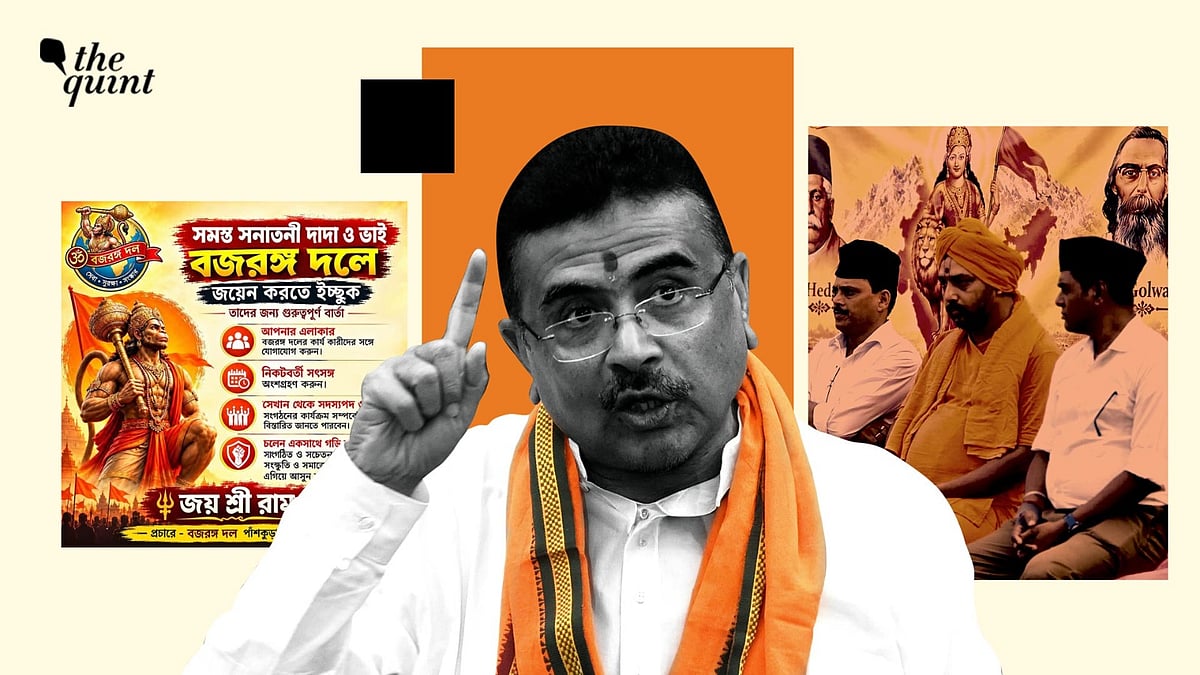
An RSS shakha event held in Khardaha, with poster depicting Hedgewar and Golwalkar.
(Photo: Special Arrangement/The Quint)
He added that the expansion was not limited to West Bengal, but part of the larger push by the RSS in its centenary year. “Not just Bengal, RSS shakhas have grown manifold in Tamil Nadu and Kerala, even without a BJP government. People are joining because they can see the work of nation-building that we do and appreciate it.”
"The moot question remains: why do the imageries of big growth come with a politics of exclusion and anxiety? The party society model of patronage networks without adequate opportunities also helped the BJP cash in through the use of force and money power," Professor Gudavarthy states.
Festivals as Site of Cultural Assertion, Communal Violence
The 2026 Durga Puja and Kali Puja celebrations under the BJP were a case in point wherein the Adhikari government attempted a dismantling of the state’s secular approach to festivals by rebranding them as “Sanatani”, including implicit and explicit calls against “experimental themes”, non-vegetarian food near pandals, “Sanatani” idols and pandals, and orders to arrest any “non-Sanatani” touching the Durga idols during immersion. Visible attempts were also made to “Navratrify” the Bengali festival.
During Kali Puja, a more subaltern celebration in various parts of Bengal was also injected with this “Sanatanism”. In Naihati in the state's North 24 Parganas district, the iconic slogan for the Boro Ma Temple was changed from the secular "Dhormo Jar Jar, Boro Ma Sobar" (Boro Ma Belongs to All Who Believe) with "Boromaye Bhakti, Sanataner Shakti" (Belief in Boro Ma is Believing Sanatan Power").
“The political messaging of these festivals revolves around a few core ideas, namely, the demographic anxiety of Hindus being overtaken by Muslims through population growth and infiltration; the anti-Hindu appeasement politics of non-BJP parties and pseudo–secularism; and the narrative of cultural and national restoration urging Hindus to unite and protect their families and culture," political analyst Mahmood states.
Therefore, Ram Navami processions, which were historically low-key in much of Bengal compared to other states, have become larger and more politically charged in the past decade.
Proponents describe this as a "reclaiming" of Hindu religious expression in public space. Opponents describe it as "a deliberate strategy" to create a Hindu identity bloc in a state where Durga Puja and other Bengali festivals were traditionally inclusive and cross-community in character.
Violence has occurred around some processions, including in Howrah and Hooghly in 2023. Both the Trinamool, then in power, and the BJP have offered different explanations for the causes, with each side blaming the other for provocation and for failure of policing.
From 2014 to 2019, analysis of news media reports shows the Sangh group, Hindu Jagran Manch (HJM), visibly involved in Ram Navami-related activities.
The event took place merely 12 days after Narendra Modi was sworn in as Prime Minister. A pracharak since 1984, Ghosh, according to analysts, was an RSS plant intended to help the with the proliferation of the Sangh’s activities. One of them was through cultural Hindu assertion through festivals.
As per a 2019 report in The Hindu from Baruipur, in 2014, the HJM provided logistical support and decided "the youth needed an icon in Bengal,” so it “decided to give the Ram Navami celebrations a push by forming celebration committees."
By 2018, the body was claiming over 20 lakh people participated in Ram Navami rallies in Bengal, including 3.0 lakh women. "Till about a few years ago, there were only a few thousand."
The Caravan, in a 2021 report, further noted that the RSS set up Ram Navami Utsav Samitis district-to-ward level, and "its sister organisations, such as HJM and VHP, were used as the face of the mobilisation drive." According to analyst Bhattacharya, groups like Bajrang Dal now have committees in nearly 325 of the 345 blocks in Bengal, barring the Muslim-dominated ones.
The Hindu 'Awakening'
From 2018 to 2021 onwards, the activities of groups such as the HJM expanded beyond festivals into sharper, moe political questions of identity. In 2018, they protested the renaming of West Bengal as 'Bangla' at Esplanade, Kolkata—calling it "an attempt to create a Bangladesh here."
In December 2018, at a rally organised by them in Kolkata, Sadhvi Saraswati said Bengal was becoming "mini-Pakistan", and that after HJM's work "nobody would be able to say that." During 2019-2020, HJM protested against alleged attacks on Hindus in Metiabruz, Kolkata, after RSS karyakarta Bir Bahadur Singh was shot.
In 2021, In East Midnapore, HJM reportedly organised Hindu Sammelans, Bharat Mata puja, bike rallies for Pulwama, karate training for girls, and relief work during COVID and Cyclone Amphan. A 2021 report by The Wire notes it had village-level committees in Nandakumar and was active in Kanthi (home of Suvendhu Adhikari) since late 2016.
The HJM put up posters across Siliguri ahead of Durga Puja, stating, “Eat biryani at a Hindu shop"; "Buy meat from Hindu-owned shops"; and "Buy puja articles from Hindu shops”.
HJM member Abhishek Das confirmed on record to the media that they “put up these posters" as they "wanted to convey a message of Hindu unity”.
He also said: "This is not a diktat but an appeal. If people support businesses run by Hindus, it will also impact the local economy."
Following the vandalism of Left-backed bookstalls in Bengal during Durga Puja, the Left Front in Darjeeling district took out a rally in Siliguri against alleged attempts to disrupt its Hill Cart Road bookstall. HJM held a counter-meeting immediately afterwards at Deshbandhu Para. Its representatives claimed opposition to the bookstall arose from Leftist "comments" that hurt religious sentiments. HJM leader Soumitra Dey claimed their protest was "democratic and peaceful".
Meanwhile, a VHP member in South 24 Parganas tells The Quint, "This is only the beginning. Hindu has awakened now. We will take back what is ours."
In spite of all this, Gudavarthy points out that one should not forget that it was a very closely fought election marred by allegations of manipulating the electoral roles.
He states,
- Access to all paywalled content on site
- Ad-free experience across The Quint
- Early previews of our Special Projects
Published: undefined