Inside Operation 'Trashi-I' and the Killing of JeM Leader Saifullah Balochi
Balochi was reportedly the leader of a heavily armed group masterminding several deadly attacks on security forces.
advertisement
The killing of dreaded militant and purported commander of Jaish-e-Mohammad (JeM), Saifaullah Balochi, in a recent gunfight in Jammu and Kashmir's Kishtwar, has come as a major breakthrough for security forces in the sensitive region.
Balochi, who had been active in the Chenab valley and the Pir Panjal regions for the last few years, was reportedly the leader of a heavily armed group, which was the mastermind behind several deadly attacks against security forces. "They were calling themselves the ‘Azrael group'," Bhim Sen Tuti, Inspector General of Police (IGP) Jammu told The Quint.
His killing is likely to deal a big blow to the organisation is likely to receive a big blow in the forested terrain. Elucidating on the "two main reasons why the operation is a major success", Tuti said,
Even after the successful operation, the forces have continued to sanitise the entire terrain to keep it free from 'terror'.
“We have eliminated this whole group, but there is still a militant presence in other districts. Nearly 20 more Pakistan-based terrorists, affiliated with Lashkar-e-Taiba and Jaish-e-Mohammad, are believed to be active in the Jammu region as part of the group," Tuti said.
Saifullah, who had entered India three years ago, was wanted for planning multiple attacks on Indian security forces, including a July 2024 assault that left four soldiers dead.
Operation 'Trashi-I'
After the abrogation of Articles 370 and 35-A in August 2019, the turf war between the forces and the militants shifted from the hinterland to the mountains and forests.
In the last five to six years, these groups have been involved in ambushing security forces and inflicting heavy damage. At least 50–60 security force personnel including Para (Special Forces) have been killed in these attacks.
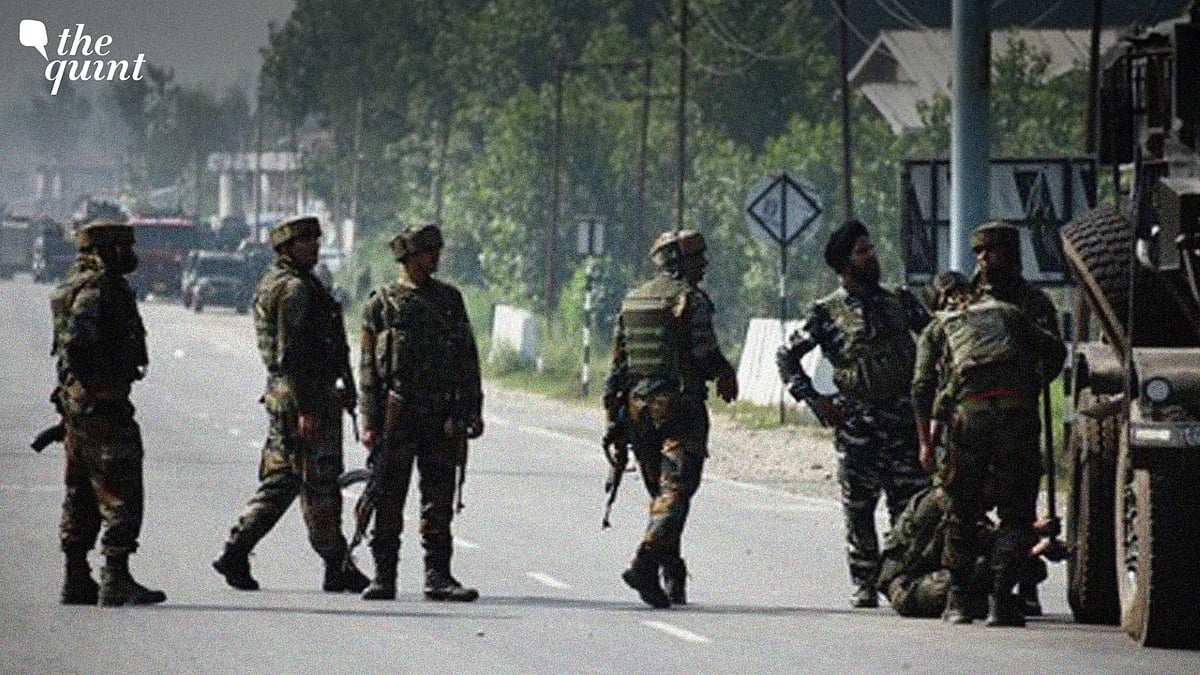
On 14 January, acting on information provided by local sources about the presence of militants in a mud house in the middle of the mountains, security forces launched an operation in the area.
Code-named ‘Trashi-I’, the operation was launched after confirmation of the presence of three Pakistani terrorists in the area. Joint teams comprising the Army’s 11 Rashtriya Rifles, Jammu and Kashmir Police, and the CRPF were part of the operation.
General Officer Commanding (GOC) of Counter-Insurgency Force Delta, Major General APS Bal, said:
Despite being hit by a bullet, the dog continued with the operation and was the first to reach near the ‘dhok’ (a local mud house). His action helped the security forces locate the hideout and neutralise the terrorists.
The injured canine was later airlifted for medical treatment, officials said. Tyson is currently in Udhampur and is reported to be in stable condition.
Months of Tracking Terror Outfits
It took 18 months for security forces to eliminate the entire group, including the JeM commander, also known by the alias Ateeq‑ur‑Rehman, hailing from Abbottabad, Pakistan. Chaudhary Mutabir Hussain—alias Farman, from Rawalakot in Pakistan‑occupied Kashmir (PoK), and a third militant, known by the code-name Huraira, whose real identity is still being verified, were also killed.
Sources in the security grid told The Quint that these militants had earlier escaped at least 17 cordon-and-search operations by taking advantage of difficult terrain, dense forests, and scattered habitation patterns that define the Chenab Valley region comprising districts like Doda, Kishtwar, and Ramban.
The Chatroo forest belt has witnessed nearly half a dozen encounters last month. An Army havildar was killed, and seven other soldiers were injured when militants hiding in dense forests opened fire on a search party in the same forest belt area of Chatroo on the intervening night of 18-19 January.
Following the successful operation, GOC Major General APS Bal issued a stern warning to anti-national elements, saying they would be identified and neutralised wherever they are.
“My message to anti-national elements is clear—anyone who is an enemy of the nation, wherever they may be and in whatever form, will be identified, targeted and neutralised,” he said.
IGP, Bhim Sen Tuti further added that there are only three local terrorists in Kishtwar district now.
“These are the same three individuals who have been active in the region for nearly two decades. During 2018, 2019 and 2020, some new recruits had joined terror ranks, but all of them have been neutralised,” Tuti said.
Chenab and Pir Panjal Remain a Tough Terrain
Former Director General of Police, SP Vaid, while speaking to The Quint, explained why the Chenab Valley and Pir Panjal range remains a long-term survival area for militants. The region’s steep mountains, deep gorges, and vast forest belts provide natural hideouts, allowing militants to move between forest compartments and high-altitude meadows, he said.
Forces nevertheless maintained that the operation will continue. "Our pursuit is long and in the coming time, we expect more successful operations. This fight will continue until the entire terror network is completely dismantled," IGP Tuti said.
Defence experts, however, remain skeptical.
“While the operation is a tactical success for security agencies, the Chenab Valley continues to be challenging due to its difficult terrain and new infiltration patterns. Security forces have intensified patrols and surveillance to prevent militants from regrouping,” an expert said.
Experts also pointed out that the purported Overground Workers (OGWs) militant support networks, which provide food, shelter, and help with communication, play a key role in militant survival, especially in these regions. Without dismantling them, it is very hard to control militant activity.
(Muhammad Mukaram is an independent journalist in Kashmir.)