
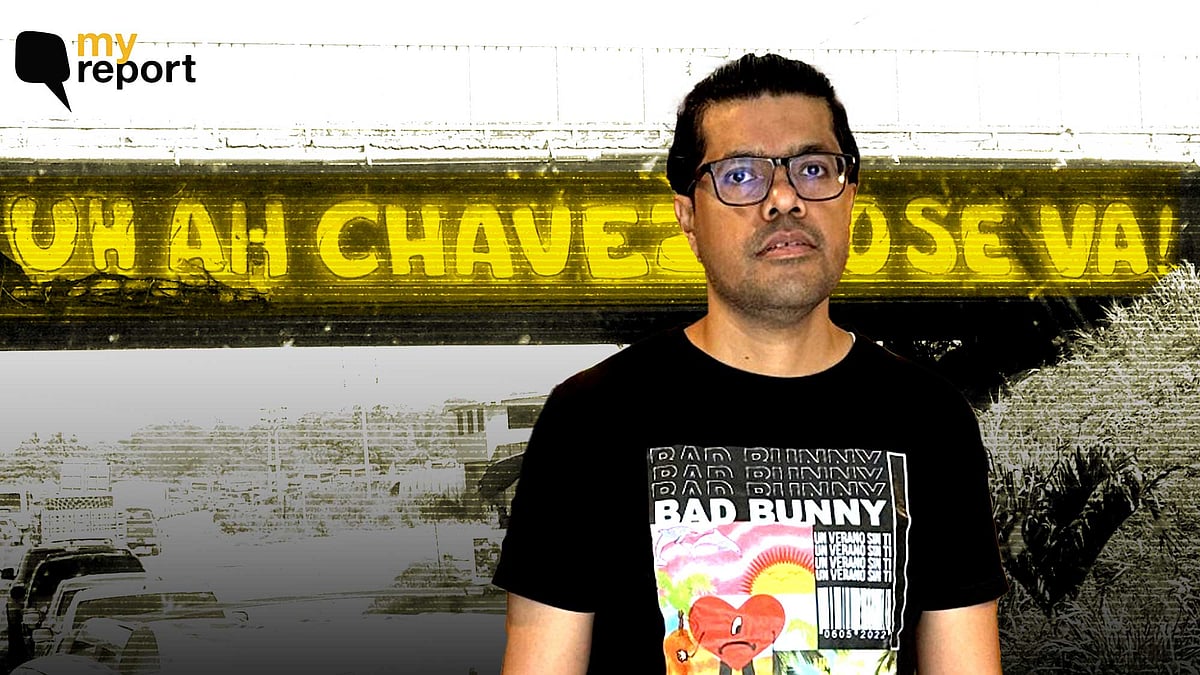
'Big Brother is Watching': How My In-Laws Survived Dictatorship in Venezuela
In the dark years of Chávez and Maduro's rule, many Venezuelans, mostly youngsters, abandoned their homeland.
advertisement
Just after reports of another street protest in 2014, I remember the call with my former mother-in-law, Mirta Navas, a Venezuelan citizen.
I was back in India, newly married. She asked when I'd come back to Venezuela to see her. I said, half joking, “Maybe when [Nicolas] Maduro steps down.”
She replied, “Si Dios quiere” (if God wills), and started laughing—not out of humour, but because it felt like the most impossible joke in the world.
Vaibhav Wankhede with his former mother-in-law Mirta Navas.
(Photo Courtesy: Vaibhav Wankhede)
A billboard of Hugo Chávez’s eyes in Caracas.
(Photo Courtesy: X)
Maduro's Violent Rise to Power
I was married to a Venezuelan woman for 11 years. Hailing from Maracay, one of Venezuela's most important cities, she had just moved to India in 2014. That year, her hope for change met brutal reality.
From the cold-blooded highway murder of former Miss Venezuela Monica Spear to the surrender of Opposition leader Henrique Capriles and Maduro’s claim of election victory, all of it added fuel to the fire that had already been burning over hunger and hyperinflation.
Young students and ordinary citizens poured into Caracas and other cities in protest. The response was ferocious. Back in India on our WhatsApp family group, we were watching videos of brutality unleashed by the Guardia Nacional (National Guard) tanks rumbling into crowds of fleeing demonstrators, unleashing tear gas, rubber bullets, and officials beating people indiscriminately.
A Downhill Trajectory
The economy was crashing. By 2015-16, price controls and subsidies fuelled a destructive black market. Societal collapse was imminent—and every man was for himself.
Las Delicias Zoo in Maracay had to shut down because if there was nothing for the population, what would they feed the animals?
Billboard graffiti with a call to save Las Delicias Zoo in Maracay.
(Photo Courtesy: Vaibhav Wankhede)
By 2017, Venezuela’s inflation rate had topped one million percent, effectively wrecking the economy. We'd send our family money through illegal remittances due to the unstable currency.
Every month, that money bought less and less food.
In 2019, my father-in-law was diagnosed with last-stage cancer. My mother-in-law had to buy syringes and bandages because the hospital had none. She herself was a patient of acute fibromyalgia, and was also impacted by a lack of medicines.
Graffiti in Caracas which roughly translates to "No way, Maduro isn't going anywhere".
(Photo Courtesy: Vaibhav Wankhede)
Dolar Paralelo (parallel dollar) was the default currency value—and the exchange rate on the streets was 20 times higher than the official exchange rate.
The global price plunge in oil didn’t help. Even during the boom years, Venezuela never saved for a rainy day. Chávez and his “socialist policies”— which were nothing but nationalisation of everything and bringing his military friends to run public sector companies—had already cost over $1 trillion in losses.
My former wife would reminisce about her childhood, saying:
That was until Chávez came in—and changed the country's name from Venezuela to Republico Bolivariano de Venezuela (Bolivarian Republic of Venezuela), in a bid to appropriate Latin America's most famous freedom fighter Simon Bolivar.
A paradox grew glaringly clear: the ruling class was enjoying luxury lifestyles abroad.
In 2017, journalists and citizen activists began exposing the lives of the Bolivarian bourgeoisie, noting how Chávez and Maduro’s children lived overseas—indifferent to shortages at home. Their Instagram posts went viral among Venezuelans: luxury cars in Miami, Christmas dinners in Europe, and multiple designer bags.
Caracas bus terminal.
(Photo Courtesy: Vaibhav Wankhede)
Bolivarian Symbolism vs Political Reality
Mirta once sent me a video of someone in a shop, supervising the customers. CCTV cameras didn’t function because of frequent power cuts, and people used to shoplift. The inflation reached such dizzying heights that for a carton of eggs, the price was different in the morning and in the afternoon—in the very same shop.
The Maduro regime launched the CLAP food boxes, containing monthly handouts of rice, pasta, oil and other staples. They were stamped with Chávez’s face, and distributed by pro-government committees, often to party loyalists first. If you were tagged as being part of the 'opposition', you could go hungry.
And it gets worse—you needed a homeland card, a new QR code-based card which has your socioeconomic status registered, so that they can make an educated guess about whether you voted for the regime or not. This was in addition to the Cedula, the national identity card.
My in-laws resisted getting the homeland card, until it was made mandatory for everything, including hospital visits.
My former father-in-law died in 2020 due to failing health and lack of medical care. My wife couldn’t visit her father in his last months or even attend his funeral because it took more than a year to get her passport renewed. The excuses ranged from: "We don’t have money" and "Passports are printed but stuck in Spain", to "The machines aren’t working" and "We don’t have support staff".
Every time I visited the Venezuelan Embassy in New Delhi, it grew smaller. It went from occupying the entire ground floor to becoming a tiny apartment.
Looking beyond the markets and streets, it became clear how deeply the regime had co-opted the state. From 2020 onwards, over half of Maduro’s cabinet members were active military officers. Even the Governors of many states, supposedly local leaders, were generals.
The Aftermath of the 'Dark' Years
My mother-in-law, who visited India in 2022-23, was surprised to see people brandishing cellphones in public, among other things. Doing that back home is an invitation for robbery, she says.
Mirta, whose grandfather migrated from Spain to Venezuela, had once promised never to leave her homeland. Now, she has sold her big house for a paltry sum and moved in with her son in Argentina. When I texted her recently saying that Maduro will face jail time, she sent a 'smiley' emoji and said, “Si dios permite” (If God allows).
Data from the United Nations show that roughly 8 million people have fled Venezuela since 2014.
I don’t support the US' invasion of Venezuela. But I won’t pretend that the picture of Maduro handcuffed and blindfolded didn’t stir something in me. For the first time in years, many Venezuelans I know felt hope that perhaps the nightmare could end soon. They have already sacrificed so much—careers, homes, and whatnot, that the idea of a new beginning, however drastic, feels like a lifeline.
All of us, in one way or another, are still waiting for that miracle.
- Access to all paywalled content on site
- Ad-free experience across The Quint
- Early previews of our Special Projects
Published: undefined