
'For Jadavpur Station's Elderly Hawkers, Eviction Means Losing Their Livelihood'
'Despite their age, many elderly hawkers at Jadavpur Railway Station still work to support families.'
advertisement
Rathin Naskar, a street vendor in his 50s who sells handkerchiefs, umbrellas, and bags at Kolkata's Jadavpur Railway Station, is tensed about what the future holds. For decades, hundreds of hawkers like him have earned their livelihoods in and around the railway station. But recent eviction drives could put their only source of income under threat.
“If the government decides to throw us away, where will we go?" he asks. "Where will I get another job?"
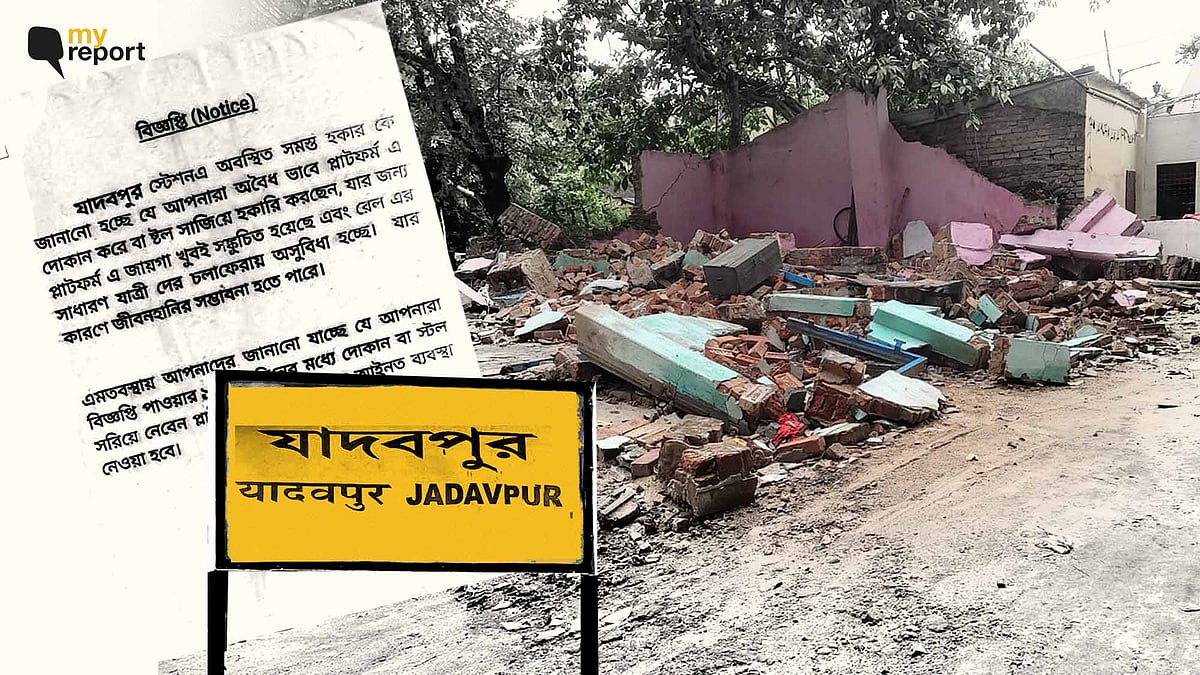
An undated notice pasted on one of the stalls at the station reads, "All the hawkers are on the platform illegally, narrowing down the space on platforms... The passengers are troubled, and this can even lead to death among passengers."
An eviction notice pasted on a stall at Jadavpur Railway Station.
(Photo Credit: Tejesh Mukherjee)
When we visited the station on 26 June, the vendors who we spoke to us claimed that the notice was pasted on 2 June. Yet, midnight demolitions were carried out less than 10 days later on 7 June, leaving them in shock.
Just after midnight, bulldozers rolled in as Eastern Railway officials, backed by Kolkata Police, launched an anti-encroachment drive. By dawn, nearly 40 stalls had been razed, and several others cleared, leaving behind heaps of rubble where a bustling marketplace once stood.
Stalls at Jadavpur Railway Station, one of the railway premises in Kolkata, where eviction drives have sparked protests and court cases.
(Photo Credit: Tejesh Mukherjee)
The Calcutta High Court then put a stay on demolitions till 30 June. The court also asked the railways to put in place a mechanism that unauthorised vendors could avail of before facing eviction. With the 30 June deadline now expired, they once again face the looming threat of eviction, as well as fear that demolitions may resume.
'Too Old to Start Afresh'
Over the past 15 years, since Naskar set up his stall at Jadavpur Railway Station, it has helped him pay for his children's education and his elderly parents' medical treatment.
Shoma Ray, a 65-year-old vendor who sells tea, snacks, and bottled water, recounted to us: "My husband and father-in-law started this shop. After they passed away, I started running this stall."
Gripped with a sense of hopelessness over the recent demolition drive and the looming eviction, she told us,
She added that her children are daily-wage workers and are unable to bear the household expenses on a regular basis. "They don't earn enough for me to stay at home and depend on them. I have no alternative source of income, and I don't know what I will do if I'm evicted," she said.
Debris of shops demolished during the railway's anti-encroachment drive at Jadavpur Railway Station.
(Photo Credit: Tejesh Mukherjee)
Kajori Mondal, a 72-year-old widow who sells ginger, garlic, chilli, and lemon, is a senior citizen who depends on her stall to pay for her medical expenses.
Another vendor, Naresh Pal, has been running a readymade clothing stall at the railway station for four decades. "Because of the uncertainty surrounding our future, our suppliers are reluctant to give us products to sell because they fear we might be evicted and their payments would get stuck," he lamented.
A 2020 study on informal street vending in developing countries found that street vending is a vital source of income, particularly for rural migrants and less-educated workers. Yet, despite their contribution to urban economies, vendors remain among the most vulnerable, with little social security or formal financial support, making eviction drives especially devastating.
As we walked away from the station towards the railway colony, we were met by the skeletal remains of the shops, crushed into debris by the bulldozer. The police buses and jeeps stood vigil, casting an ominous chill over the wreckage.
Back at the railway station, the vendors, who understand little about the legal processes, are pinning their hopes on the Calcutta High Court to get further relief.
(The Quint has reached out to Eastern Railways and Kolkata Police regarding the evictions in and around Jadavpur Railway Station. Their responses are awaited, and the story will be updated as and when they respond.)
(Names of the vendors have been changed to protect their identity.)
(Satyaki Dasgupta is an Assistant Professor, Department of Economics, Christ University, Bengaluru, and Tejesh Mukherjee is a PhD student at Calcutta University, West Bengal.)
(All 'My Report' branded stories are submitted by citizen journalists to The Quint and the views expressed above are the citizen journalist's own. The Quint neither endorses nor is responsible for the same.)
- Access to all paywalled content on site
- Ad-free experience across The Quint
- Early previews of our Special Projects
Published: undefined