
Noise Pollution: 'Why Has This Everyday Lawbreaking Become So Normalised?'
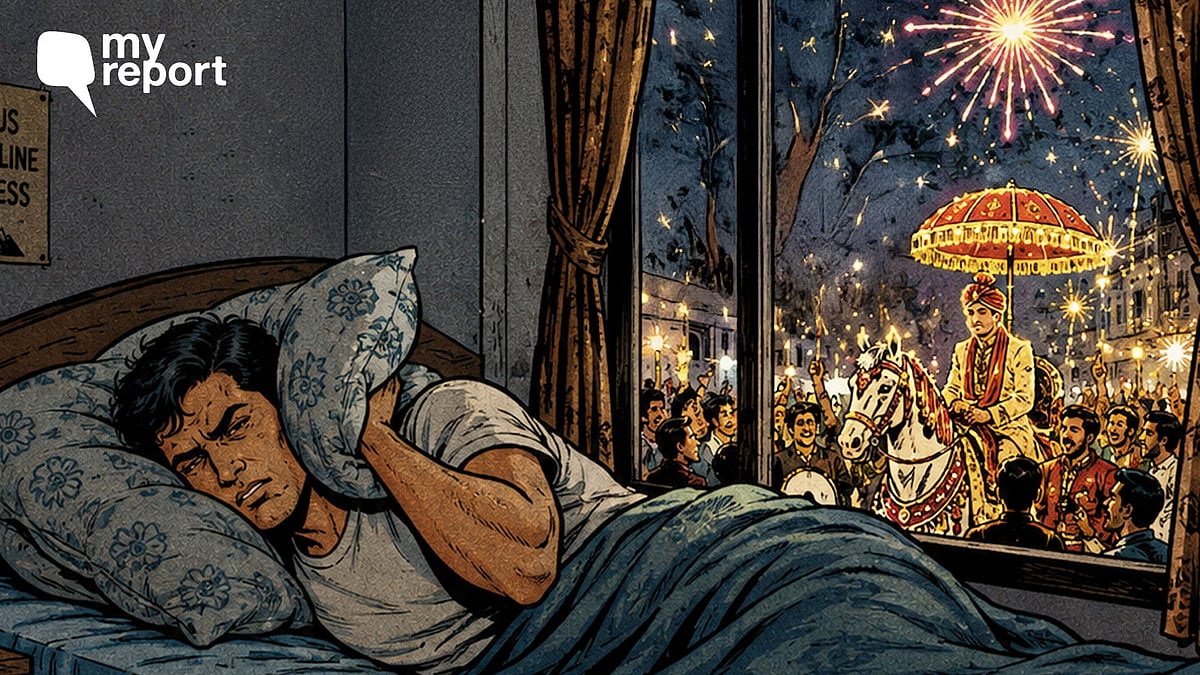
'I returned home after a 300-km drive, only to be kept awake by a wedding DJ and fireworks late into the night.'
advertisement
I am a resident of Hanamkonda city in Telangana. On 25 June, Thursday, after driving nearly 300 km, I finally reached home around 11 pm. Like any other person after a long journey, all I wanted was a good night's sleep.
But that wasn't to be. At midnight, there were fireworks right outside my house, followed by loud music blaring from a DJ. I assumed it was a wedding procession.
Fair enough. Weddings are meant to be celebrated. Surely it would pass in 10 minutes. Ten minutes became thirty. Thirty became an hour. The music only grew louder.
The wedding procession passing outside Manu Ramshetty's house.
(Photo Credit: Manu Ramshetty)
'Everyone Deserves a Peaceful Night's Sleep'
Like most Indians, my first instinct wasn't outrage. It was tolerance. I kept telling myself, "Why create a scene? Everyone gets married. Let them celebrate." This is how most of us react—not because we enjoy the noise, but because we've been conditioned to believe that enduring inconvenience is part of being a good neighbour.
At around 1:35 am, my patience gave way to frustration. I dialled 100. The operator assured me the police would arrive within five minutes. The nearest police station is barely a two-minute walk from my home.
Again, I was told the police had been informed and that I would receive a callback. Another thirty minutes passed. No callback. No police. No reduction in volume.
Firecrackers outside the author's house.
(Photo Credit: Manu Ramshetty)
Out of curiosity—and perhaps disbelief—I opened Gemini and searched whether noise pollution was even something citizens could complain about. The question itself says a lot about our society.
'Secularism In Noise Pollution'
Noise pollution is remarkably secular. It doesn't care whether it comes from a wedding DJ, fireworks, temple loudspeakers, a mosque, a church, a political procession, or a late-night party.
This time, Gemini suggested calling 112, India's national emergency helpline. So I did. The response was identical. "The police will come." They never did.
By 2:30 am, more than an hour after my first complaint, I had stopped expecting help. I sat in my living room thinking about something that disturbed me more than the noise itself.
"These are rich people's problems." Not because I am rich. But because uninterrupted sleep, peace inside your own home, and the expectation that the law will protect that peace increasingly feel like luxuries rather than basic rights.
My wife walked in and asked, "Have you dialled 100?" I smiled.
"I've called three times."
'The Normalisation of Noise'
Then I said something no citizen should ever have to say. "There is nothing we can do. Just try to sleep." The helplessness hurt more than the noise.
To my surprise, I discovered in my CCTV footage that two policemen had actually visited the location around 1:20 am—even before I made my first complaint. They spoke to someone and left. The footage is too blurry to suggest anything improper, and I won't speculate.
Screengrab from the CCTV footage showing policemen speaking to people participating in the procession.
(Photo Credit: Manu Ramshetty)
Maybe when I called later, nobody called back because they already knew the situation. They had already tried and failed.
For the first time, I actually felt sympathy for the police. Not because they solved the problem. But because they couldn't. The DJ finally stopped at 3 am.
Eventually, an interceptor police vehicle arrived. Everything became silent. Five minutes later, after the police vehicle left, the drums and fireworks started again. It was almost comical—a cat-and-mouse game between law enforcement and those determined to ignore the law.
Finally, around 3:40 am, everything ended. The troubling part is that nobody involved is ignorant of the law. The DJ operator knows music isn't permitted late into the night.
In fact, when you hire many DJs, they warn you in advance: "If the police come, you'll have to manage." That single sentence reveals an uncomfortable truth.
'The Social Acceptance Of Noise Pollution'
Society has quietly accepted that these rules are optional. If someone objects, they become "the spoilsport." The person asking for sleep becomes the unreasonable one.
The inconvenience has become a culture. We often laugh at movies where the police arrive only after everything is over. Ironically, in my case, the police arrived while it was happening.
Yet, nothing changed. That is somehow more depressing. As individuals, most of us are reasonable. As a crowd, we become different people. Volume becomes power. Visibility becomes status. The louder the celebration, the greater the prestige. But true strength has never come from noise.
This is not merely about one wedding. It is about a society that consistently pushes noise pollution to the back burner because it doesn't seem urgent. Unlike theft, assault, or murder, nobody dies immediately because of loud music.
But millions quietly lose sleep. Shift workers lose productivity. Students lose concentration. Children wake frightened. Elderly people suffer. Patients recover more slowly. Mental health deteriorates. And slowly, citizens lose faith that the system exists to protect even their most basic right—the right to peace inside their own homes.
We dismiss it as a "first-world problem." It isn't. It is a civilisation problem. How we treat the silence of others says as much about our society as how we celebrate our own happiness.
I still believe India can do better. I still believe our police deserve the authority and support to enforce laws that already exist. And I hope that one day, when my son asks whether the law protects ordinary people’s basic rights, I can answer loudly with confidence instead of silence.
(The Quint reached out to S Ravi Kumar, Inspector of Police, of the local station regarding this citizen journalist's complaint. He said he would respond within two days. This story will be updated as and when we receive a response.
(All 'My Report' branded stories are submitted by citizen journalists to The Quint and the views expressed above are the citizen journalist's own. The Quint neither endorses nor is responsible for the same.)
- Access to all paywalled content on site
- Ad-free experience across The Quint
- Early previews of our Special Projects
Published: undefined