
'I Gave 10 Years to French. CBSE's 3-Language Policy Puts My Livelihood at Risk'
'Our concern is not with Indian languages. We want to ensure students and educators are not unfairly disadvantaged.'
advertisement
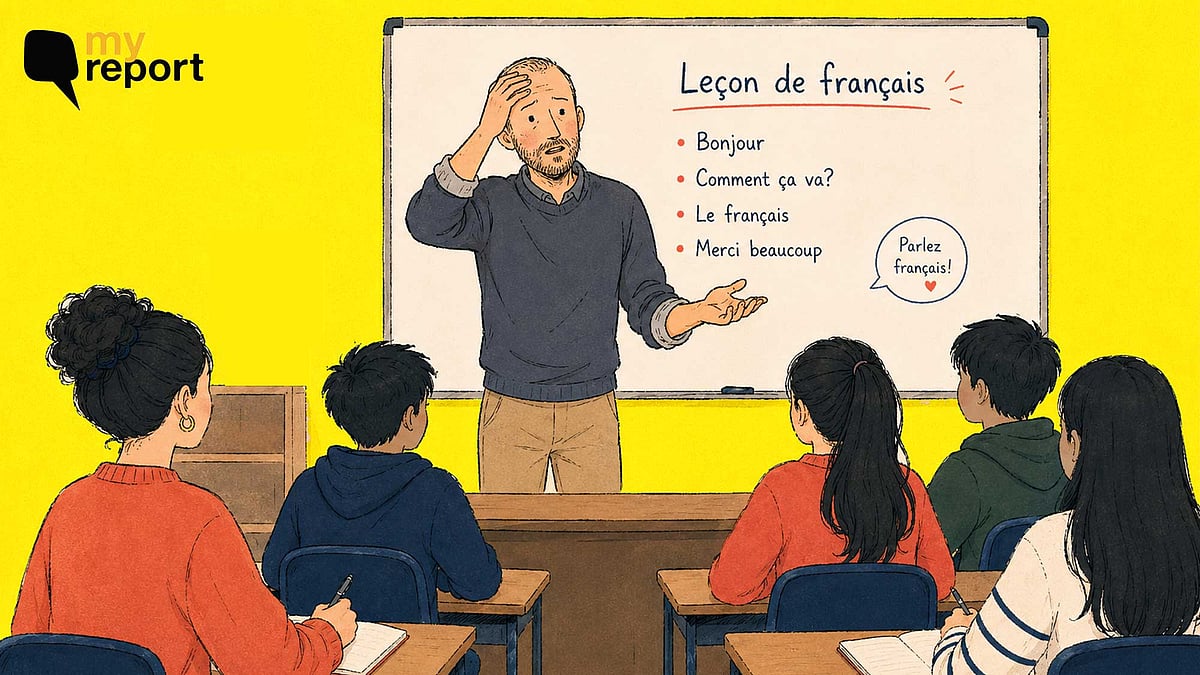
I am writing this not just as a French language teacher, but as a father and the sole breadwinner of my family who is deeply worried about what lies ahead.
The National Policy on Education, 2020 and the National Curriculum Framework (NCF), 2023 promoted multilingualism, and also encouraged foreign languages as part of a globally connected education system.
However, the recent implementation of the CBSE language structure, which mandated a three-language formula, has created a situation where foreign languages such as French, German, and Spanish are rapidly losing meaningful space in schools.
And expecting students to pick a fourth language after they are already under the academic pressure of Maths, Science, Social Science, and three languages seems impractical.
As a result, many schools have already started reducing or discontinuing foreign languages in middle and secondary classes.
'Can't Change My Career or Start Afresh'
I have devoted more than 10 years of my life to this profession. Teaching French was not just my job—it became my identity, my passion, and the way I built my family’s future. Today, for the first time, I fear losing that future.
At this stage of life, suddenly changing professions is not easy. Even if I try to enter the corporate sector, I will most likely have to start with a fresher-level salary because I do not have relevant experience in that space, despite having years of professional teaching and communication experience.
'Many Others Feeling the Pressure'
And my situation is not unique.
Some of my colleagues have spent 15-20 years in this profession. Many are the sole earning members in their families. Behind every “foreign language teacher” is a family living with growing uncertainty and fear.
At the same time, students are also suffering.
Many students who have been learning French or other foreign languages for the last 4-5 years are now suddenly being forced to change direction academically.
Students are already stressed because of syllabus changes, delayed availability of books, intense competition, exam-related controversies, and uncertainty regarding future careers and employment.
Instead of expanding opportunities, the current implementation is unintentionally reducing students’ choices and global exposure.
Our concern is about balance, student choice, proper implementation, and preserving multilingual education in the true spirit of NEP 2020.
If India wants to become a global leader and create globally aware citizens, then students should not be forced into a system where international languages and global opportunities gradually disappear from mainstream education.
The Supreme Court has agreed to examine whether the CBSE’s mandatory three-language policy for class 9 students places undue pressure on students, and whether there are logistical challenges in implementing it or not.
But I want to highlight that the case should also be viewed from the POV of foreign-language teachers like me.
Dharmendra Pradhan on the 3-Language Policy
Defending three-language policy for class 9 students, Union Education Minister Dharmendra Pradhan told NDTV that CBSE has not introduced an entirely new system.
Speaking to the news channel on 28 May, Pradhan claimed that "99 percent of CBSE schools" are already studying in their native language from classes 6 to 8, and the latest circular only states that the arrangement should continue in class 9 as well.
He further added, “My daughter studied Marathi till class 8,” arguing that learning in one’s mother tongue is not unusual in India.
(Mohit Bhola is a French language teacher with over 10 years of experience in school education. A DELF-certified educator pursuing an MA in French, he advocates for multilingual education, student choice, and meaningful language-learning opportunities.)
(All 'My Report' branded stories are submitted by citizen journalists to The Quint and the views expressed above are the citizen journalist's own. The Quint neither endorses nor is responsible for the same.)
- Access to all paywalled content on site
- Ad-free experience across The Quint
- Early previews of our Special Projects
Published: undefined