'AMU's Student Union Must Recognise Women's College Students as Equals'
On 5 November, AMU students will vote in a student union elections for the first time in eight years.
advertisement
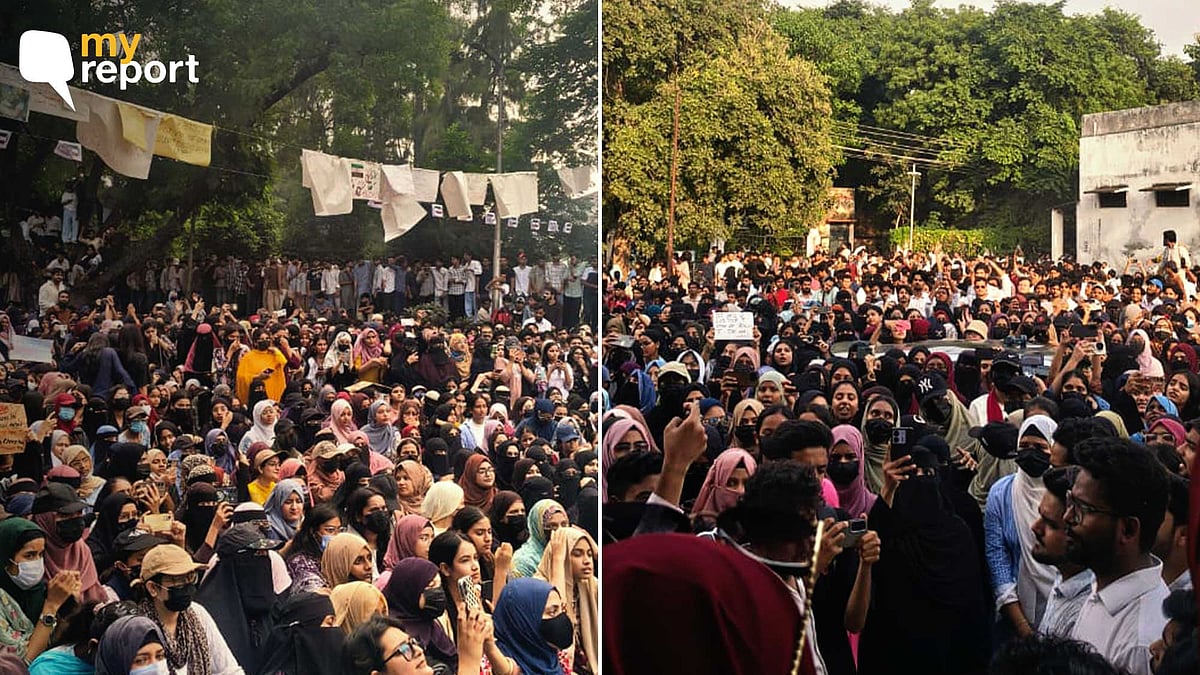
On 5 November, students of Aligarh Muslim University (AMU) will vote in a student union elections for the first time in eight years, following a 20-day student protest and hunger strike demanding for its restoration.
For me, this is personal. I have spent six years at AMU, three of them as an undergraduate at Women’s College, a gendered sub-institution within the university with its own culture, intimacies, and struggles. My time there was defined by a sense of absence.
The last student union elections was held in 2018, after which AMU suspended elections in June 2019 upon completion of the student union term. The pandemic disruptions came in 2020, and studies shifted online.
There was no elected student body to approach when things went wrong, and no one to hold accountable. Our seniors finished large parts of their degrees online, and we inherited the aftermath.
Without representation, students stop expecting to be heard, and that is how a campus learns to stay quiet. But as the campaigning begins, I keep asking: who struggles, who votes, and who wins? Where do Women’s College students stand?
'Two Unions, One Gap'
AMU has two parallel structures. The AMU Students’ Union is the main representative body, while Women’s College has its own student union for the undergraduate women enrolled there.
A separate union gives women their own forum and their own elected leaders. But it also lets the main union function without being electorally answerable to a large section of women students.
Their issues can stay off its agenda because their votes aren’t part of its electorate.
Because Women’s College students are not part of the main electorate, they have no direct way to elect women to its leadership.
The return of the student union is an opportunity to make it more inclusive, rather than simply going back to how things were before. Women’s College students must be recognised as an equal part of AMU’s student community, regardless of where they study or live.
If the main student union does not address their concerns, the responsibility for these issues remains divided too.
The gap can be seen in governance. As per section 22 of the Aligarh Muslim University Act and Statute 14, the President, Vice-President and Secretary of the AMU Students’ Union sit on the AMU Court, the university’s supreme governing body.
Additional seats are allocated to elected student representatives from different faculties and Executive Council nominations through the central union framework. The Women’s College Students’ Union president has no equivalent seat.
Students of the Women's College can raise concerns, but those decisions are made in bodies where its leaders have no guaranteed presence.
This absence is not merely symbolic. It reflects the structural disparity faced by Women’s College students within AMU’s institutional and political framework. A separate student union cannot compensate for their exclusion from the wider institutional framework.
'Demands Of Women's College Students'
I am not arguing for abolishing the Women’s College Students’ Union. It should keep its own electorate.
The demand is that its president, vice-president, and secretary become ex officio members of the AMU Students’ Union, and that women get 33 percent reservation in the main union.
These demands have been raised repeatedly, and discussions on women’s representation are increasingly shaping campus politics. Can a university truly call its students equal when some are permitted to shape its political vocabulary while others must struggle even to enter the conversation?
Women students cannot be counted on for numbers and slogans and then pushed into a separate arrangement when electoral power is on the table. If participation strengthens the movement, representation should strengthen its institutions too.
I ask this not against the student movement but for it. A movement demanding accountability from the university must also practise it. A union worth reclaiming is also one worth reforming.
(The Quint has reached out to AMU regarding the issues raised in the piece. Their response is awaited. The story will be updated as and when they revert.)
(All 'My Report' branded stories are submitted by citizen journalists to The Quint. Though The Quint inquires into the claims/allegations from all parties before publishing, the report and the views expressed above are the citizen journalist's own. The Quint neither endorses nor is responsible for the same.)