
Is Vagueness, Misuse Really the Reason Upper Castes Want UGC Rules Rolled Back?
'The Supreme Court’s decision to stay 2026 UGC regulations reflects institutional hesitation, even discrimination.'
advertisement
Less than a month ahead of the Supreme Court’s next hearing on the new regulations notified by the University Grants Commission (UGC), the debate on equity at central universities has emerged as a major flashpoint.
This equity debate took a violent turn last week outside the Arts Faculty in North Campus, prompting Delhi University to ban “public meetings, processions, demonstrations and protests of any kind” for a period of one month starting 17 February. Meanwhile, protests at Delhi's Jawaharlal Nehru University (JNU) intensified over the weekend after its Vice Chancellor Santishree Dhulipudi Pandit in an interview reportedly called UGC rules "totally unnecessary", "irrational", and "wokeism". Clashes broke out late last night between Left-led All India Students' Association (AISA) and RSS-affiliated Akhil Bharatiya Vidyarthi Parishad (ABVP), who accused each other of violence and stone-pelting.
The University Grants Commission (Promotion of Equity in Higher Education Institutions) Regulations, 2026 mandates establishing Equal Opportunity Centres, Equity Committees and Equity Squads to keep caste-based discrimination in check; time-bound grievance redressal; as well as punitive actions against central universities for non-compliance.
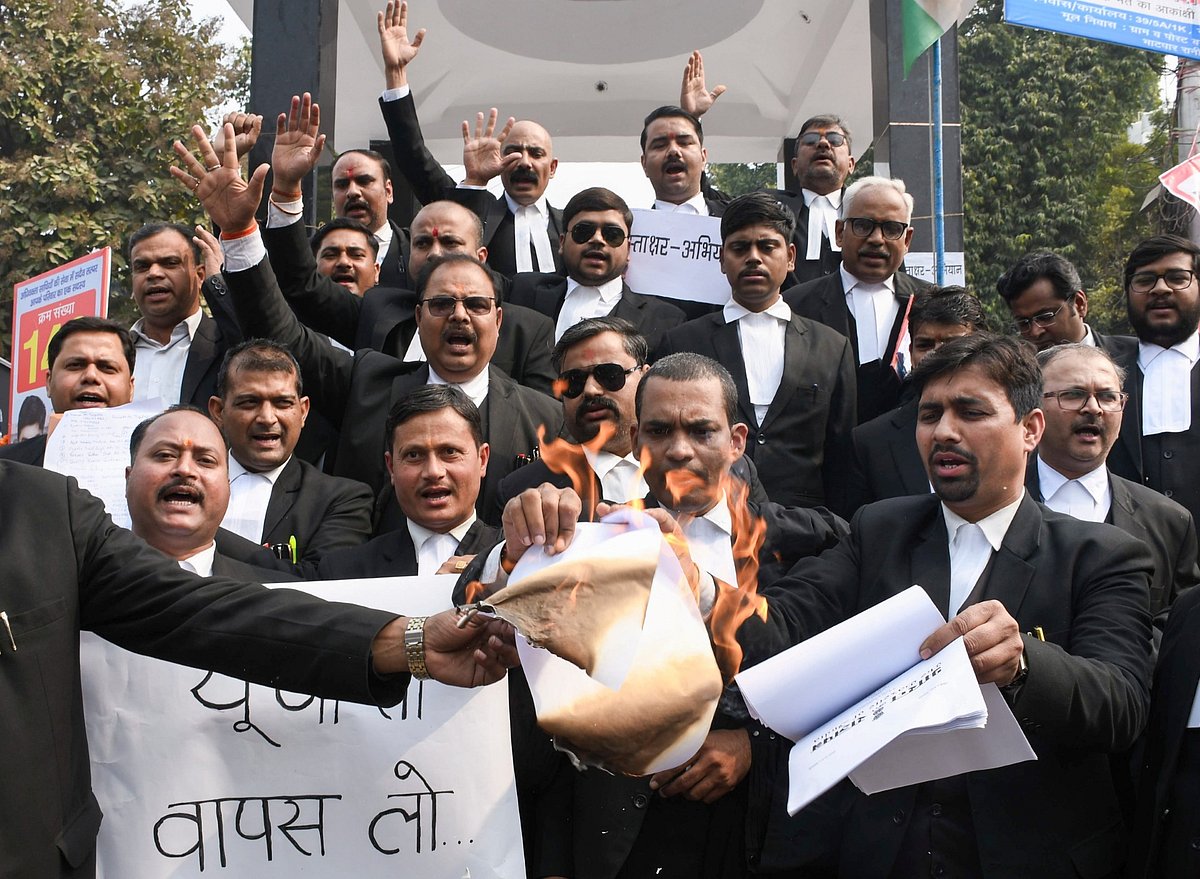
Soon after they were notified on 13 January, these regulations were met with severe backlash from upper caste groups (including several BJP office bearers), which unified to demand a rollback of these rules claiming they would lead to “reverse discrimination,” “malicious or fake complaints against general category students,” and “division among students on campuses.”
Despite the Union Education Minister Dharmendra Pradhan assuring critics that “there will be no discrimination and no one can misuse the law,” the regulations were challenged in the Supreme Court by a batch of petitions filed on 27-28 January. Claiming that the rules were “exclusionary” and “discriminatory against people belonging to general classes,” the petitioners sought an urgent hearing, which the top court granted.
On 29 January, a Bench comprising Chief Justice of India Surya Kant and Justice Joymalya Bagchi stayed the 2026 regulations—observing that they were prima facie vague and capable of misuse—and ordered that the 2012 regulations will operate in the interim. The Supreme Court issued a notice to the Union government and the UGC to file a response in the next hearing scheduled for 19 March.
In this story, The Quint examines the new UGC rules to ascertain:
Why is the Definition of Caste Discrimination Controversial?
The clause in UGC’s new regulations, which has become the bone of contention, is 3c which defines caste-based discrimination as “discrimination only on the basis of caste or tribe against the members of the Scheduled Caste (SC), Scheduled Tribe (ST), and Other Backward Classes (OBCs).” The petitioners reportedly argued that this definition excludes individuals from the general category and that discrimination cannot be presumed to occur only against one section of the society.
However, social activist Anand Teltumbde argued that Clause 3c is in addition to Clause 3e, which includes everybody. Clause 3e defines discrimination as “any unfair, differential, or biased treatment or any such act against any stakeholder, whether explicit or implicit, on the grounds only of religion, race, caste, gender, place of birth, disability, or any of them,” where stakeholder includes students, faculty members and non-teaching staff. It is similar to the 2012 regulations, only those were restricted only to students and didn’t include teaching/non-teaching staff.
Definition of 'discrimination' in UGC's 2026 Regulations
Definition of 'discrimination' in UGC's 2012 Regulations
Meanwhile, former UGC Chairman Sukhadeo Thorat was of the opinion that though the new regulations are an improvement over the 2012 regulations, they have serious limitations in defining behaviours that constitute caste-based discrimination in educational institutions. He told The Quint:
Thorat added that the rules need to clarify the educational institutions covered, cautioning that autonomous institutes such as IITs and IIMs may get excluded under the current rules. “I suggest that a law on promoting equity and caste-based discrimination should be brought in by a central government regulation, not just UGC, to ensure all institutions come under its purview,” he said.
Should There Be Punitive Action Against 'False Complaints'?
A clause in the Draft 2026 regulations, which were released in February last year, provided punitive action for false complaints. Its removal from the final 2026 rules has irked upper caste groups. On being asked if this makes the new regulations open to misuse, Teltumde recalled the 2018 Supreme Court judgment which had diluted provisions of the SC/ST (Prevention of Atrocities) Act, 1989 citing “possible misuse.”
The move had triggered nation-wide protests and six months later, the Parliament passed an amendment to the Act, restoring its stringent provisions. In February 2020, the Supreme Court had acknowledged concerns with the earlier ruling and upheld the amendment.
The UGC, in its report to a Parliamentary Standing Committee, reportedly submitted that cases of caste-discrimination in central universities had risen by 118 percent in the last five years.
Besides, the new regulations do provide for an appeal to the Ombudsperson in case a person is not satisfied with the report of the Equity Committee. This means, for example, a general category student can appeal to the Ombudsperson against a marginalised student who may have filed a false complaint. With this provision in place, do we need a clause imposing punitive action for false complaints?
Teltumbde responded, “No established jurisprudence equates procedural safeguards with punitive action against a complainant. If that logic is applied, even the government could face counter-action whenever accused persons are acquitted. Procedural safeguards are meant to ensure fairness in investigation and appeals, while institutions are expected to exercise normative judgment. Determining what is false or malicious is the outcome of due process.”
He cited the case of Rohith Vemula, wherein the closure report filed by the Telangana Police in May 2024 attributed Rohith’s death by suicide to personal reasons and said there is no evidence to confirm if Rohith belonged to the Dalit community. He also cited the 2006 Khairlanji massacre, where the Bombay High Court held that there was no conclusive proof the killings were committed on the ground of caste.
“If punitive action is introduced against complainants, everyone who intervened in Rohith’s or Payal Tadvi’s case could be prosecuted. It creates a double whammy for Dalits — first, they face victimisation and if they speak up, they risk being punished for filing false complaints,” Teltumbde argued.
Are These Regulations an Effective Step Towards Curbing Caste-Based Discrimination?
On being asked if the UGC’s regulations in their current form are effective in promoting equity and curbing caste-based discrimination, Teltumbde said, “Caste in India is a deeply embedded social reality that cannot be mapped concretely. Even so, the regulations can aim to minimise if not eradicate discrimination through institutional processes. But that effort won’t succeed until the State acknowledges that the problem exists.”
While Article 15 of the Indian Constitution prohibits discrimination on grounds of religion, race, caste, sex, and place of birth; Article 15(5) allows the State to make special provisions for the advancement of socially and educationally backward classes, or for SCs and STs, in educational institutions.
While recollecting a recent viral news video clip where a school teacher is seen telling a journalist, “Ab chappal ko sir par to nahi rakh sakte," when enquired about caste-based discrimination, Teltumbde said the State should work towards mitigating such entrenched prejudices in society in line with the tenets of the Constitution.
In fact, the UGC’s new regulations were a response to a PIL in the Supreme Court filed by the mothers of Rohith Vemula and Payal Tadvi.
Teltumde retorted, “It has taken the Supreme Court six years to urge the UGC to frame strong and implementable regulations. But when upper caste groups, such as Karni Sena or Savarna Samaj Coordination Samiti, protested against these regulations, the top court took it up as an urgent matter and stayed the regulations the very next day. Why is such ultra-efficiency never shown to people, who are languishing in jail for years without trial?”
Thorat too opined that the Supreme Court came under pressure and even lent support to the arguments of the upper caste petitioners.
In fact, three years after the death by suicide of Dalit student Darshan Solanki at IIT Bombay, the case has not even gone to trial. "I am having to go from Ahmedabad to Mumbai for the hearings on a plumber's salary. The investigation seems to be going nowhere. I haven't been offered any compensation either," Ramesh Solanki, Darshan's father told The Quint. Their counsel Avinash Ovhal claimed, "There have been 39 hearings so far but the trial has not even begun. The accused's counsel is prolonging the procedure."
Why Now? Is There a Political Intent Behind These Regulations?
In January last year, the Supreme Court had directed UGC to frame anti-discrimination laws which are “more than just symbolic gestures.” Following this, UGC released the draft regulations in February 2025 for public comment and stakeholder suggestions. UGC then submitted its report on cases of caste discrimination to a Parliamentary Standing Committee, before rolling them out on 13 January this year.
He pointed out that UGC operates within the framework of the Union government and rarely acts in isolation from it.
In the 2024 Lok Sabha elections, the Samajwadi Party had made significant inroads among the OBC and Dalit electorate, dethroning BJP as the single-largest party. Teltumbde posited, “The BJP’s strategy could be seen as appealing to SC/ST/OBC communities — a larger social bloc — while assuming that upper caste voters, who have historically leaned towards it, are unlikely to shift allegiance despite dissatisfaction.”
Despite the controvery surrounding the regulations, there has been no statement from BJP leaders, including Prime Minister Narendra Modi, on the same. Neither has there been strict action against those who agitated against the Modi government demanding a repeal of the regulations.
“Visuals of protests led by upper caste groups show that there was no police around, they weren’t met with resistance. On the contrary, if such demonstrations were carried out by students belonging to marginalised communities, they would’ve met with oppressive action,” Teltumde claimed.
Why No Outrage Over 2012 Regulations, Despite Similar Definition of Caste Discrimination?
With the new UGC rules in abeyance, the 2012 regulations by the same name are currently in force. However, they have not drawn any backlash from Savarna groups even as they explicitly list behaviours that constitute caste-based discrimination arguably better than the 2026 regulations. Why?
“People were barely aware that the 2012 UGC regulations even existed; they were framed largely in an advisory tone. By contrast, the 2026 regulations introduce time-bound action, structured monitoring, and punitive action for non-compliance, may have triggered stronger reactions,” Teltumde said.
Besides, he said, even if the new regulations come into force, it is a far cry that they will be honestly implemented. “That is because we have not invested in creating a deeper attitudinal shift in the last 70 years. Too often, regulations are introduced in response to a crisis, to show concern but without ensuring structural reform. What is needed is continuous sensitisation — educating students, faculty and non-teaching staff about caste realities and discrimination. Without this, implementation on the ground may remain largely symbolic,” he concluded.
- Access to all paywalled content on site
- Ad-free experience across The Quint
- Early previews of our Special Projects
Published: 23 Feb 2026,10:31 AM IST