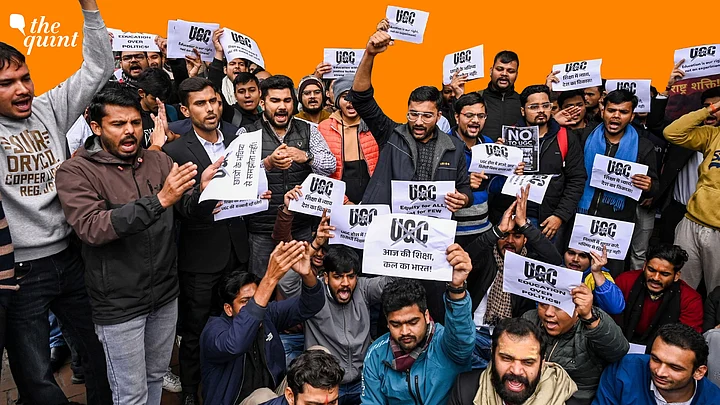
The University Grants Commission (UGC)'s regulations on preventing caste discrimination and promoting equity in higher education instiutions have been in the eye of the storm since they were notified on 13 January.
The University Grants Commission (Promotion of Equity in Higher Education Institutions) Regulations, 2026 — a purported upgrade to the 2012 regulations by the same name — mandate:
Establishing an Equal Opportunity Centre to ensure implementation of policies for disadvantaged groups
A 10-member Equity Committee, with mandatory representation from Other Backward Classes (OBC), Persons with Disabilities (PWDs), Scheduled Castes (SC), Scheduled Tribes (ST), and women
Equity Squads for maintaining vigil and preventing any discrimination on campus
An 24X7 Equity Helpline to report any incidents of discrimination on campus
Time-bound grievance redressal mechanisms
A national-level monitoring committee to oversee the implementation of these regulations
Non-compliance to these could lead to a higher education institute getting debarred from offering degree programmes and participating in UGC schemes.
Soon after they were notified, students belonging to upper castes staged protests outside the UGC headquarters in Delhi claiming that the new regulations would lead to "reverse discrimination" and "division on campus." Agitations were led by the Rajput Karni Sena across Rajasthan, while many office bearers within BJP ranks stepped down demanding rollback of the new rules.
The regulations were challenged in the Supreme Court by a batch of petitions claiming they exclude students belonging to upper castes or unreserved category from protections against discrimination. A Bench of Chief Justice Surya Kant and Justice Joymalya Bagchi on 29 January ruled to keep the regulations in abeyance, saying they were vague and open to misuse.
In an exclusive interview to The Quint, former UGC Chairman Sukhadeo Thorat weighs in on the new regulations, points out their limitations, asserts on the need for a central law against discrimination and calls out the Supreme Court for lending support to the petitioners' arguments. Excerpts:-
Are UGC's 2026 regulations an improvement over the 2012 regulations?
UGC's new regulations are supposed to be an improvement over the 2012 regulations, which were framed over 13 years ago by the UPA II government. They came in response to the Supreme Court's directives on the petitions filed by the mothers of Rohith Vemula and Payal Tadvi.
In my view, the new rules are an improvement over the old ones on two counts. First, the UGC will have a standing committee which will monitor whether universities and colleges are implementing the new regulations or not.
Second, the regulations mention that in case there is an appeal against the head of the institution, it should go to an independent authority, either a Chancellor or Ombudsperson.
Then there is certain improvement in sensitisation programmes — workshops, posterisation, and an undertaking at the time of admission that the student will not practice discrimination — which have been borrowed from the anti-ragging legislation.
Policy wise, are the new regulations watertight or is there room for improvement?
There are serious limitations in the 2026 regulations. The 2012 rules not only defined discrimination, and separately caste discrimination, but it also listed about 28 forms of discrimination—which the 2026 regulations completely excluded. They leave it to the Equity Committee to list forms of discrimination, which in my view, is a mistake.
The Equity Committee may not have enough expertise to identify forms of discrimination associated not only with caste, but also gender, ethnicity, tribal status, religion, physical disability, and economic background.
The general practice is that the regulation itself should list behaviours that constitute discrimination, as was done in 2012 rules, the Untouchability Offences Act, 1955 as well as in the SC/ST (Prevention of Atrocities) Act. Over a period of time, when new forms of discrimination were identified, they were added to the original list stated in the law. In fact, the SC/ST Act began with 25 forms of caste discrimination and now the amended Act, 2018 includes 40 forms of discrimination.
The other thing is that if the rules are applicable to all institutions and if each of the 60,000 educational institutions identify their own forms of discrimination, there will be huge legal complications.
Secondly, there should be adequate representation for SC, ST, and OBC members on the Equity Committee, which is currently not specified.
Thirdly, there is a need for clarity on the educational institutions covered. The rules say all institutions at the Center and state are covered, but the definition of institution covers educational institutes mentioned in Section 3 of the University Grants Commission Act, 1956. It excludes many institutes like —
IITs (which fall under IIT Act,1961),
IIMs( which fall under IIM Act, 2017);
standalone institutions that fall under AICTE;
agricultural universities fall under the Agriculture Council;
law universities fall under the Bar Council (which comes under the Union Law Ministry)
film institutes fall under the I&B Ministry
NDA falls under the Union Defence Ministry.
My suggestion is that this should be a central government regulation, not just UGC or Ministry of Education, to ensure all institutions come under its purview, irrespective of the ministry.
These are the limitations of the 2026 regulations, and if we remove them, the regulations can be improved.
The Supreme Court observed that the regulations were "vague," particularly around the definition of caste discrimination. So was the Supreme Court right in pointing those out?
But, the Supreme Court's argument is based on those of the petitioners who challenged these regultions. The petitioners contended that caste — SC, ST and OBC— shouldn’t be mentioned separately in the rules but included in the general definition of caste. I disagree with these arguments.
Caste should be defined properly, the way it was in 2012, and there should be a list of other forms of discrimination too. The Supreme Court is not able to understand that the general provision of discrimination already includes caste, tribe, religion, gender, and physical disability, but the nature and source of discrimination differ across each of these categories.
The forms of discrimination faced by an SC individual are different from those faced by OBCs, STs, or religious minorities. There should be a separate list of the different forms of discrimination under the overall provision and caste should be mentioned separately.
If you look at the United Nations' regulations, they have separate regulations for women, PWDs, and on racism — all under an umbrella category of discrimination. Why are the petitioners opposing this for caste? I don’t agree with the argument of the Supreme Court.
The Supreme Court also said the new regulations are open to misuse. Agitating upper-caste groups demanded that rules be "caste neutral."
They didn’t use the word "caste neutral," but they are implying the provision should include upper castes, asserting that the regulations are based on the assumption that unreserved category students do not face discrimination. But this is not a correct argument.
The point is that the 2026 law gives provisions for discrimination against anybody, including say gender-based discrimination meted out by an ST student. It doesn't identify who is the discriminator and who is discriminated. It covers caste discrimination by anybody, including upper castes or OBCs. Most discrimination against Scheduled Castes is by OBCs, and the law doesn’t exclude that.
This is an incorrect understanding of the law by the petitioners and the Supreme Court judges.
Why were OBCs not included in the draft regulations, though they were later added to the final regulations?
OBCs were not included in the 2012 regulations because they got reservations in central institutions around 2009; so there was no immediate need to include OBCs.
But now, they face discrimination similar to that faced by students belong to SC communities. Besides, OBC reservation is a caste-based reservation and that is why OBCs are included.
Draft regulations have been public since February 2025. Why is there a sudden backlash now? Has the Supreme Court bowed to upper caste pressure?
I would not put a finger on the Supreme Court, but it has certainly come under pressure. It wanted to deal with the (upper castes-led) agitations and that is why it immediately responded. I don’t have a problem with that. On the part of the students, it is definitely political and ideological.
My problem with the Supreme Court is that it has also lent support to the arguments made by the petitioners, especially in its oral statements. Although in the written statement too, it has mentioned that the new regulations are "vague" and "subject to misuse"— not with respect to upper castes, but a general misuse if the regulations aren’t clear and there is a problem with interpretation. But other comments are very supportive of the petitioners, which the Supreme Court should not have made. One was that the regulations will lead to division on campuses. The second was that caste should not be mentioned separately and brought under the general definition of discrimination.
This is not good. If the court is pronouncing a verdict and makes such comments, I don’t have a problem. But when the court is putting a point up for discussion in the next hearing, then it should not lend support to an argument.
UGC's data, that it submitted to a Parliamentary Standing Committee, reportedly shows cases of caste discrimination rose by 118 percent in the last five years. But there is no evidence of "fake cases" being used against upper-caste students.
The argument of misuse and division is a very unfounded one. The 2012 guidelines have been in practice for more than 13 years. Has there been a single case of misuse or false complaints lodged by Dalit students against upper-caste students?
Dr Ambedkar examined this issue under the Untouchability Atrocities Act in the context of villages, but the same logic applies here. SC/ST students on university campuses are as it is on the defensive—they are discriminated against; they don’t have the economic strength needed to lodge a false complaint against an upper caste because they know it will bounce back against them. So this argument of misuse is neither theoretically nor empirically proven. It is a political argument.
Similarly, division of students on campus is a very incorrect argument. The point being, there is already division on campus. Campuses have been diversified over time with the massification of education. During the British era and early 50’s, campuses were dominated by males, particulary upper-caste males. Then women came in, then SCs, STs, religious minorities came in. So campuses now are in a diversified form and diversity brings division. Students come with their prejudices on caste, ethnicity, religion and gender.
My reports on AIIMS have shown that peer groups and friendships are often formed on the lines of caste, religion, and gender, with SC students often being isolated. So division already exists. The objective of these regulations is to bring equity and social inclusion, not division.
The reservation policy, for example, has brought upper-caste students and SC/ST students together; they have begun to understand each other better. In the legislature too, when the upper-caste MPs and SC/ST MPs sit together and discuss issues, it brings about harmony and unity . The purpose of these UGC regulations is the same. It will lead to sensitisation of students.
And again, we currently have regulations against sexual harassment, have they brought about a division on campus between male and female students? No.
So this is a wrong argument and unfortunately, the judges have supported it.
Should the clause penalising "fake cases”, which was there in the draft regulations, be brought back as a plausible solution to where the Supreme Court has left the case right now?
No, that is a wrong provision. Even in Maharashtra, the Marathas and Kunbis have asked for such a penalty on a person who has been discriminated against, if the case turns out to be false. This issue also came under the scrutiny of the Standing Committee, attached to Ministry of Social Justice and Empowerment.
There are two objections to this. First, you can’t have a provision in the law, which is counter productive to the framework of the said law. The law here is for those who face discrimination and they need protection — the poor need more protection from those who discriminate. Now in that very law you’re adding a provision that if the case is false, one will receive punishment. This will act as a deterrent for marginalised students to not lodge complaints, because they know that the committees (which decide these cases) are dominated by upper-caste faculty, and there is a possibility of discrimination from within the committee. The Parliamentary Standing Committee had also opposed this, noting that investigations into caste atrocities often suffer from wilful negligence on the part of upper-caste authorities.
Secondly, if there is a genuine case, an isolated case of a false complaint, defaming someone, there are already provisions in the law for defamation. It’s not like there is no protection. The upper-caste student can also appeal to the Ombudsman against a marginalised student who filed a false complaint, say with a malafide intention.
How can an Equity Committee be constituted with proper representation of maginalised communities when 98 percent of the faculty in IITs and IIMs are from the general category?
This issue had also risen when I was the Chairman of the AIIMS committee — there was a lot of discrimination during the interview process and there was evidence for it. So we recommended that if there is no internal faculty available, you can bring in faculty from outside. Here, I don’t think that will happen.
There should be at least 50 percent representation from SC, ST, and OBC groups, and within that, half should be women. Additionally, there should be women representation also. But at the moment, that is not the case.
Yogendra Yadav, in his YouTube video, has pointed out that in the 47 central universities, only six Vice Chancellors are OBC, one SC and one ST. And it is the Vice Chancellor, which will nominate people for the committees. Given the predominance of upper castes in faculty and in the administration, quite obviously there will be a tendency to have a majority of them from non-Dalit, non-ST and non-OBC backgrounds.
Was there a need to bring in the 2026 regulations, preferably on the lines of anti-ragging and PoSH rules, to bring down cases of caste discrimination or were the 2012 guidelines good enough?
The United Nations has guidelines on discrimination, which includes discrimination on the basis of gender, race/caste, physical disabilities, etc. UNICEF has adopted these provisions in the sphere of education, saying discrimination won't be permitted and policies will be brought about for inclusivity, such as reservations. The Indian government is a signatory to all this; and as a follow up it has brought in rules for discrimination based on gender or physical disabilities. But it still hasn’t brought in rules for caste-based discrimination— at least not until 2012—even as so many Dalit students died by suicide.
And more than international statutes, our Constitution provides basis for this. Article 14 mandates equal opportunity, equality before law; Article 15 states no discrimination will be allowed based on caste, religion, creed, culture, place of birth, gender. And Article 15(5) is very important as it authorises the government to make policies, legal and otherwise, for educationally and socially backward classes to get due representation in legislature and educational institutions.
The 2026 UGC regulations are in line with the Indian Constitution and they have been framed such that fundamental rights to equal opportunity are not harmed, while delivering long-overdue justice to historically marginalised communities.