
Explained: Scope of Military Memoirs and 'Permissions' Amid Naravane Book Row
In India, the rules around military personnel publishing books are shaped by a mix of regulations and security laws.
advertisement
"Clearance has to be taken for anything pertaining to current operations. If it is a very general book, anything of a general nature, you don’t have to take permission. But anything which has security ramifications, you have to take clearance," Lt General (retd) Kamal Davar, former Director General of the Defence Intelligence Agency, told The Quint amid the recent controversy surrounding former Chief of Army Staff MM Naravane’s memoir.
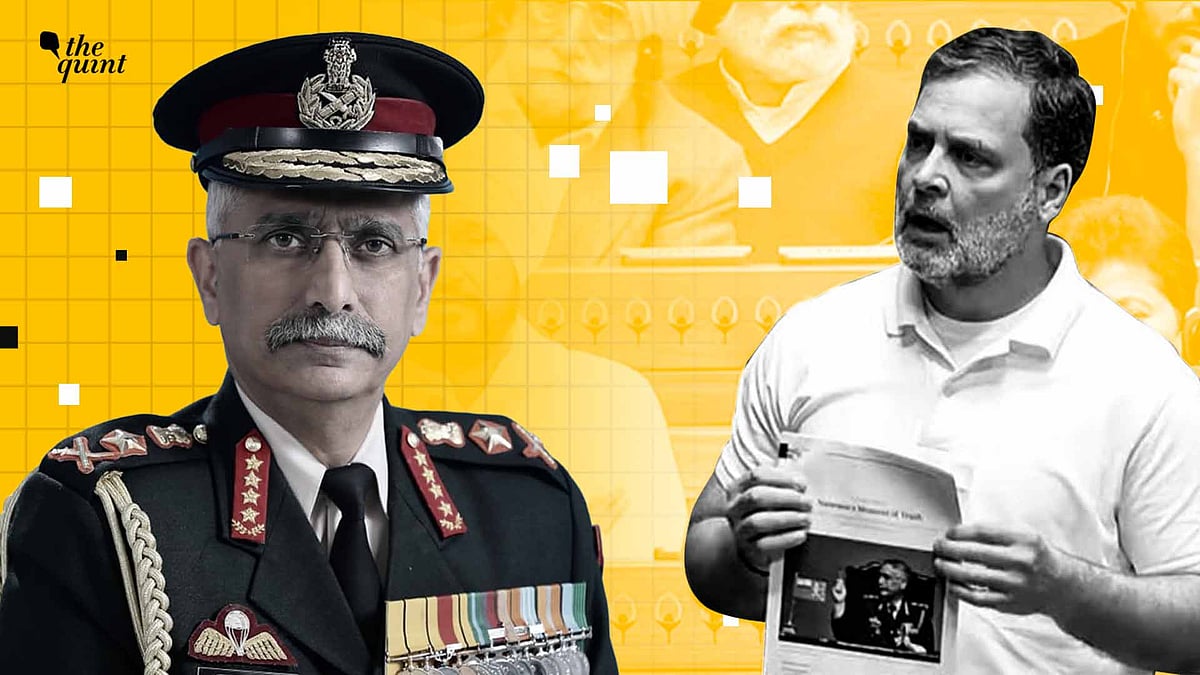
General Naravane’s book, Four Stars of Destiny, triggered a sharp exchange in the Lok Sabha on Sunday, 1 February, when Leader of the Opposition Rahul Gandhi attempted to refer to The Caravan magazine's piece based on excerpts from the book's unpublished manuscript.
Gandhi held up printed pages from the article and quoted from them to make his case, prompting immediate objections from Defence Minister Rajnath Singh and Home Minister Amit Shah. The Bharatiya Janata Party (BJP) argued that the excerpts had neither been officially released nor verified, and questioned the basis on which they were being cited in the House.
As the book becomes a focal point in discussions about transparency and the intersection of politics with military narratives, The Quint explains the rules around military personnel writing and publishing books as well as talks to veterans on the boundaries of military memoirs.
What Is the Defence Ministry's Stance?
General Naravane’s memoir has been awaiting clearance from the Central government for over a year, a delay that first drew attention in late 2023. At the time, reports pointed to mandatory approvals as the reason the book’s release was being held back.
Though it was to be published in April 2024, the memoir, which details General Naravane's tenure as the Army Chief and includes reflections on key military and strategic decisions, has still not been formally released.
This change was noticed within hours of Gandhi holding up a printed copy in the House and quoting from it, observers told The Quint.
While the Ministry of Defence has not provided a public explanation for the hold-up, publishers and booksellers appear to be complying with an implicit directive, removing the book from sale, they allege.
In June 2021, the Ministry of Defence (MoD) formally approved a policy, laying down how records related to wars and military operations are to be preserved and eventually published.
The circular on 'Archiving, Declassification & Compilation of War/Operations Histories'.
(Photo Courtesy: sansad.in)
As a general principle, documents are to be considered for declassification after 25 years. Older records, once assessed by archival specialists, are to be transferred to the National Archives of India, but only after the relevant operational histories have been compiled.
What Does the Rulebook Say?
In India, the rules around military personnel writing and publishing books are shaped by a mix of service regulations and long‑standing security laws.
This requirement exists to ensure that details related to defence, operations, or internal functioning are not shared publicly without vetting. The rule applies to books, articles, letters, speeches, or any other form of publication that may have implications for security or defence operations.
Once an officer retires and is no longer under the Army Act, Section 21 of the Army Rules does not automatically apply. Legal experts and senior retired officers told The Quint that the rule is linked to being “subject to the Act”, which ends with retirement.
However, there is a related set of rules introduced through a 2021 amendment to the Central Civil Services (Pension) Rules, 1972. Under this framework, retired government officials who served in intelligence or security organisations listed under the Right to Information Act, 2005, must obtain prior clearance from the relevant authority before publishing any material related to that organisation’s work.
Importantly, these rules do not explicitly name the Army, Navy, or Air Force, though officers with intelligence or sensitive operational experience are generally expected to exercise caution.
Separate from service or pension rules, India’s Official Secrets Act, 1923, continues to apply to all individuals, serving or retired. The Act makes it a criminal offence to disclose officially confidential information that could harm the country’s security interests. This law remains the core safeguard against releasing genuinely classified information, regardless of an officer’s status.
In practice, this means that serving officers must follow the formal clearance process under the Army Rules, while retired officers need to exercise judgement and remain mindful of security laws.
Many retired officers voluntarily share drafts with the MoD or relevant authorities when their work touches on operations or other non-public matters. This is not a mandatory step under the Army Rules, but is a precautionary measure to avoid inadvertently breaching security norms or legal obligations.
A retired Army General, wishing to remain anonymous, summed up the restrictions as:
What Do Army Veterans Have To Say About the Controversy?
Speaking to The Indian Express, Major General (retd) VK Singh, who served with the Corps of Signals, said, "It is the first time I am hearing that it is the publisher that has sent the manuscript for clearance to the MoD. If at all, as a precaution, it is the retired army officer, and not the publisher, who should ask for the review.”
Major General Singh, too, cited the broader laws such as the Official Secrets Act and provisions related to national security that would still apply.
Meanwhile, the retired Army General, who spoke anonymously to The Quint, said the critiques of military operations should be "acceptable and discussed in a civilised manner".
"Given that the civil leadership comprising the Defence Minister, National Security Advisor, the Prime Minister, and the Cabinet Committee on Security have primacy, and because wars are not purely military events but are politico-military affairs, what was rendered to Naravane doesn’t seem to be a sagacious strategic advice," he said, adding:
"We forget that the Armed Forces deal with very grave issues, and there is a dire need to learn lessons from every military event. But because governments like to hide things, those lessons aren’t imbibed, which in turn thwarts the evolution of national security and military doctrines," he said.
Lt Gen Davar added that there are some aspects that "must never come out."
“When it comes to things that are of a top-secret nature, there are books which have security connotations and geopolitical connotations in the long run. Then the Army is concerned. Through the Defence Intelligence Agency, through the Military Intelligence Directorate, we put it up, and they get the clearance from the MoD," he added, emphasising that the MoD gets to decide "whether the text has any adverse security connotations".
Naval veteran, Commodore (retd) Uday Bhaskar, spoke about the undocumented military history. “My own assessment is that India's military history is very rich, but it has not been adequately and rigorously documented. And whatever is available is largely through memoirs and books and writings of retired officers," he told The Quint.
"But the institutional kind of attention to military history, in my mind, is below the median. There are too many layers of classification and security which do not allow full justice to be done to the richness and texture of India's military history,” he lamented.
- Access to all paywalled content on site
- Ad-free experience across The Quint
- Early previews of our Special Projects
Published: undefined