
Naravane Memoir Row: Risks of Militarising Politics & Politicising the Soldier
The proverbial “sword-arm” of the sovereign simply cannot succumb to partisan passions.
advertisement
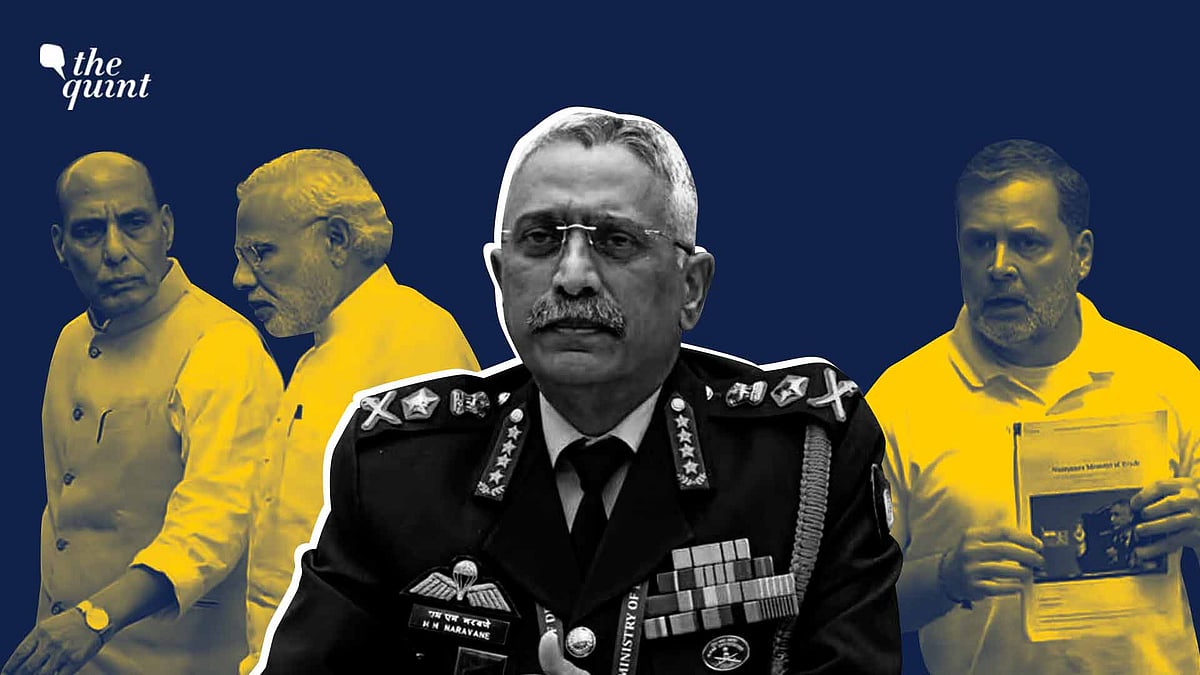
The recent controversy surrounding former Indian Army Chief General MM Naravane’s unpublished memoir Four Stars of Destiny raises questions far beyond the ensuing political one-upmanship.
The gravest threat is to the future of the Constitutional institution of the Indian Armed Forces to remain apolitical. The proverbial “sword-arm” of the sovereign simply cannot succumb to partisan passions. The institution’s apolitical perception is not maintained by the restraint of the soldiers alone; it is upheld or undermined by the conduct of the political class—both from the ruling and the Opposition benches.
However, as India’s political discourse is becoming dangerously 'militaristic' and inflicted with 'muscular' passions, appropriation of the 'Indian Soldier' under partisan flags, is always susceptible. With the stifling air of hypernationalism all around, such an unwarranted co-option of the apolitical institution into political exchanges comes with a long-term cost.
Keeping the Armed Forces Above Politics
Eventually, partisanship or perceived tilt towards one political party or the other will undermine the fundamental character, professionalism, and trust in the Armed Forces.
Prior governmental sanction on service matters that are 'classified information' or entail operational/decision-making details are covered. The idea is to protect sensitive information from public disclosure, which otherwise could impact national security. These legalities, along with the Official Secrets Act (1923), can restrict unauthorised disclosure or quotation, even after retirement.
Who Really Crossed the Line?
The controversy over quoting an uncleared military memoir exposes less a breach of rules and more a deeper anxiety about narrative control.
General MM Naravane’s unpublished memoir has been pending clearance by the Ministry of Defence (MoD). While it was scheduled for release in April 2024, it has curiously remained uncleared so far. So technically, excerpts from the same cannot be quoted in public space, let alone brought into parliamentary debate.
So, technicalities aside, what explains the thin-skinned meltdown and flashing of the rule book in the Lok Sabha, which ultimately led the Speaker of the House to advise the Opposition leader, “Sadan ki garima banaye rakhein” (Maintain the dignity of the House)? While a rule is a rule and nothing can justify contravening it, one would have to be living under a rock in recent times to miss the regrettable erosion of the vital “distance” between the apolitical institution of the Armed Forces and politicians.
Ironically, the excerpts that the Opposition leader was supposedly reading out from a published article in an investigative journal do not materially contradict operational facts, but only the spirit of what routinely gets postured for the mass consumption.
Apparently, the controversial excerpts (if true, as they remain unsubstantiated given that they are not approved for publication) allude to directive confusion and constraints, portents of indecision, and to suggestions of passing the buck, for example, “Jo uchit samjho who karo” (Do as you deem fit).
Politicising Veterans
Competing narratives around military decision-making often say more about political image-management than operational truth. This section examines how such disputes unfairly drag veterans into partisan crossfire, eroding respect for rank, institution, and professional dissent.
This less-than-sure plot sounds a lot less decisive and empowering than the narrative that the government had, in fact, given a free-hand to the military to take the necessary steps.
Such controversies end up slotting veterans into partisan camps, hence opening the floodgate to troll-armies who couldn’t be bothered about the achievements, ranks, or dignities, earned by a military professional.
The accusative inelegance of petty partisan politics could theoretically name and shame an individual (owing to their opinions), even though there is a service rank prefixed to their name. As the truism goes, an individual retires but not the rank; therefore, when a veteran is called out, one willy-nilly degenerates the rank and by that extension, the institution.
Care to not draw a veteran and his/her opinion into a partisan slugfest must be maintained. In this specific case, it is important to remember that General MM Naravane had abided by all protocols and given the book for necessary clearances.
Secondly, the oft-posited but misplaced suggestion that veterans should not give any opinions is also facetious, as they can and must enrich the national debates with their diverse perspectives. To treat them as silent dummies is also an insult to an individual and institution that invests a lot in experiences, training, and measured thinking.
Also, the same levels of alacrity and rule-fronting that are exhibited in downplaying and rubbishing a contrarian opinion by a veteran is never matched in fervour with concerns of impropriety, when a veteran’s opinion is found to be palatable, glorifying, and valorising the dispensation of the day.
The Peril of Political Ownership
As political discourse grows increasingly militarised, India’s Armed Forces risk being pulled into partisan battles they were constitutionally designed to avoid. The recurring invocation of the 'Indian Soldier' for political gain threatens the institution’s apolitical character and ultimately, public trust.
The institution of the Armed Forces, too, no longer has the likes of Generals Cariappa, Thimayya, Manekshaw, Sagat or a Hanut, who could put institutional considerations before political pressures. There are always good reasons to 'barrackise' and insulate the Armed Forces from the topical and political winds of the time. But today, the literal gates of cantonments have been opened up, callously and dangerously.
As the brilliant but controversial General K Sundarji said, “The apolitical nature of the Indian Army is one of its greatest strengths.” It is that apolitical necessity that gets compromised every time a “Indian Soldier” is invoked in political context, whether his/her opinion is favouring or militating against the storyline made by a Government.
In the US, when Donald Trump had recklessly started calling some of his soldiers as 'his generals', many hackles were raised. His insinuations of misuse of the 'uniform' had led to the infamous walk along the Lafayette square with the then Chairman of the US Joint Chiefs of Staff Mark Milley in military fatigues. The wise General later expressed regret at his physical presence in a political moment, to the discomfiture of a couldn’t-care-less politician like Trump.
Mark Milley later noted presciently, “We do not take an oath to a King, Queen, a tyrant, or a dictator. We do not take an oath to an individual. We take an oath to the Constitution of the United States”. It ought to be the same case in the Indian narrative. The veteran and his opinions (as duly cleared) need to be handled with care, dignity, and without partisan lens.
(The author is Bhopinder Singh, a Former Lt Governor of Andaman & Nicobar Islands and Puducherry. This is an opinion piece and the views expressed above are the author’s own. The Quint neither endorses nor is responsible for the same.)
- Access to all paywalled content on site
- Ad-free experience across The Quint
- Early previews of our Special Projects
Published: undefined