Rahul vs BJP Over India-China 'Revelations' in Ex Army Chief's Unreleased Book
Defence Minister Rajnath Singh questioned the authenticity of the material Gandhi sought to quote.
advertisement
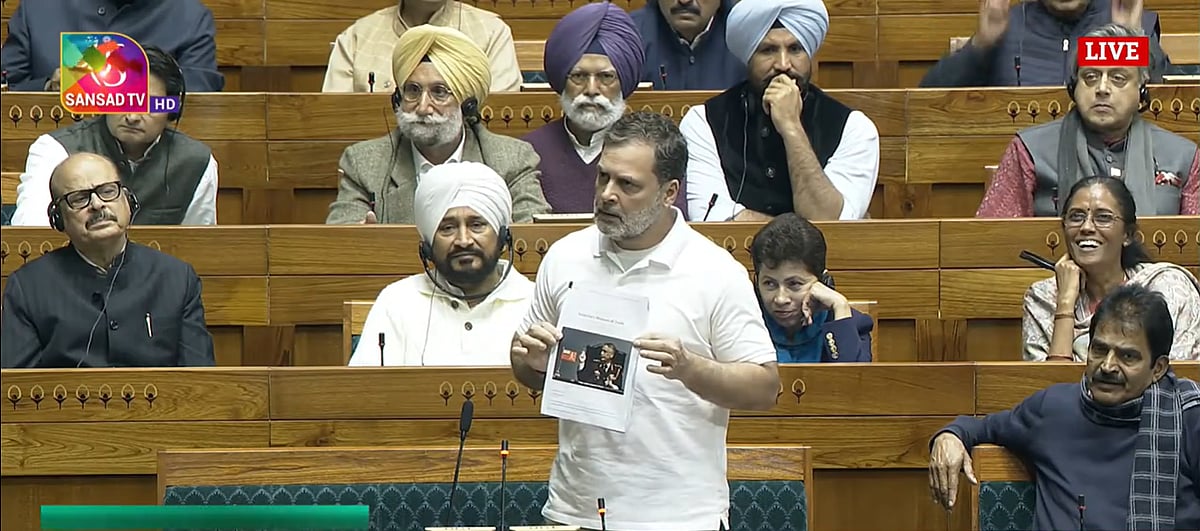
On 2 February, the Lok Sabha was adjourned following a heated exchange during the discussion on the Motion of Thanks to the President’s Address.
Leader of the Opposition Rahul Gandhi attempted to quote from an unpublished memoir of former Army Chief General MM Naravane, leading to strong objections from Home Minister Amit Shah, Defence Minister Rajnath Singh and other BJP members.
Speaker Om Birla intervened, citing parliamentary rules, and the session was suspended amid continued uproar.
According to The Hindu, the controversy began when Gandhi alleged that details from General Naravane’s unpublished memoir raised questions about the conduct of Singh and Prime Minister Narendra Modi regarding Chinese actions along the Line of Actual Control in 2020.
The Speaker objected to Gandhi’s attempt to cite the memoir and a related magazine article, warning him against referencing unauthenticated sources in the House.
As reported by Financial Express, parliamentary procedure prohibits members from quoting unpublished or unauthenticated material during debates. The Speaker has the authority to require any quoted document to be laid on the Table of the House for verification.
Since the memoir in question was not publicly available, it was deemed inadmissible as evidence in parliamentary proceedings.
As highlighted by The Indian Express, Speaker Om Birla reiterated that no book, magazine, or newspaper article unrelated to the proceedings could be quoted in Parliament.
Despite Gandhi’s insistence on the authenticity of his sources, the Speaker maintained his ruling, and Parliamentary Affairs Minister Kiren Rijiju called for adherence to the established rules.
During the session, Defence Minister Rajnath Singh questioned the authenticity of the material Gandhi sought to quote, stating, “He should tell us if the said book has been published or not. It has not been published. He cannot claim to quote from it.”
The Speaker’s intervention led to a prolonged disruption, with both treasury and opposition benches refusing to yield, resulting in the adjournment of the House.
“The Speaker has given a ruling that articles from magazines or newspapers cannot be quoted in the House. Debate in the House should be held according to the laws,” Om Birla stated, as referenced in the coverage.
Coverage revealed that the Motion of Thanks was moved by BJP MP C. Sadanandan Master and seconded by Dr Medha Vishram Kulkarni. The debate was scheduled for 18 hours, with PM Modi expected to reply on 4 February. Gandhi had earlier indicated he would address his concerns regarding the Union Budget and other national issues during this session.
In the aftermath, reporting indicated that Union Minister Kiren Rijiju publicly criticised Gandhi for his repeated attacks on the government’s economic policies, urging him not to “disparage India” while exercising his right to critique. Rijiju referenced international economic projections and comments by Elon Musk to highlight India’s growing global economic stature.
Further, analysis showed that senior Congress leader P. Chidambaram declined to comment on Gandhi’s “dead economy” remarks, stating he was unaware of the context. Chidambaram instead focused on critiquing the Union Budget’s lack of economic strategy and failure to address key challenges identified in the Economic Survey.
At the end of the session, as details emerged, Gandhi also called for a parliamentary discussion on air pollution, urging the government to declare it a national health emergency. He emphasised the need for a comprehensive plan and adequate budgetary allocation to address the health and financial burdens caused by pollution.
Note: This article is produced using AI-assisted tools and is based on publicly available information. It has been reviewed by The Quint's editorial team before publishing.