'The Odyssey' Review: Christopher Nolan Falls Short of Epic Expectations
What the film lacks in its conviction, it makes for it in its acting performances, writes Deepansh Duggal.
advertisement
For a film about immortality, Christopher Nolan’s The Odyssey feels surprisingly mortal. While the Gods blessed Odysseus, I am not entirely sure whether they blessed this adaptation.
This isn’t to say that The Odyssey doesn’t have its merits.
For all its scale, The Odyssey rarely feels as awe-inspiring as the legend it's adapting. Granted, it has majestic sequences, powerful acting performances and, truth be told, even some of its departures from Homer's original epic add nuance to the film. But these flashes of brilliance never quite coalesce into the transcendent cinematic experience one expects.
Another Nolan Hero Consumed by Guilt
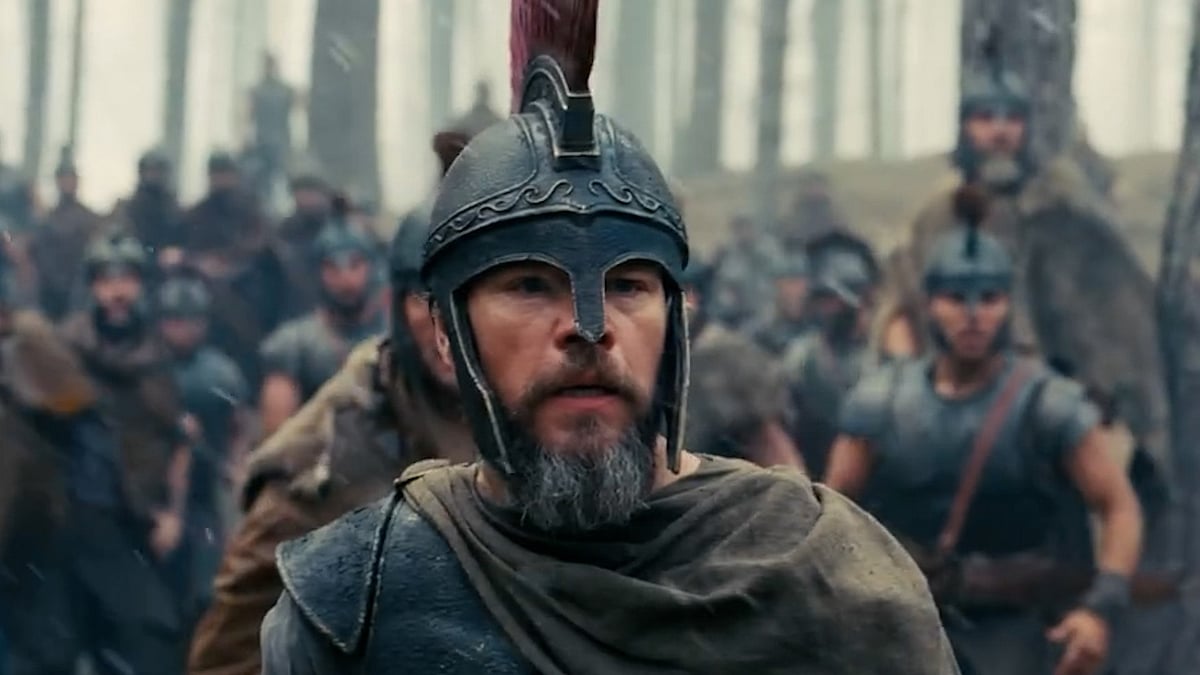
On the upside, the film soars when it asks uncomfortable questions about the ethics of the Trojan War. How just was it to offer the Trojan Horse as a symbol of peace—only for it to become a flagrant violation of that very trust? Odysseus (Matt Damon), the architect of the deception, is haunted by the moral weight of his own ingenuity, struggling to reconcile his celebrated victory with the cost at which it was won.
Matt Damon in a still from 'The Odyssey'.
(Photo Courtesy: YouTube)
It is a moral reckoning that echoes Nolan's Oppenheimer (2023), where another brilliant mind comes face to face with the devastation wrought by his greatest triumph. Though separated by millennia, both men are united by the same tragic irony: they achieve immortality through acts that leave them haunted by the very destruction they unleash.
In Nolan's world, history remembers the victors, but their consciences never let them forget the victims.
Compelling Questions, Incomplete Answers
The film introduces compelling narrative threads and thought-provoking moral dilemmas, but rarely explores them with the depth they deserve or resolves them in a manner that feels emotionally or thematically satisfying.
We see slivers of Odysseus’s pride—his urge to defy the Gods, his act of blinding Polyphemus, and in the process, endangering the lives of the men aboard his ship. The question remains: Is Odysseus able to overcome this excessive pride? The answer is left ambiguous, not in a way that allows viewers to draw their own conclusions but in a way that denies the question a meaningful payoff.
The film also grapples with another philosophical question: Is Odysseus wrong to forsake the dead and deny his fallen men the burial they deserve in order to save his own life? Or does the instinct to survive outweigh one's duty to the dead? Odysseus finally journeys west to honour the dead, only after realising that his men, now in Hades, still carry the bitterness of that abandonment.
A Cast That Rises Above the Script
What the film lacks in its conviction, it makes for it in its acting performances. Arguably the strongest of the cast is Lupita Nyong'o. It wouldn’t be an exaggeration to call her an absolute scene-stealer.
As Helen of Troy—the woman whose face launched a thousand ships—she is painfully aware of the devastation caused by the Trojan War. Lupita embodies Helen’s rage and her contempt for Menelaus beautifully.
“Many left Troy for your face," Menelaus tells her. She cuts him short: "They left for your brother's ambition." It is one of the film's finest lines, stripping away the romantic myth that has long defined Helen's story.
Perhaps the most underwritten character in the film is Antinous, who is little more than a sleazy bully with virtually no defining traits beyond his cruelty. The role is so relentlessly one-note that even Robert Pattinson, despite delivering an earnest and committed performance, is left with precious little to work with. His character arc is that of a jerk who tries his best to emasculate Telemachus (Tom Holland).
Tom Holland in a stil from the film.
(Photo Courtesy: YouTube)
Speaking of Telemachus, I kept waiting for a meaningful redemption arc in which Odysseus's son finally musters the courage to defend his family, reclaiming the agency stripped from him by the men who had long humiliated him in his own home.
The Epic's Strongest Emotional Currents
This critic did not feel the slightest emotional or romantic chemistry between Odysseus and Calypso (Charlize Theron). Whether this stems from the writing or Theron's restrained performance is difficult to say, but at no point does Calypso seem genuinely desperate to make Odysseus her immortal husband.
The film later reveals that she always knew Odysseus would eventually leave, yet by underplaying the emotional push and pull between them—which the source material explores in its full complexity—Nolan strips the relationship of the tragic complexity that gives it such poignancy in Homer's epic.
Her fleeting appearances are few and far between. Anne Hathaway, as Penelope though, is the acting powerhouse that forms the emotional core of the film.
Anne Hathaway in a still from 'The Odyssey'.
(Photo Courtesy: YouTube)
Watch out for the scene in which Penelope urges Telemachus to lock the suitors inside the hall and burn them alive. Hathaway is absolutely ferocious here, unleashing a fury so visceral that it ranks among the film's most unforgettable moments.
The Journey Ends Without Catharsis
It wouldn’t be fair if this critic doesn’t appreciate Nolan’s casting choices. Rapper Travis Scott plays a bard who narrates the story of the Trojan War. Nolan analogises oral tradition to rapping, thus making Scott an apt choice for the role.
Another thoughtful casting decision is Elliot Page, a trans man, as Sinon, whom Odysseus describes as "the bravest man he knows." By entrusting Page with one of the story's defining acts of courage and self-sacrifice, Nolan allows his lived journey to resonate subtly with the character's unwavering conviction, making the casting feel meaningful.
For a film so deeply invested in the idea of home and the longing to return to one's roots, the emotional groundwork leading to Odysseus's reunion with Penelope feels surprisingly underdeveloped. The homecoming, which should have landed as the film's most cathartic moment, barely moved me.
The Odyssey spends nearly three hours trying to find the road to Ithaca, only to lose itself somewhere along the way. There are flashes of a Homer run, but this voyage ultimately sails home with less than the legend promised. Even Homer knew that every great voyage deserves a worthy homecoming. This one loses its way just before the shore.
(Deepansh Duggal is a film critic based out of New Delhi. His work has appeared in Hindustan Times, OPEN, Outlook, Frontline Magazine and The Economic Times. He has a particular interest in anti-capitalist narratives and films that lie at the intersection of power and ideology. )