
Satluj Taken Down: It's a Film That Refuses to Let the Dead Disappear
Jaswant Singh Khalra's biopic was released after years of censorship. Zee5 was made to take it down within two days.
advertisement
Bhai Jaswant Singh Khalra has been silenced once again. Three decades have passed since Punjab Police personnel abducted him from his home, subjected him to inhuman torture, and ultimately killed him. Yet even today, Bhai Jaswant Singh Khalra continues to challenge the darkness, exposing the truth about one of the darkest periods in independent India's history.
Bhai Jaswant Singh Khalra, who exposed the fate of countless disappeared and unidentified victims, himself became a victim of the same machinery of custodial torture, enforced disappearance, and extrajudicial killing that he had courageously documented. Like many of those whose stories he sought to bring to light, his body was allegedly disposed of in the Harike canal never to be found.
We watched Satluj Yesterday. By this afternoon, news broke that the film had been removed from Zee5 and would not be shown in India. After facing censorship for nearly four years, the film, originally titled Ghallughara, later renamed Panjab 95, and finally released as Satluj, had briefly become available on Zee5 without cuts, only to be taken down within 48 hours for Indian audiences.
How much has really changed between 1995 and 2026?
By silencing the film, the state has once again revealed its unwillingness to confront the voices of those innocents who were brutally tortured and disappeared. Even after three decades, the institutions of the state continue to suppress Bhai Jaswant Singh Khalra's voice and the truths he sought to uncover and expose.
It remains accessible on Zee5 Global, so viewers outside India can still watch it.
As a piece of cinema, Satluj is compelling. Its narrative is tightly constructed, the pacing is controlled, and despite its runtime of nearly two hours and forty-three minutes, it never feels drawn out. Much of that credit goes to editor Sreekar Prasad, whose careful editing keeps the film moving. Yet Satluj is more than a skillfully made political thriller. It forces its audience to confront a tough question: how much has really changed between 1995 and 2026? The film connects themes of institutional impunity, police violence, and the decline of the rule of law.
Satluj is neither a conventional political thriller nor a story about militancy. Unlike Maachis, which examines the making of an insurgent, Honey Trehan's film follows an ordinary citizen who refuses to look away. Jaswant Singh Khalra's investigation begins not with dramatic revelations but with dusty municipal registers, hospital records, and crematorium logs. What appears to be mundane paperwork gradually becomes irrefutable evidence of an extraordinary crime.
Inspired by true events, Satluj tells Khalra's relentless effort to gather evidence of thousands of extrajudicial cremations that took place during Punjab's years of militancy and counterinsurgency. His investigation ultimately exposes the terrible human cost of a conflict sustained not only by violence but also by silence and institutional support.
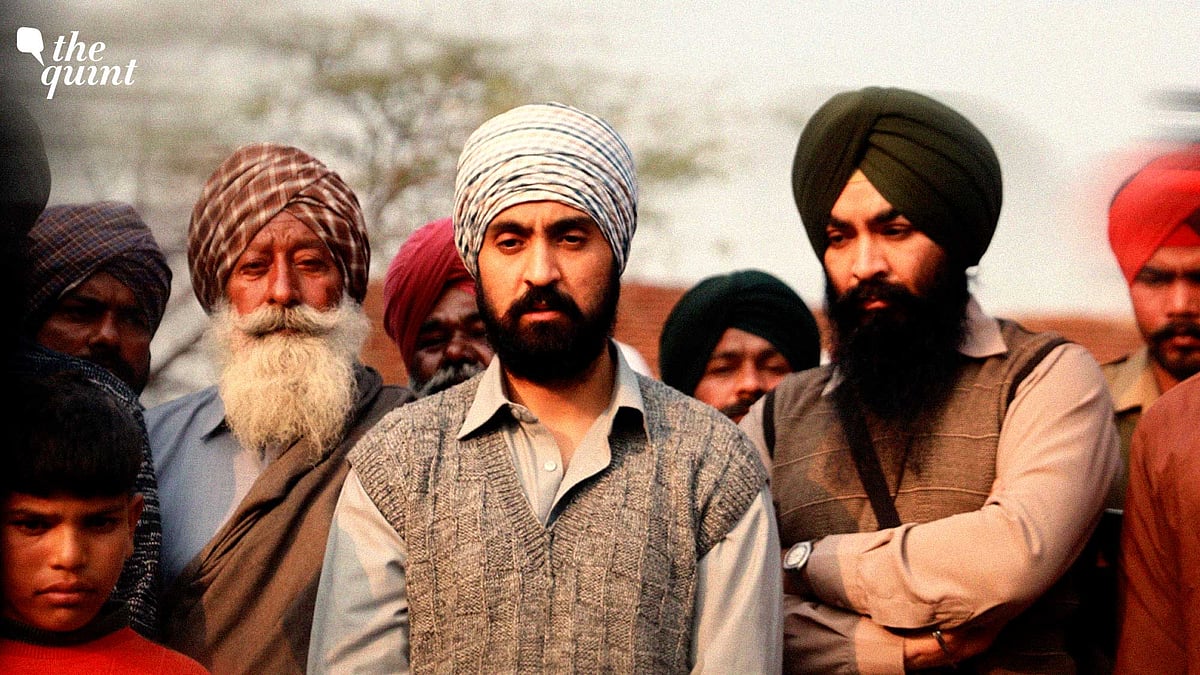
One of its most powerful moments occurs when Jaswant Singh Khalra, portrayed with great restraint by Diljit Dosanjh, speaks to an audience in Canada.
"The country that calls itself the world's largest democracy has made a mockery of justice."
He continues,
"Just tell us: which precious body did you burn, and in which cremation ground? The law says photographs of unidentified bodies must be preserved. The law says their clothes must be kept until their families claim them. Instead, a mockery has been made of the law, a mockery has been made of the nation, and a mockery has been made of people who ask for nothing more than a death certificate."
These words capture the film's moral heart.
Portrayal of State Violence
One of the film's notable performances comes from Saurabh Sachdeva as Senior Constable Satnam Singh. Torn between loyalty and moral responsibility, Satnam symbolises those trapped in systems that reward obedience over conscience. His choice to stand with Jaswant Singh comes at a terrible price. He, along with his mother, his pregnant wife, and the rest of his family, pays for that choice with their lives.
The opening sequence effectively sets up the film's moral context. A group of policemen joke about promotions, marriage, and drinking, sharing moments of camaraderie as their jeep displays the words "Shubh Karman Te Kabhu Na Taro"Never refrain from performing righteous deeds." The irony is clear. In moments, the same officers execute unarmed young men in cold blood. One senior officer casually asks a subordinate if he wants to become an inspector, reminding him that his fiancée will only marry him after his promotion. The implication is chilling: promotions are earned through killings. In just a few minutes, the film turns mundane workplace chat into a disturbing glimpse of institutional violence.
Suvinder Vicky delivers a chilling performance as SSP Sugga, a character who embodies the state's impunity. For him, murder has become routine administrative work, justified by the belief that the end always validates the means. Vicky plays him without melodrama, making the character's quiet confidence all the more unsettling.
Diljit Dosanjh gives perhaps the most subdued performance of his career. He avoids theatrical flourishes, emotional excess, and grandstanding speeches. Instead, he captures the quiet dignity of Jaswant Singh Khalra—a man whose moral courage lies in unwavering persistence rather than loud statements. His chemistry with Geetika Vidya Ohlyan, who plays Paramjit Kaur Khalra, serves as the emotional core of the film. Their relationship is not glamorised with dramatic speeches about sacrifice or patriotism. Instead, their shared resolve is shown through silence, mutual understanding, and an unspoken acceptance of the consequences to come.
With Satluj, Honey Trehan has created one of the year's best films. Ironically, the censorship surrounding its release only strengthens the very argument the film aims to make—that uncomfortable truths continue to be silenced. Long after the film ends, its questions remain.
Special mention goes to cinematographer KU Mohanan, whose camera captures Punjab's landscape with striking tenderness, contrasting its quiet beauty against the brutality within it. The difference is haunting.
The Ideal Sikh
The film has now been removed again and is unavailable in India until further notice. If you have access to Zee5 Global, it is worth watching—not just as a film, but as a chance to think about the relationship between memory, justice, and accountability.
The question now is: why would the government want the film removed when the events depicted took place during the Congress regime? When the BJP itself celebrates Samvidhan Hatya Diwas on the anniversary of the Emergency, then what problem do they have with this film being released in theatres, or why did they have to remove it from ZEE5 within 48 hours?
One answer could be the celebration of "Supercop" KPS Gill by the BJP supporters online. On social media, it is very common for BJP supporters to troll Sikhs and their institutions using KPS Gill's photo while abusing Sikhs. They would not want to tarnish the image of their "supercop," who was decorated and received prestigious government awards including the Padma Shri, even after being convicted of molestation in the case brought by IAS officer Rupan Deol Bajaj.
The idea works well within the BJP's political framework. We have seen how the BJP has handled criticism through labels such as "Khalistani," "Pakistani," or "Naxalite," depending upon the region, religion, or context. So, whenever dissent emerges from Punjab, the image of KPS Gill and the celebration of killings in the name of militancy reappear, even though it has been established that numerous innocent youngsters were killed in fake encounters during that period, and many police personnel have been convicted by CBI courts.
Then there's also former CM Beant Singh, in whose rule a major chunk of the 'encounters' took place. His political heir, Ravneet Bittu, is a minister in the Modi government. Perhaps the issue isn't even about individuals but of continuity in how successive central governments have viewed Punjab.
The bigger question remains: why does the state not want to engage with Sikhs with empathy and try to heal their wounds? No government has tried to provide closure to Sikhs or genuinely understand their concerns. When you ignore the truth or attempt to suppress it in this way, you further alienate people and deepen their sense of disconnection from the state.
Whether you agree with every point the film makes or not, Satluj raises questions that democracies cannot ignore. It asks what happens when institutions stop holding power accountable, when families spend decades searching for answers, and when seeking justice is viewed as an act of defiance. These questions go well beyond Punjab in the 1990s, making the film relevant to the present as much as to the past.
The dialogue of Bhai Jaswant Singh Khalra, "Main hanere nu challenge karda haan" — "I challenge the darkness," still echoes in the contemporary political period. While the police personnel who abducted and killed him will eventually perish, he continues to challenge the darkness in one way or another and bring the truth to light through people like Honey Trehan, Diljit, and thousands of others for whom human rights matter, who refuse to bow down to tyranny, and who continue to challenge it.
- Access to all paywalled content on site
- Ad-free experience across The Quint
- Early previews of our Special Projects
Published: undefined