'Ek Din' Review : Sai Pallavi and Junaid Khan Star in an Inane Romance
It is impossible to take this premise seriously—or the film at large, despite its blue-chip backing by Aamir Khan.
advertisement
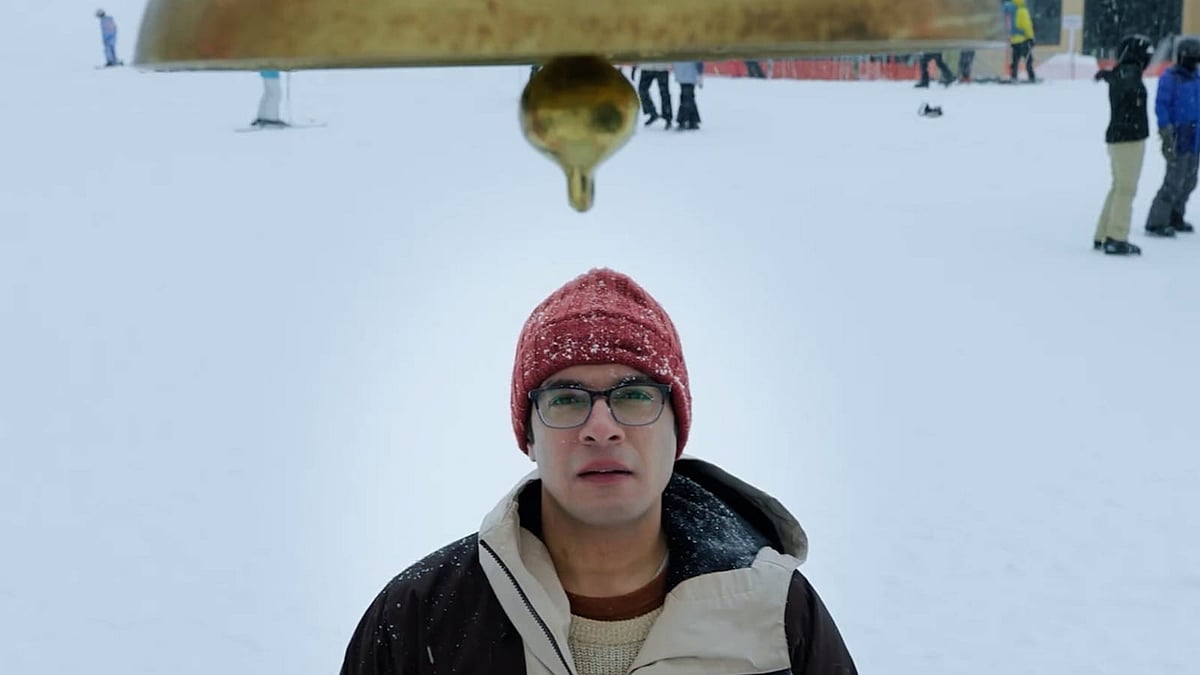
There is a bell in Ek Din that, when rung, grants wishes. Dinesh a.k.a. Dino (Junaid Khan) makes a wish, but his perennial pessimism prevents him from actually ringing it. No matter, though: the universe is on his side. As he walks forlornly away, a robust gust of snowy wind rings the bell, and Dino’s wish is granted.
If this seems silly, just wait till you hear what his wish is. Dino is one of cinema’s classic mousy corporate drones, with a crush on an impossibly beautiful, manic pixie dream girl colleague. That colleague is Meera (Sai Pallavi), the very personification of a breath of fresh air: Dino avers that when she walks in, time slows down, but his heart beats faster.
So, on an office holiday in Japan (don’t ask), Dino stands before the wish-granting bell and asks that Meera be his, even just for one day.
Throwback to 'Jab Tak Hai Jaan'
It would have been whimsical enough, if by some small contrivance, Meera was forced to spend a day in Dino’s company and thus warmed to him. But this film doesn’t want just whimsy—it wants sweeping emotion. It wants to be Saiyaara or, worse, Jab Tak Hai Jaan.
In a plot twist straight out of that latter film, Meera (incidentally also the name of the Katrina Kaif character in JTHJ) has a head injury in Japan that causes her to lose her short-term memory. Tended to by a conveniently Indian doctor, just as the amnesiac Shah Rukh Khan was, Meera learns that she has an illness wonderfully suited to fulfil Dino’s wish: transient global amnesia.
She has lost her short-term memory for 24 hours, but once she regains it, she won’t remember this one day.
Sai Pallavi as Meera in Ek Din.
(Photo Courtesy: YouTube)
An Unconvincing Romance
There’s very little here to hold on to. Saiyaara also suffered from an outrageous plot, but its stirring lead performances, compelling songs, and genuine heartache swept us past these complaints. The romance in Ek Din is very wishy-washy, truncated as it is by this arbitrary temporal frame and circumscribed by an absurdly specific medical condition.
Dino announces himself as Meera’s boyfriend, as she has forgotten that she is dating their shifty boss, Nakul (Kunal Kapoor in a thankless role). Nothing in his past behaviour suggests that Dino is capable of such melodramatic untruths. Still, we accept it and move on. But then, Dino tells Meera later that they should ‘break up for one day’ and just be friends until her memory comes back. Wouldn’t it have made more sense to suggest friendship in the beginning? A similar, innately ridiculous plot point extends the climax needlessly, too.
A still from Ek Din.
(Photo Courtesy: YouTube)
Forgettable Performances and Poor Writing
But it’s a slog to watch. Nobody else in the cast is given anything worthwhile to do. They’re all clichés: the office gossips, the mean senior colleague, the rishta-toting mummy. Boring. So it’s up to Sai Pallavi to try hard to make something of this material.
But she is defeated by Sunil Pandey’s unimaginative direction (the random snowy Japanese forest? the repeated imagery of bells?), and Sneha Desai and Spandan Mishra’s screenplay, which keeps insisting it is not like Hindi films—and that it is about real life.
Perhaps the point here is that real life is like the films. But surely the way to make that point is not to capitulate to cliché and contrivance, but rather to transcend them—to use them as springboards (as, say, Karan Johar did so successfully in Rocky Aur Rani Kii Prem Kahaani). The makers of Ek Din do not realise this.
(Sahir Avik D'souza is a writer based in Mumbai. His work has been published by Film Companion, TimeOut, The Indian Express and EPW. He is an editorial assistant at Marg magazine.)