'Border 2' Is Loud, Uneven, and Overlong But Effective
Sitting at nearly 3.5 hours long, 'Border 2' manages to serve some powerful action amidst all the noise.
advertisement
Even by its own standards, mainstream Hindi cinema has spent a frankly weird amount of time and energy dwelling on Pakistan and Indo-Pakistan narratives of late. The beastly Dhurandhar, the thoughtful Ikkis, the well-crafted Freedom At Midnight, and now the thunderous Border 2 (I feel like I’m missing one). You'd think we don't have other stories to tell.
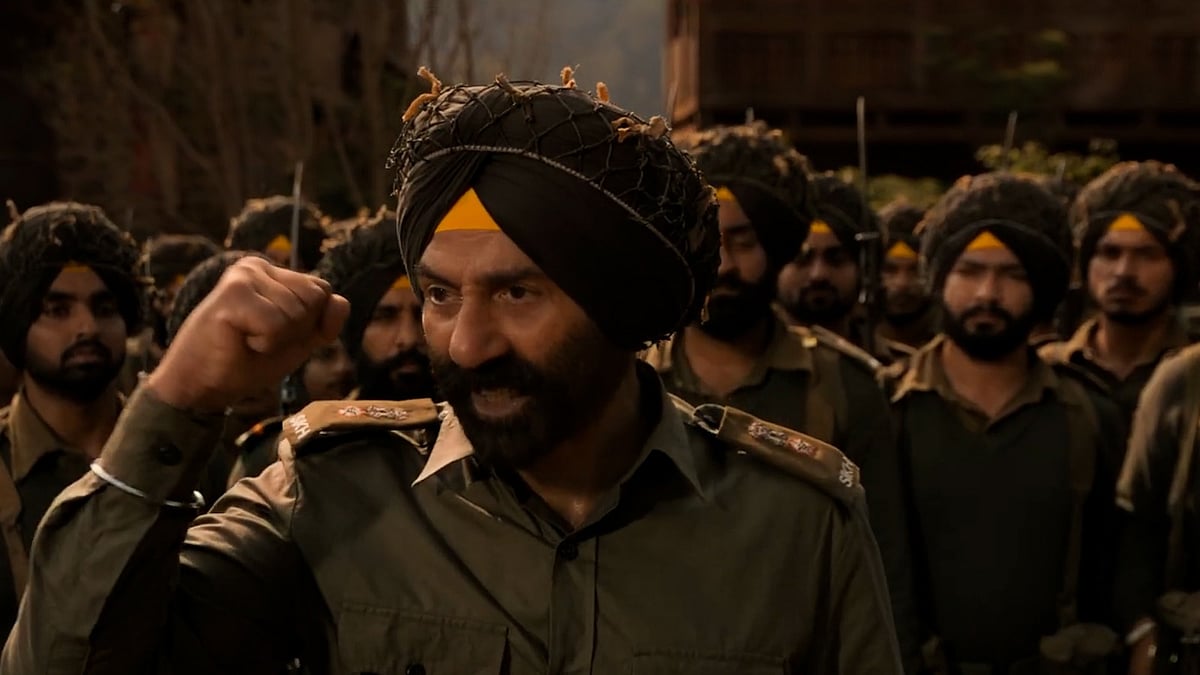
Border 2, a sequel to JP Dutta's popular 1997 ensemble war saga, is centred on the India-Pakistan war of 1971. On screen, the only link between the two films is Sunny Deol—except here, Deol plays a different character: Lt Col Fateh Singh Kaler.
The first half of director Anant Singh’s film covers the friendship story of three cadets: one from the Indian Army—Hoshiar Singh Dahiya (a sincere Varun Dhawan is enjoyable to watch again after I don’t know how many years), one from the Navy—Mahinder Rawat (an awkward, out of place Ahan Shetty), and one from the Air Force—Nirmal Jit Singh Sekhon (Diljit Dosanjh remains a treat). All under the watchful eye of Fateh Singh (Sunny Deol’s stern dad energy works well here).
Until they are all called to war.
A Defeating Duration
Anant Singh (Kesari), along with his co-writer Sumit Arora, refuses to hold back. He wants to cover it all, and then circle back some more. At 3.5 hours, there’s no room for restraint.
Sunny Deol and Mona Singh in Border 2.
(Photo Courtesy: YouTube)
We get an origin story of three cadets and their friendship. We see their individual love stories and marriages. We see them being called to war on different fronts—the toll on their families, and the losses they face on the frontlines. Not to mention the heroic set pieces they spearhead, and so on.
All this while Fateh Singh gets his own lengthy arc as a soldier, a leader, and a father who must watch his own son get sent into combat. And of course, his own small army of action scenes as the “muscle” of the movie. Not to mention the collection of supporting characters: army wives (the delightful Mona Singh continues to be everywhere), and fellow soldiers who must also get their own scenes, moments, and arcs.
Ironically, more than the actual war part of this war film, it’s the “lighter,” more “uneventful” first half that’s far more affecting. In this opening stretch, we’re allowed to just be with these characters and form a bond with them—and they with each other. It’s in this friendship story that the film finds its beating heart.
Diljit Dosanjh is a delight in Border 2.
(Photo Courtesy: YouTube)
I’d argue the filmmaker has a far stronger grasp on us when building the relationships between these men than he does in any of the film’s lengthy combat sequences. When we meet him, Varun Dhawan’s Hoshiar Singh is a Haryanvi lone wolf who doesn’t have a family to call or visit.
A Return To Form For Varun Dhawan
As Hoshiar, there’s a commitment and conviction in Varun Dhawan that we haven’t seen since perhaps Bhediya. I like the self-seriousness and stiffness he brings to the character—not to mention the gruffness and weight of age we feel in his presence when the narrative jumps ahead a few years, with him leading his own unit on the battlefield.
Varun Dhawan as Hoshiar in Border 2.
(Photo Courtesy: YouTube)
All this while, Ahan Shetty’s Joseph Noronha is… just there. So little does his presence register that I didn’t even know his character’s name until I later looked it up. Ahan fares well enough when he merely has to be present as part of the trio of friends. But it’s when he splits off and gets his own arc as an officer in the Navy that he becomes particularly tough to stomach.
It certainly doesn’t help that he’s given the film’s clunkiest set pieces. The green screen–heavy naval combat sequences, where Joseph is aboard a ship and forced to fend off enemy submarines, single-handedly capture everything wrong with the mediocrity that passes for VFX in mainstream Hindi cinema. If each of these characters is supposed to represent a different branch of the military—in writing, execution, and performance—the Navy certainly got the short end of the stick. Sekhon’s aerial dogfight sequences are more watchable and coherent in comparison, though that isn’t saying much.
Structurally, it’s interesting which of the four lead characters (and stars) are killed relatively early in the second half, and which soldier on (pun intended) and are allowed to lead the final battles. But the fact remains that the action-heavy second half risks descending into a blur of explosions, shootouts, screaming, and rousing speeches. Sunny Deol’s supersoldier Fateh Singh single-handedly ends up destroying more Pakistani tanks (I counted) than the entirety of Sriram Raghavan’s recent biopic Ikkis—a film that’s literally about tank warfare.
Uneven Action Set Pieces
As to the film’s approach to its Pakistani characters, their leaders are expectedly smirking and growling.
Ahan Shetty in Border 2.
(Photo Courtesy: YouTube)
I liked what the film does with certain claustrophobic trench skirmishes led by Hoshiar Singh, but editor Manish More’s focus is to constantly intercut between the various battlefronts, limiting the impact of any one. It’s why the film’s strongest battle sequence comes in the first half, when Fateh Singh leads his squadron to reclaim a village and a key bridge from the enemy. It’s a well-plotted, well-executed sequence because not only does the narrative stay with it, we’re invited to watch the three-pronged strategy devised unfold.
In one scene, a Pakistani soldier begs Fateh Singh for his life. The soldier is told that he has nothing to worry about because he is also merely serving his country. But the most touching moment comes later on.
A rampaging Hoshiar Singh is face-to-face with a frightened young Pakistani soldier. The very same soldier that, at the start of the film, Hoshiar let live when both were trying to refill their water bottles at a river. Now facing each other on the battlefield, the two men are confused, neither going for the kill as they should.
Lost in a moment of humanity amidst the carnage, neither knows what to do. That is until others make the decision for them.
Border 2 is in theatres starting 23 January.
(Suchin Mehrotra is a critic and film journalist who covers Indian cinema for a range of publications. He's also the host of The Streaming Show podcast on his own YouTube channel. This is an opinion piece, and the views expressed above are the author’s own. The Quint neither endorses nor is responsible for the same.)