'Freedom at Midnight' Shows Why India Is Still Afraid Of Its Own History
'Freedom at Midnight' season 2 shows why reckoning with India’s violent inception is a political necessity today.
advertisement
“Those who cannot remember the past are condemned to repeat it,” is perhaps the most famous line in historical memory, attributed to the philosopher George Santayana. The sociologist WEB Du Bois offered a similar warning: “A nation must honestly face its past, and if it does not, that past will haunt it.”
Many thinkers have converged on a shared insight: national beginnings are not neutral or straightforward, but messy and contested, marked by violence, exclusion, and erasure.
The nation state, as Benedict Anderson put it, “is an imagined political community.” Revisiting that style of imagination—who counts as “us,” who is cast out, what violence is justified or forgotten—is a political act of justice that strengthens democracy.
Created by Nikkhil Advani, Freedom at Midnight is a study of how India and Pakistan were imagined into being, and what that imagination cost. Season 2, in particular, stages some of the hardest truths about the creation of the two states.
The Birth of Two Nations
Opening in June 1947, in the aftermath of the decision to partition the subcontinent, the show moves from the hurried drawing of borders and the day of independence through partition massacres, the integration of princely states, the first war over Kashmir, Gandhi’s last attempts at communal reconciliation, and finally, his tragic assassination.
Season 2 of Freedom At Midnight
(Photo Courtesy: YouTube)
The series is bookended by Dr BR Ambedkar. At the start, he introduces the Indian flag and its symbolism: saffron for courage, white for peace and truth, green for fertility and growth, and the navy-blue Ashoka Chakra, representing the wheel of law and justice. At the end, he reads the Preamble to the Constitution, which envisions India as a “sovereign socialist secular democratic republic” and promises justice, liberty, equality, and fraternity.
On one level, it recovers how the founders imagined the country, highlighting the values they articulated and the costs of trying to live by them. On another, it functions as a warning: the ideals we now take for granted were fiercely contested and fragile from the outset.
Violence, Vengeance, and the Question of the ‘Enemy’
Advani and his team trace the making of communal rage with care and nuance. They show the cumulative effects of British divide-and-rule, the arbitrariness of slicing through villages where people had lived together for generations, the rushed implementation of partition, and the constant stoking of fear.
A still from Freedom at Midnight season 2
(Photo Courtesy: YouTube)
The violence appears as reactionary and cyclical, driven by distorted notions of revenge, rather than as proof of any community’s inherent savagery.
Instead of dwelling on atrocity for shock value or to inflame fresh hatred, Advani underscores the tragedy and human cost on all sides. Like the recent war film Ikkis, he implicitly asks: “What enemy?”
One illustrative thread involves the British Indian Army, whose soldiers are forced to decide between India and Pakistan. Men who lived, trained, and fought together are abruptly separated, only to be ordered, within a year, to shoot at former comrades they once considered brothers.
Gandhi as the Moral Centre
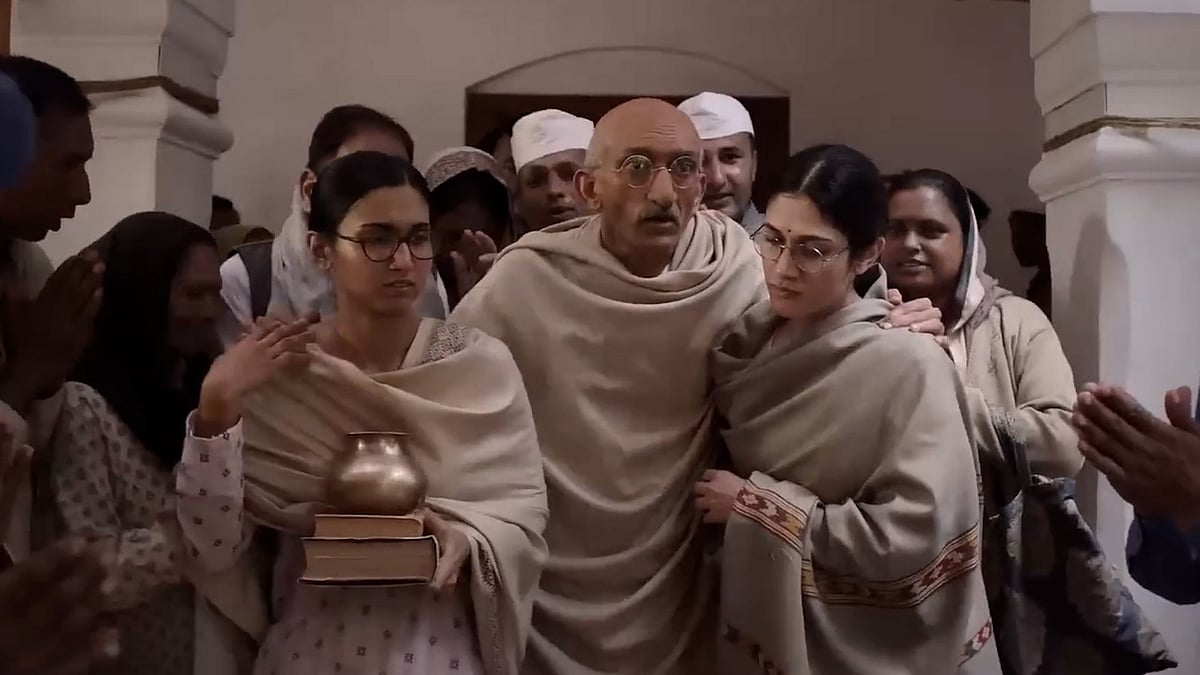
Gandhi serves as the moral centre of the season. But his idealism is constantly in tension with Jawaharlal Nehru and Vallabhbhai Patel’s urgent approaches to keep their state functioning. He delivers many of the most affecting lines on the futility of violence and the necessity of unity and peace. Politically, he is increasingly sidelined, but Nehru and Patel keep turning to him for moral direction.
Chirag Vohra as Mahatma Gandhi
(Photo Courtesy: YouTube)
When he sees the country drifting away from his principles, he responds with his familiar tactic: fasting. The series shows, in one instance, Gandhi’s fast in September 1947 to halt communal carnage in Calcutta, where he manages to persuade furious mobs to lay down their weapons. What the Punjab Boundary Force could not accomplish in Punjab, Gandhi managed in Calcutta without a single weapon.
We also see his fast unto death in January 1948, which demanded communal harmony in Delhi and pressured the Indian government to release funds owed to Pakistan. In both instances, he uses the same instruments of noncooperation once deployed against the British, but now turned against a state threatening to reproduce the very colonial logics it supposedly rejected.
Colonial Afterlives
Echoing Mahmood Mamdani’s argument that “the postcolonial state did not break with the colonial state; it restructured it”, Freedom at Midnight season 2 ultimately depicts how the Indian state inadvertently carries forward the syntax of colonialism—on its own soil.
Patel and VP Menon’s campaign to integrate the princely states exemplifies this. We watch them persuade, pressure, and, when required, coerce the monarchs into signing instruments of accession. They themselves acknowledge that they are borrowing from the British playbook of divide and rule—a pointed, if understated, parallel between imperial and postcolonial statecraft.
Sidhant Gupta as Jawaharlal Nehru
(Photo Courtesy: YouTube)
The show also dwells on the growing rift between Nehru and Patel. Patel comes across as the consummate pragmatist, perennially focused on security, territorial integrity, and institutional stability. Nehru, by contrast, is portrayed as more emotive and principled. He disapproves of Patel’s decision to send the army into Junagadh before its ruler has formally signed the instrument of accession.
In another scene, Nehru insists on firing those with Hindu nationalist sentiments from the Home Ministry, taking a tougher line on their rhetoric against Gandhi and his supposed “appeasement of Muslims.” Patel, meanwhile, is keen to preserve the Home Ministry’s autonomy from the Prime Minister’s Office and to uphold a robust conception of free speech.
Jinnah And The Tragedy of Getting What You Want
The darkest character arcs in the season belong to those who surrender to pride or allow trauma to harden into hatred and violence.
Advani’s Jinnah is not fully demonised as an Islamist ideologue or a cartoonish antagonist. He is shown as a tragic figure who helps create his own suffering.
Arif Zakaria plays Jinnah
(Photo Courtesy: YouTube)
We see him struggling with an illness he keeps hidden from the public—on-screen text at the end claims that if this had become public knowledge, it could have changed the likelihood of partition. In an early, subtly devastating scene, he returns to his home in Bombay to find it being packed up. Advani renders this as a muted, interior conflict: Jinnah cannot bring himself to admit that he is unsure about his decision, or that he may have demanded for more than he truly wanted.
The episode closes with him and his sister, Fatima, in a car, driving away from a city they will never see again. He’s getting exactly what he asked for, but must now reckon with the cost.
In Pakistan, he exercises his new authority with brittle, wounded pride. He refuses entry to his former Indian counterparts, including Gandhi, who wants to visit to calm communal tensions and protect Hindu and Sikh minorities. Even after Gandhi’s assassination, Jinnah dismisses him as a mere “Hindu leader,” despite his own sister insisting that Gandhi was much more than that.
From Trauma to Extremism: A Stand-In for Godse
Anurag Thakur plays Madanlal Pahwa
(Photo Courtesy: YouTube)
The other major tragic arc belongs to Madanlal Pahwa, a Punjabi refugee from Montgomery, which becomes part of Pakistan. We first meet him anxious and on edge: sensing the danger of rising communal tensions in their town, he tries but fails to convince his father to flee. Their relationship is strained, and when the violence finally breaks out, his father abandons him.
Madan survives, makes his way to India, joins a Hindu nationalist group, and ultimately attempts to assassinate Gandhi. The series approaches his transformation with empathy, insisting that we sit with the real grief, terror, and betrayal that lead him to his radicalisation—without ever excusing it.
Notably, the season never names Nathuram Godse or shows him on screen, instead using Madan’s story as a stand-in for him. It is hard not to also read this as a refusal to grant Godse the perverse celebrity status he now enjoys in certain circles.
A Fractured Family: Nations as Intimate Ruptures
Rajendra Chawla as Sardar Valabhbhai Patel
(Photo Courtesy: YouTube)
Structurally, Freedom at Midnight season 2 frames India and Pakistan as members of a fractured family. Gandhi appears as the ageing father of the Indian nation, struggling to hold together children who are no longer convinced by his methods. Jinnah is cast as his estranged brother, who walks away to become the father of Pakistan.
Nehru and Patel function as Gandhi’s sons—bound by shared purpose but constantly quarrelling. This family metaphor humanises towering historical figures and recasts the India-Pakistan conflict not as a distant geopolitical contest but as an intimate rupture marked by betrayal, grief, and longing.
In Anderson’s terms, the show lets us see the “style” in which these new political communities were imagined—who could be folded into the family, who had to be written out, and how those lines hardened into borders.
Essential Viewing in Today’s India
The series suggests that the founding promises of justice, liberty, equality, and fraternity were always fragile, contested at every turn, and repeatedly undermined by fear, prejudice, and convenience.
It also implies that the postcolonial state, far from a clean break from its colonial predecessor, often reproduced its worst habits—centralisation, surveillance, majoritarianism—under a different flag.
The ending, rather than providing closure, is a provocation. As Ambedkar’s voice reading the Preamble fades, we are left to consider not only how far we have drifted from that vision but how actively we are dismantling it now in our laws, institutions, classrooms, and streets.
Freedom at Midnight thus becomes essential viewing in today’s India, which has largely abandoned Gandhi’s principles in favour of angry, insecure and vengeful Hindu nationalism. It is an urgent reminder to confront our past so that it ceases to haunt—and shape—our future.
Freedom at Midnight released on January 9 2026 and is available to stream on SonyLIV
(Kaashif is a writer and film critic from Mumbai, currently based in London. He is the Assistant Culture Editor of The Polis Project.)