How Bengaluru, Hyderabad and Other Cities Lost Their Lakes—and Became Heat Traps
In 25 years, urbanisation in Bengaluru has expanded by over 87%, resulting in a 30% cut in area occupied by lakes.
advertisement
There is an old man in Hyderabad's Banjara Hills neighbourhood who remembers a lake that was once there. He remembers the breeze that came off the water in April, when the rest of the Deccan Plateau baked in the dry heat.
Both the lake—and that breeze—are now gone. In its place stands a mall, a parking lot, and about two degrees more heat than there used to be.
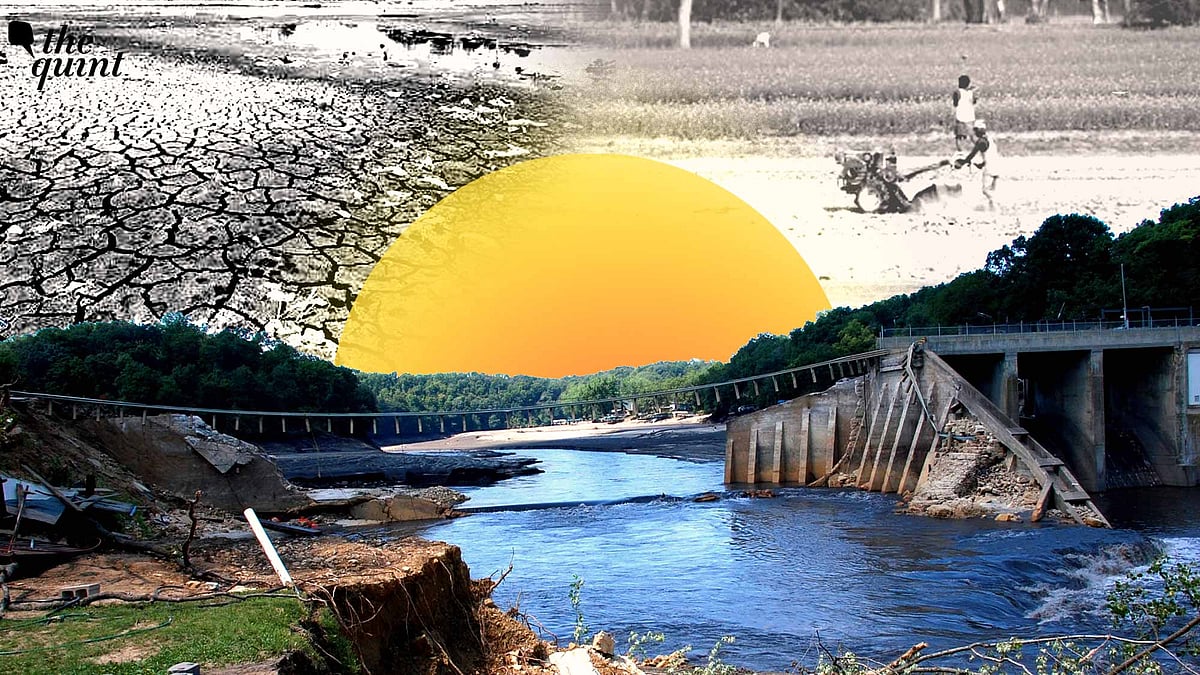
As Hyderabad and other major cities like Bengaluru, Chennai, and Delhi have watched their lakes, ponds, and wetlands disappear beneath concrete and real estate development, Indian cities are becoming more vulnerable to dangerous heat, and millions of people are paying the price.
The Science of How Wetlands Cool Cities
Water cools the air through a process known as evapotranspiration—a combination of evaporation (where water from lakes turns into vapour using solar energy) and transpiration (where plants release water vapour through their leaves after absorbing water from the soil).
A 2024 review of over 100 cities, published in the journal The Innovation, found that urban wetlands provide cooling effects of approximately 4.7-4.9°C.
Research compiled by the All India Disaster Mitigation Institute confirms that botanical gardens and large urban parks run about 5°C cooler than surrounding built-up areas, and street tree canopies reduce nearby air temperatures by about 3.8°C on average. Increasing tree cover in a neighbourhood by just 5 percent can reduce local temperatures by 1°C.
Wetlands, ponds, and lakes, too, act as what researchers describe as "natural sponges." They store water during the monsoon and gradually release it over time, recharging groundwater and helping moderate nearby temperatures during periods of high heat.
Healthy wetlands, with their open water, plants, and moist air, create a kind of thermal buffer zone. This buffer slows down the spread of extreme heat across a city. It also helps keep night-time temperatures from staying dangerously high after sunset.
By keeping the area cooler, wetlands reduce the need for air conditioning. Otherwise, every AC unit running in a city releases waste heat outside, making the streets hotter and causing even more people to use their AC.
When wetlands are removed and lakes are filled in, that natural buffer disappears. What takes its place is not harmless. Instead, concrete, asphalt, and metal surfaces act as heat sinks, soaking up the sun's heat during the day and releasing it slowly at night, keeping temperatures high all day and night.
Scientists call this the urban heat island effect, and India's cities are now experiencing that very quickly.
The Water That Once Cooled a City
Before urban planners and real estate developers changed the landscape, Indian cities were designed around water.
The Qutb Shahi rulers of Hyderabad, who ruled the Deccan from the 16th century, knew something modern planners have forgotten: in a semi-arid region with unpredictable monsoons, having water stored near where people live is essential infrastructure.
The Hyderabad tank system, documented by researchers at the Society for Advancement of Creative Integration, consisted of hundreds of tanks linked in cascading chains that followed the natural slope of the Deccan Plateau. When rain fell, it moved from tank to tank, filling reservoirs, recharging groundwater, and moderating the microclimate.
The last Nizam, Osman Ali Khan, commissioned the legendary civil engineer Sir M Visvesvaraya to design Hyderabad's flood protection system, which resulted in the construction of Osman Sagar and Himayat Sagar reservoirs, structures that protected the city for decades.
In Bengaluru, this intelligence evolved in its own unique way. The feudal lord Hiriya Kempegowda, under the Vijayanagara Empire, built an interconnected network of lakes across the plateau that supplied water for drinking and irrigation.
At its peak, Bengaluru had around 920 tanks and lakes in the 1960s. The city did not sit beside a major river, so these lakes were the city's lifeline.
Chennai and the nearby districts of Kancheepuram and Tiruvallur once had over 6,000 lakes and reservoirs, known locally as eris. These made it possible for people to live in an area with unpredictable rainfall.
City by City: How the Lakes Disappeared
Hyderabad is perhaps the starkest case study in India.
The city once called the "City of Lakes" was built by rulers who understood that the Deccan's semi-arid climate demanded a water-based infrastructure system. The interconnected tank-cascade system they built, consisting of hundreds of linked reservoirs, managed stormwater, recharged groundwater, moderated the microclimate, and irrigated surrounding farmland.
Then the real estate market arrived. The boom of the 1990s and 2000s marked a decisive turn, with more than 3,000 water bodies encroached upon, transforming shared environmental assets into land for commercial and residential development.
According to researchers, between 1989 and 2001 alone, the city lost 3,245 hectares of water bodies, roughly 10 times the area of Hussain Sagar.
Hussain Sagar, the most iconic lake in Hyderabad, itself has shrunk by more than 40 percent in area.
Madhapur, now the heart of Hyderabad's IT corridor and home to offices of some of the world's largest technology companies, was once a network of interconnected lakes.
The economic loss is calculable. Using global ecosystem service valuation estimates, researchers found that Hyderabad's lake degradation costs approximately $30.44 million, or about Rs 2,494 crore, annually in lost ecosystem services alone, a figure representing around 65 percent of the Greater Hyderabad Municipal Corporation's entire budget for 2024-25.
In recognition of the crisis, the Telangana government created HYDRAA, the Hyderabad Disaster Response and Asset Protection Agency, on 19 July 2024, specifically to identify and demolish encroachments on lakes, ponds, and water channels.
Whether this institutional response will succeed where decades of environmental law have failed remains an open question.
Bengaluru tells a similar story, if anything more dramatic in its temperature data.
TV Ramachandra, coordinator of the Energy and Wetlands Research Group at the Indian Institute of Science, put the change in terms no temperature chart can match:
The city once described as the "Garden City" had a green cover of 68 percent in 1973. Today, that figure stands at roughly 6 percent. The built-up area grew from 7.3 percent of the city's footprint in 1965 to 52.4 percent by 2009.
Over the past 25 years, urbanisation in Bengaluru has expanded by over 87 percent, resulting in a 30 percent reduction in the area occupied by lakes and wetlands.
The National Remote Sensing Centre confirmed that Bengaluru has lost nearly 10 square kilometres of lake area in the past two decades, and average temperatures have climbed by 1.5°C during the same period.
Dharmambudhi Lake, which had served Bengaluru's residents for over 500 years under the Hoysalas, Wodeyars, and Kempegowda, was filled in 1969 to hold consumer fairs and later converted into a bus terminus. That trajectory, a functioning ecological asset turned into a transport hub or a housing layout, repeated itself across the city over the next five decades.
Chennai is unique in that its 2015 floods and 2019 water crisis arrived as paired consequences of the same policy failure.
When the city removed its wetlands to build residential layouts, it removed both its cooling infrastructure and its flood management system.
Of the more than 6,000 lakes and reservoirs that once served Chennai and its neighbouring districts, authorities now count 3,896. Chennai city alone has lost nearly 150 water bodies and approximately 2,400 acres of water body area to urbanisation.
Successive state governments promoted housing projects by significantly converting water bodies into residential colonies. The city's wetlands, which once formed natural cooling corridors, were replaced by impermeable rooftops and roads that trap heat.
Delhi leads all Indian cities in heat severity.
A Delhi government report found that nearly half, specifically 49.1 percent, of the capital's official water bodies no longer exist.
The Yamuna floodplain, once a significant wetland buffer on the eastern edge of the city, has been encroached upon so severely that it now functions as a surface that absorbs and radiates heat rather than moderating it.
Why This Happened
The destruction of India's urban wetlands was not the work of a single villain. It is the cumulative outcome of several overlapping failures that persisted for decades.
Land scarcity in fast-growing cities made every low-lying, flat, and therefore easily buildable water body surface look like opportunity.
Wetlands were classified as "wasteland" in revenue records, making them administratively easier to convert than agricultural or forest land.
Urban master plans through the 1980s and 1990s were drawn up with minimal integration of environmental data. As one researcher put it, "urban planning has been devoid of environment planning."
Institutional fragmentation made enforcement nearly impossible.
Urban water bodies in most cities fell under multiple jurisdictions: municipal corporations, state revenue departments, irrigation departments, and state governments often held overlapping or contested authority over the same lake.
Solid waste disposal compounded the damage. With no organised landfill sites adequate to city-scale waste generation, municipal garbage found its way into lake beds.
Untreated sewage was directed into water bodies across every city studied here, killing the aquatic vegetation that drives cooling and turning ecological assets into open sewers.
In Bengaluru, the decline in community involvement in lake maintenance accelerated the collapse, as the traditional institutions that once managed these commons dissolved under urban pressure.
Legal protections that existed, including the Wetlands Conservation and Management Rules of 2017, arrived too late for much of the lake network and faced weak enforcement on the ground.
What It Will Take to Rebuild the Buffer
The situation is not hopeless, but we need to be honest about how much work real restoration will take.
The Central government's Mission Amrit Sarovar, which focuses on the rejuvenation of village ponds and water bodies, had successfully restored over 68,000 water bodies as of January 2025 through community participation.
India's Ramsar wetland network has grown from 26 sites in 2014 to 96 sites by December 2025, covering over 13.6 lakh hectares.
In January 2025, Indore and Udaipur became the first Indian cities to receive the Ramsar Convention's Wetland City Accreditation, which mandates that municipal master plans align with wetland preservation, effectively treating lakes as flood buffers in law rather than real estate in practice.
In Bengaluru, the BBMP's Lakes Division is implementing rejuvenation projects, including removing encroachments, redirecting sewage, desilting lake beds, and planting native species.
Science also points clearly to what needs to happen at scale. A global meta-analysis covering over 100 cities found that green-blue infrastructure such as parks, wetlands, and restored water bodies can lower local temperatures by 2 to 5°C, with larger and denser features producing the most significant reductions.
NITI Aayog warned, as far back as 2018, that 21 Indian cities including Delhi, Bengaluru, Hyderabad, and Chennai could run out of groundwater by 2030, affecting 100 million people. The same lakes that cooled those cities also recharged the aquifers those cities now depend on from external pipelines and tankers.
But science alone cannot generate political will. Urban wetlands require unified legal ownership, dedicated maintenance budgets, and inclusion in city master plans as protected infrastructure with legal status equal to roads or sewage treatment plants. And residents living nearby should be recognised as custodians, not obstacles to development.
(Ankit Mishra is an ICSSR Fellow at Govind Ballabh Pant Social Science Institute, Prayagraj, where his research focuses on environment, climate change, public policy and governance.)