
Trump's Oil Dream is a Curveball for Climate Action, But It’s Not All Bad News
Despite Washington’s gatekeeping, much of the world, however unevenly, is moving beyond fossil fuels, say experts.
advertisement
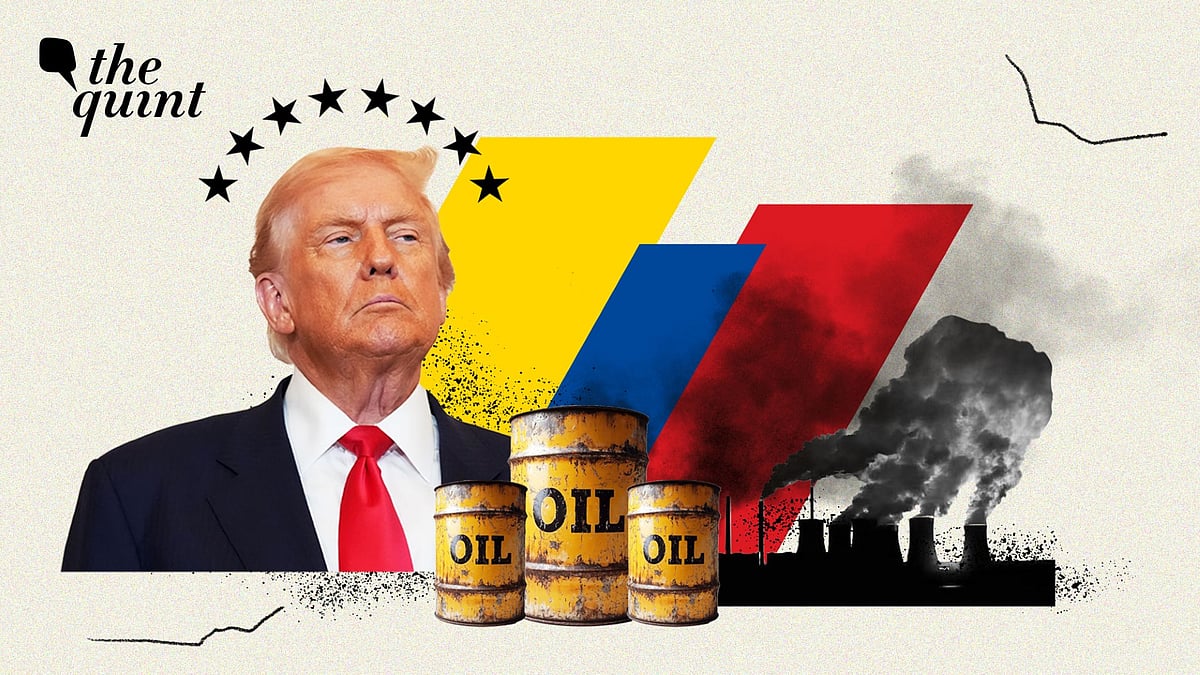
Donald Trump's plan to control Venezuela's vast oil reserves comes with a big if. Neither the South American country's political instability nor the revival of its broken oil infrastructure will be fixed overnight.
But, as climate experts point out, the latest operation is yet another curveball for climate action. "The attack on Venezuela is part and parcel of the Trump administration's determination to stay in the oil age," Bill McKibben, a prominent American environmentalist and founder of the climate action group 350.org, tells The Quint.
Yet, it's not all bad news.
"The rest of the world absolutely can make meaningful progress toward phasing out fossil fuels despite the intransigence of the Trump administration and his Republican supporters in Washington," Mark Hertsgaard, Cofounder and Executive Director of Covering Climate Now, a collaboration of news outlets, tells The Quint.
"Indeed it already is," he adds.
The Environmental Toll of Venezuelan Op
Trump is unapologetically pressing forward with his oil dream. The US President even told NBC that the big oil firms will either "get reimbursed by us, or through revenue" to rebuild Venezuela's energy infrastructure.
At 303 billion barrels, Venezuela has the largest oil reserves in the world. Data shows that in November 2025, Caracas produced 0.9 million barrels per day. Several climate experts have pointed out that even raising that to 1.5 million barrels per day could produce devastatingly high levels of carbon pollution.
But with the success of Trump's oil dream "by no means a given", experts told The Quint they don't expect any immediate climate fallout even if Trump and his administration are "doing all they can to wreck the climate that belongs to all of humanity."
In January 2025, Trump had declared a "national energy emergency" with the goal of boosting oil and gas production to "make America rich again". His eyeing the Venezuelan oil then seems an overseas extension of his 'drill, baby, drill' pledge.
"Trump's interests in oil are near-sighted as are all his interests. He views himself as the 'Czar' of his region i.e. the Americas. There are American oil companies that are hurting because Venezuela has not managed its economy very well since 2013," Sanjeev S Ahluwalia, Distinguished Fellow at Chintan Research Foundation, tells The Quint.
The climate fallout that did emerge right away, however, was the narrative spin. Like, Matt Ridley, the British author often labelled a climate skeptic, contended in The Daily Mail that Trump's Venezuela strike proves "oil is still the lifeblood of prosperity."
"There’s no denying that when the world's biggest economy doubles down on fossil fuels, it slows how fast the world as a whole can leave fossil fuels behind," says Hertsgaard, adding that "the inertia of economic and political systems and human mindsets slow progress."
Then, of course, there are the tariff wars, upping the ante on annexing ecologically sensitive and mineral-rich Greenland, and cutting funding for crucial climate institutions like NASA’s Earth Science division and the Environmental Protection Act (EPA).
"Yes, American presidents are extremely powerful, and they can, over a certain period, change the course of America's trajectory," Ahluwalia argues. "But US companies are playing their role in the energy transition. There is more (innovation and investment) happening in energy transition within the US than there is in many other countries around the globe."
Lorne Stockman, Research Director at US-based Oil Change International, a clean energy advocacy group, concurs. She tells The Quint that apart from private players, many state and local governments and communities in the US "are determined to win a transition to clean, renewable energy, and stop new fossil fuel projects."
'Uneven' But Solid Steps Forward
Even as Washington postures itself as a gatekeeper of global energy flows, much of the world, however unevenly, seeks to move past fossil fuel dominance.
Less than two months ago, renewables and energy transition dominated discussions at COP30 as countries across the world made pledges, set new targets, and recommitted (at least on paper) to the global target of moving away from fossil fuels.
Over 80 countries agreed for devising a global roadmap to phase out fossil fuels. At the first-ever International Conference on the Just Transition Away From Fossil Fuels scheduled for April in Colombia, climate experts are hopeful of progress. The conference was announced by its two co-sponsors, Colombia and The Netherlands, even before the final plenary session at COP30 where the Brazilian presidency spoke in its favour.
"UN procedural rules require consensus-based decision-making which enabled Saudi Arabia and a handful of fellow petrostates to prevent the final COP30 agreement from endorsing the roadmap. But the conference in Colombia won't be conducted under those rules, so the petrostates won’t be able to veto progress," says Hertsgaard.
Recent research by Oil Change International shows that aside from four Global North “Planet Wrecker” countries, of which the US is the worst offender, the rest of the world combined actually reduced its oil and gas production between 2015 and 2024.
Stockman argues, "Outside of the US, that old order is already disintegrating, and the transition to clean, affordable renewable energy is underway."
With the prices of solar, wind, batteries, and other renewables continuing to fall, that trend should continue, experts point out.
Moreover, Hertsgaard points out that the US is a "diverse country where 74 percent of the population wants the government to take stronger climate action, and where states like California—the world’s fourth biggest economy, when measured separately from the rest of the US—continue to accelerate their transition away from fossil fuels."
"What will happen in the US over the next three years remains to be seen, and much will depend on whether Democrats regain control of one or both houses of Congress in the November elections. In any case, the fight is far from over," adds Hertsgaard.
The World Needs to Move to Renewables Now More Than Ever
Climate experts further opine that the events in Venezuela underline that it's in the strategic interest of countries to unhook themselves from "fuels that are subject to control and embargo."
“The direct declaration that the effective takeover of Venezuela is specifically targeting the world's largest proven oil reserves is yet another warning sign of how politically explosive and toxic oil interests can be,” said Julian Popov, Bulgaria's former Environment Minister, in a statement. "Reducing dependency on fossil fuels by shifting to clean energy will reduce the dictatorial, corruption, and military conflict risks around the world."
Beyond Russia's war on Ukraine and the latest US operation, control over fossil resources have a long history of triggering violence and retaliation. The clean energy transition, therefore, is no longer just an environmental imperative, but a security imperative.
"Moreover, oil and gas companies profit from war, because it’s so energy-intensive. This gives them a vested interest in perpetuating conflict. Additionally, climate disruptions can create or exacerbate conflicts over shrinking access to food, water, and other key resources," says Stockman.
Unlike fossil fuels, renewable energy sources are distributed and locally accessible. They do not require invasion or control through brute force, nor do they produce the same zero-sum competition that has turned regions like the Middle East, the Caspian basin, and now Venezuela into arenas for great power rivalry.
Ahluwalia, however, argues that fossil fuels are not the sole drivers of conflict, and eliminating them would not magically end wars or military takeovers.
He explains,
Stockman, too, believes that. "A faster transition to clean energy will reduce governments' appetites for wars over oil. But unless we also transition to a more democratically run, less extractive energy system, resource wars will continue."
- Access to all paywalled content on site
- Ad-free experience across The Quint
- Early previews of our Special Projects
Published: undefined