Delhi's Clean Air Days End as AQI Spikes Post Diwali: Did Green Crackers Work?
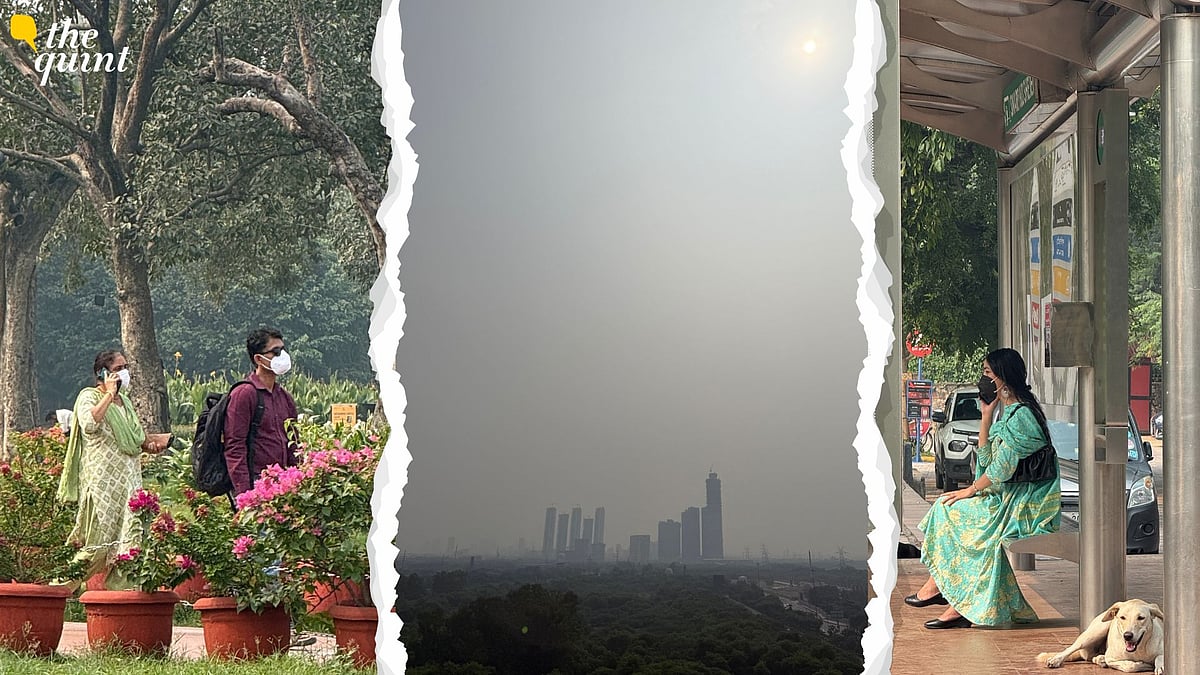
The AQI in several parts of the city crossed 350 on Diwali night, and remained high on Tuesday morning.
advertisement
2025 had been an anomoly of sorts as far as the air quality of the Delhi-NCR region was concerned. For the January-August period, the national capital registered its best average air quality index (AQI) in the last eight years, barring the pandemic years, thanks to strong wind patterns, above-normal rainfall, and high temperatures.
Not anymore.
"It was worse this morning. The air felt heavier, breathing was harder, and running was difficult. Last week it felt fine, but today there’s a clear difference," YS Negi, 63, who was out for a run at Lodhi Garden, told The Quint.
The night before, as India celebrated Diwali, several parts of Delhi recorded an AQI above 400, according to SAMEER, a mobile app developed by the Central Pollution Control Board (CPCB) that provides hourly air quality updates.
These reporters analysed the difference in air quality by comparing the AQI before and after Diwali. The first reading was taken on Saturday, 18 October and another on Tuesday, 21 October at four different locations. In most areas, the AQI had doubled or nearly doubled.
AQI at Connaught Place on Saturday vs Tuesday.
AQI at Jangpura on Saturday vs Tuesday.
AQI at India Gate on Friday vs Tuesday.
AQI in Lodhi Garden on Tuesday, 21 October.
Did Green Crackers Work?
On Wednesday, 15 October, the Supreme Court allowed the use of 'green crackers', relaxing the annual blanket ban on firecrackers that aims to curb severe air pollution in the Delhi-NCR during Diwali. The court noted that the blanket ban had previously led to black marketing of conventional firecrackers and argued that permitting ‘eco-friendly’ green crackers could help curb their illegal production and sale.
Delhi Chief Minister Rekha Gupta welcomed the verdict, saying it honours the spirit of the festival while 'striking a balance' between tradition and environmental protection.
As per the Supreme Court’s order, only green crackers were allowed between 6 am and 7 am, and again from 8 pm to 10 pm, on the day before Diwali and on Diwali.
However, it was evident on Diwali night (as well as in the days before and after) that these restrictions were not being followed.
Speaking to The Quint, Sunil Dahiya, Founder and Lead Analyst, Envirocatalysts, says that it is evident from PM2.5 concenration data that more firecrackers were burst this year than last, causing a sharp decline in air quality during and after Diwali.
"The Supreme Court’s conditions on firecracker timing and exclusive use of green crackers were both violated, with multiple proofs showing regular crackers were also burst. These breaches, combined with the higher volume of crackers, caused PM2.5 levels to spike from 70–100 µg/m³ during the day to an average of 670 µg/m³ across Delhi, with several stations recording PM2.5 levels as high as 1,800 µg/m³,” he says.
Anjal Prakash, Research Director at the Bharti Institute of Public Policy, Indian School of Business, says, "The reasons these measures may not have worked are pretty straightforward — low public compliance, limited availability or higher cost of green crackers, weak enforcement of bans and penalties, and the continued use of conventional firecrackers by some groups.”
Writing for The Quint last week, Shailaja Chandra, former Chief Secretary of Delhi, argued that enforcing the Supreme Court rules was unrealistic in the first place. She predicted, "Even the most zealous police cannot monitor 1,700 unauthorised colonies, hundreds of slums, dozens of urban villages, and thousands of regular colonies in Delhi. Expecting arrests or detentions across a city of 25 million is impossible. The most congested areas simply won’t comply, and defiance will overwhelm the state’s capacity."
Commuters in Delhi make their way to work wearing face masks and using handkerchiefs to protect themselves from the polluted air.
(Photo: Raqeeb Raza/ The Quint)
Moreover, while green crackers are claimed to be 30 percent less polluting than traditional firecrackers, experts have repeatedly warned of their health risks. “The pollutants may be lower, but the smoke and dust remain. You cannot eliminate that. Any firecracker that emits smoke and dust will affect people’s health,” Dr Rajesh Chawla, senior pulmonologist at Apollo Hospital, told The Quint.
Explaining this further, Dahiya says, "even if everyone had burst green crackers, it would have led to higher emissions."
Remnants of firecrackers litter a residential area in Delhi on Tuesday, 21 October.
(Photo: Anoushka Rajesh/The Quint)
As fireworks rang out across the city well into the night, the air quality took a hit, leaving the city shrouded in thin veil of smoggy haze. Delhi’s 24-hour average AQI stood at 356 at 9 AM on Tuesday, according to CPCB data, and remained high at 255 by 2 PM.
"It’s better here (Lodhi Garden) compared to other places, since there are a lot of trees," said another regular jogger at the garden in Central Delhi.
Just 72 hours earlier, on Friday evening, AQI levels were much lower, ranging between 180 and 200.
For reference, the CPCB classifies air quality as follows:
51–100 is “satisfactory”
101–200 is “moderate”
201–300 is “poor”
301–400 is “very poor”
401–500 is “severe”
The Impact on Health
"We do see a spike in sales of inhalers around this time of the year. It happens every year. This year, we have had a few sales so far, but we expect it will go up in the coming weeks," Girish, who works at a chemist shop in Jangpura, told The Quint.
Poor air quality can cause breathing difficulties, coughing, flu-like symptoms, and chest pain, and in severe cases, may trigger asthma, COPD, and cardiac problems. Children and the elderly are particularly vulnerable.
People strolling at India Gate on the morning after Diwali wear face masks to protect themselves from the toxic air.
(Photo: Raqeeb Raza/ The Quint)
Speaking to The Quint for a previous article, Dr Priyanka Singh, Consultant and Eye Surgeon at Neytra Eye Centre in New Delhi, explained that air pollution can also affect eye health, causing watery eyes, itching, redness, irritation, and even pain.
"When particles from pollution, dust, and smoke enter the eyes, they disrupt the tear film that normally keeps them moist and lubricated, leaving the eyes dry and uncomfortable," she said.
Experts say the best way to protect against pollution-related illnesses is to minimise exposure as much as possible.
'It's About to Get Worse'
This year, the better-than-usual air quality through the year were because of favourable weather conditions -this year we had more number of rainy days. The monsoon has been longer which results in slightly lower confrontations for an elongated stretch which reduced the average ... till now.
But the winds are changing now.
“It’s important to note that until Diwali, winds were blowing toward Delhi from the southeast. They’re now shifting to the north and northwest, meaning winds from Punjab and Haryana will begin reaching Delhi around the second week of November,” says Dahiya, explaining that the drop in temperature around that time is likely to worsen pollution levels.
So, the spike around 20–22 October was primarily due to firecrackers, but that impact is now fading. What we’ll see going forth (as we do every year) is pollution from the perennial sources that persist throughout the year — an increasing number of private vehicles, construction dust, industrial emissions, and landfill fires.