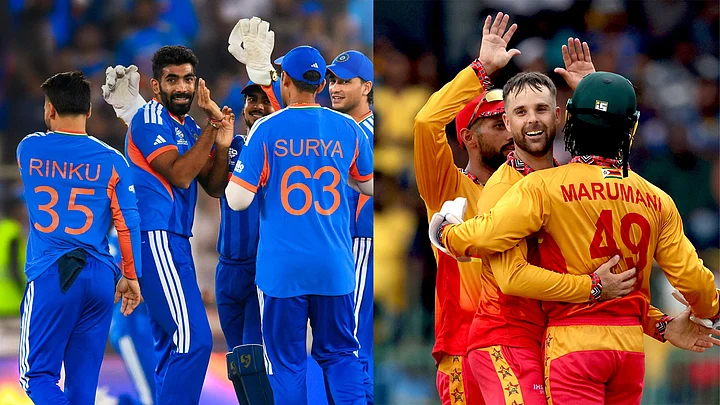
“Pressure does funny things to people.”
Before the commencement of the ICC Men’s T20 World Cup 2026, had you been asked to predict which player — and from which team — might utter that line ahead of India’s first do-or-die encounter, Zimbabwe’s Ryan Burl would hardly have featured among the likeliest candidates.
Yet, here we are.
India rarely host Zimbabwe unless absolutely necessary. In fact, across the entire history of T20 Internationals, the two sides have never faced each other in this format on Indian soil. And, you would not expect them to meet at the global stage either. In all of T20 World Cups, there has been only a solitary contest between the two teams.
Yet, here we are.
India have played Zimbabwe 13 times in this format of the game — 12 of those matches being held at the Harare Sports Club. The Chevrons have won three of those matches. Neither of those defeats had a catastrophic cascading effect on the Indian team.
Yet, here we are.
The Context of India vs Zimbabwe
Where is the action at?
At the MA Chidambaram Stadium in Chennai, where India will face Zimbabwe in their second Super 8 fixture. This is a match whose precise stakes will be known even before the first ball is bowled. Whether a straightforward win will suffice, or whether a substantial Net Run Rate (NRR) boost will be required, depends on results elsewhere.
The context of the game is as such that after losing their first Super 8 fixture to South Africa, India find themselves in a precarious position.
Precarious, after a solitary defeat?
Indeed — owing to the margin of it. India suffered a 76-run defeat at the hands of the Proteas, while the West Indies, whom the co-hosts will meet on 1 March, defeated Zimbabwe by 107 runs in their first fixture of this stage.
The concoction of the two has resulted in a table that might trigger nightmares among the most indifferent Indian fans. Both West Indies and South Africa have a NRR far superior to that of India.
Discussing margins of victory in a preview can appear discourteous to the opposition, but the reality is — depending on the outcome of the fixture between the other two Group 1 teams, India’s requirement from this game will be finalised.
A win, or a win by a significantly large margin?
Whatever the equation, one certainty endures: India must perform at a level far removed from what they produced against South Africa. As for Zimbabwe, gauging their caliber based on the defeat to West Indies will be inequitable, for, despite those matches being held in a different country altogether, they did beat former champions Australia and Sri Lanka.
Who Comes, Who Goes?
When a team suffers their biggest-ever defeat at the T20 World Cup, in terms of runs, every aspect is a talking point. More so, if the team is India. More so, if the team possesses the world’s number 1 T20I batter in the squad, who has scored 15 runs in four matches.
After three consecutive ducks, Sharma finally scored his first runs at a T20 World Cup in the last match against South Africa. Though, he did not look comfortable in that fixture either. Though, from what batting coach Sitanshu Kotak said in the pre-match press conference, it seems certain that Sharma will have the long rope.
His health was a bit bad. And then after that, he didn't have that much momentum. But last game, again, he looked good. And over thinking about one individual, personally, I never liked. Because we are playing with two- all-rounders and six batsmen. If we focus so much on one person, then obviously, without saying, that person also will be under pressure. So when he was hitting 100–80–70–90, no one was discussing that. So our job is to keep him in a good frame of mind and once he starts hitting the ball again, you will see the same Abhishek again, there is no doubt. Now in this game nobody can give guarantee that he will do it in the next match, but I think he is not far.Sitanshu Kotak
Since 2025, Sharma has scored the third-highest runs as an opener (1026) among those who are playing at the T20 World Cup, with only Brian Bennett and Sahibzada Farhan ahead of him. His strike rate of 196.93 is also the highest among those who have scored a minimum of 300 runs as an opener.
If Sharma retains his place — and with Ishan Kishan firmly entrenched after his recent exploits — the question arises: is there room for Sanju Samson? Unlike the firm stance taken earlier regarding Suryakumar Yadav, Kotak kept options open.
There can be changes, yes. And obviously, it goes without saying that we discussed (Sanju Samson). Because there are two lefty openings, number three is left-handed and opposition's bowling off-spin. I personally don't think that there is any problem there also. But because we lost wicket in the first over in three games, obviously any team would think. So we are thinking and we will see how it goes because we never decide the team too early and obviously it is not fair to start telling your plannings also in so advance. But yes, definitely there will be thoughts.Sitanshu Kotak
The obvious question here is — provided he plays, who will Samson replace?
Tilak Varma seems to be the most likely option. Though he is currently India’s fourth-highest run-scorer in this competition with 107 runs, his strike rate of 118.88 has caused his team a few troubles. Moreover, while Varma is India’s second-highest run-scorer in T20Is since 2025 with 674 runs, his strike rate of 127.41 ranks him at the 11th spot.
That aside, no other changes are likely, barring Axar Patel replacing Washington Sundar. Rinku Singh had to leave the team with a personal emergency, but he will be available for selection against Zimbabwe.
What Are the Concerns?
An off-spinner bowling the first over has become the Indian team’s equivalent of death and taxes — inevitable. Taking a cue from Aiden Markram, Aryan Dutt and Salman Ali Agha, we might see Sikandar Raza rolling his arm over in the first over today, having recovered from his injury.
For India’s southpaws, off-spin remains a major trouble. The following are the strike rates of left-handed Indian batters against off-spin in the ongoing tournament.
Shivam Dube — 131.58
Ishan Kishan — 117.39
Abhishek Sharma — 100.00
Tilak Varma — 88.89
Moreover, according to data sourced from CricViz, India has the lowest batting average against slower balls from fast bowlers among Super 8 teams. Their average is merely 15.33, alongside the highest dot-ball percentage of 40.2%. This weakness has fueled the "slower ball trap" strategy successfully used by opponents on sluggish pitches. Zimbabwe’s pace twin, Brad Evans and Blessing Muzarabani, who have 32 wickets between them, can exploit the weakness with their repertoire of variations.
Life moves swiftly at a T20 World Cup. Teams that appear invincible one week can find themselves staring at elimination the next, but by the end of the day, depending on not one, but two results, India could reclaim their usual stature.
Will they? Or, as Ryan Burl said, will pressure do funny things to the Indian cricket team?