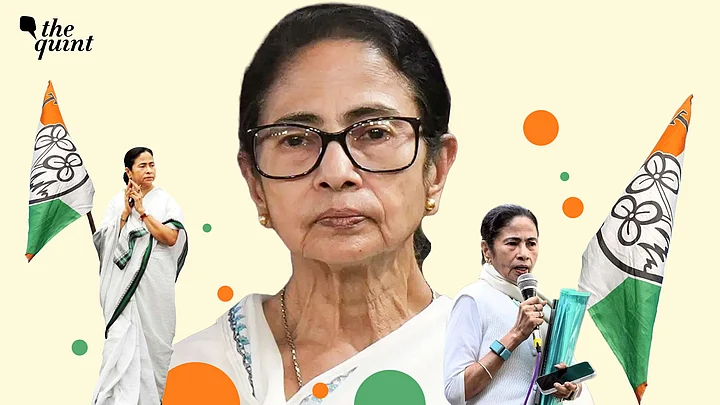
The Bharatiya Janata Party (BJP) winning West Bengal is the largest single-election political shift in any major Indian state since the party came to power in 2014. It is larger than the BJP’s 2017 sweep of Uttar Pradesh. It is larger than the Trinamool Congress' own 2011 displacement of the Left Front.
The political vehicle that has structured Bengali politics for nearly 30 years is gone. One of the most consequential women in independent India’s politics has lost her seat, her state, and her party’s grip on power, all in a single counting day.
The BJP won 207 seats out of 293. The Trinamool won 80. The Congress holds two. Humayun Kabir’s TMC breakaway—Aam Janata Unnayan Party—holds two. The Left and the All India Secular Front hold one each.
This cannot be assimilated to anti-incumbency. The scale is too large.
What made it possible? Three answers are circulating. The BJP says: Hindu consolidation, after 15 years of Trinamool corruption and welfare exhaustion. The Trinamool says: a manipulated electoral roll, plus EVM tampering, against which it has formally lodged challenges. Independent commentary has split along ideological lines.
A third reading is possible. Three forces operated at once. Each would have hurt the Trinamool on its own. Together, they produced a magnitude none of them would have produced alone.
Scandal as Structure, Not Exception
The first force was 15 years of accumulated grievance.
In August 2024, a postgraduate trainee was raped and murdered inside RG Kar Medical College and Hospital in Calcutta. The body was found on hospital premises at dawn. The principal of the institution, Sandip Ghosh, was protected for weeks before he was finally arrested. Junior doctors went on strike across the country. The Supreme Court was forced to intervene.
The Chief Minister led a public candlelight march. Her own administration was the focus of the inquiry. Bengali voters did not need to articulate the dissonance to register it.
Sandeshkhali came earlier the same year. Sheikh Shahjahan, the Trinamool’s local strongman in 24 North Parganas, faced allegations of land-grab and sexual assault. State machinery buried it. The Enforcement Directorate was physically attacked when it tried to investigate. The Calcutta High Court intervened.
These were not two scandals. They were a pattern.
The pattern became clearest in March 2026, on the eve of polling. Field surveyors of Axis My India—a polling agency conducting routine pre-election work—were detained by the state machinery. There was no articulable cause. The likeliest explanation: their early survey returns were not favourable to the incumbent. This was an authoritarian act by a Chief Minister who had lost confidence in her own outcome.
Voters notice these things. They do not always tell pollsters about them. But they remember on polling day.
Underneath the scandals, the welfare model had begun to flatten. Lakshmir Bhandar, the Trinamool’s signature cash transfer to women, reached around two crore Bengali women: Rs 1,200 per month for general beneficiaries, Rs 1,000 for minorities.
The scheme was not symbolic. It mattered. But by 2026, it was no longer politically novel. It had become an entitlement, not a gift. Bengal’s young workers continued to leave the state—for Bengaluru, the Gulf, construction sites everywhere. They came back to vote against the conditions that had pushed them out. RG Kar told them what they already knew. Bengal had stopped being a place where institutions worked.
Error, Arithmetic, and Electoral Consequence
The second force was the Special Intensive Revision (SIR) of electoral rolls.
The numbers, sourced directly from Election Commission of India (ECI) documents and Supreme Court records, are these. In January 2025, Bengal’s electoral roll stood at approximately 7.66 crore. The 2024 Lok Sabha was conducted on a roll of 7.6 crore. By the time the SIR exercise concluded in April 2026, the roll had been compressed to approximately 6.83 crore. That is a net reduction of about 77 lakh voters from the 2024 baseline, and about 83 lakh from January 2025.
The mechanism was as follows. On 28 February, the ECI published its final roll. It contained 7,04,59,284 voters. Of these, 60,06,675—about 8.5 percent of the total—were placed under a category called “logical discrepancy.” Their right to vote was suspended pending judicial review.
Of these 60 lakh names sent for review, approximately 32.6 lakh were ultimately found eligible and restored to the rolls. Approximately 27.1 lakh were declared ineligible and deleted. The Supreme Court itself heard appeals on the deletion category.
This means the algorithm that flagged voters for “logical discrepancy” got it wrong about 54 percent of the time. Justice Joymalya Bagchi placed this fact on the record himself, during proceedings on 13 April. The category—“logical discrepancy”—did not exist in any other Indian state during the same nationwide SIR exercise. It was unique to West Bengal.
The ECI's own state Chief Electoral Officer (CEO), Manoj Agarwal, said publicly that the higher turnout percentage was largely an arithmetic effect of the smaller denominator. Former Chief Election Commissioner (CEC) SY Quraishi made the same observation. Three institutional voices—the bench, the state’s CEO, and a former CEC—confirmed what was happening on the rolls.
Did the SIR cause the BJP victory? Almost certainly not. The Trinamool’s own decay would have produced a meaningful BJP gain on any electoral roll. Did the SIR enable the scale of the BJP victory? Almost certainly yes.
In Jangipur, the Hindu share of the electorate rose from 46 percent to 52 percent after the SIR. Muslims went from majority to minority on the rolls. In Farakka, the Muslim share fell from 67 percent to 60 percent. These shifts were not theoretical. They created the arithmetic conditions in which a Hindu consolidation could deliver large margins, not narrow ones.
The Trinamool’s grievances created the demand for change. The SIR amplified the supply of seats available to deliver it.
The Matua Paradox
The third force was the Matua belt—and what it reveals about identity in 2026 India.
The Matuas are Hindu refugees from East Bengal, settled in West Bengal since Partition, organised through the Matua Mahasangha. They live primarily in 24 North Parganas and Nadia districts. They were among the most heavily affected groups under the SIR. By their own community leaders’ estimate, more than half of Matua voters were missing from the 2026 rolls.
If the conventional rules of Indian electoral analysis applied, the Matua belt should have voted against the BJP. The BJP controls the Central government. The Central government’s ECI ran the SIR exercise. The SIR exercise removed Matua voters in large numbers. This should have produced anger.
It did not.
The Matua belt voted for the BJP at scale. The community appears to have responded to the deletion stress not by abandoning the BJP but by intensifying its identification with the political vehicle most associated with Hindu refugee citizenship protection. The Trinamool’s welfare schemes—Lakshmir Bhandar, Kanyashree, others—had reached Matua households. They did not override what was happening.
This is not Hindu nationalism in any reductive sense. It is something more specific. A community under perceived demographic threat reached for the political identity that promised protection. The depth of the welfare relationship was less determinative than the depth of the recognition need.
If the Matua finding is what it appears to be, it points to a structural shift in Indian voter behaviour that has been building across multiple states for the past decade. Bengal has now made it undeniable.
The shift is not from secular politics to religious politics. That framing is too crude. The shift is more precise: from a politics where voters reward redistributive performance to a politics where voters reward identity recognition.
Scholars have observed the same configuration in Hungary under Orbán, Turkey under Erdoğan, Israel under Netanyahu, the United States across recent cycles. It is not unique to India in mechanism. What is unique to Bengal is the scale at which it has now been demonstrated.
What Bengal Forces Us to Rethink
This is why the result is consequential beyond Bengal.
Not because the BJP won Bengal. State governments change in democracies. Not because the SIR produced compositional effects on the rolls. Electoral rolls are revised regularly, and the SIR will be litigated and applied to other states under existing legal frameworks.
The result is consequential because it marks the point at which the assumptions most Indian political commentary has used since the 1990s have stopped being adequate to read the country. Two of those assumptions need rethinking now.
First, that welfare delivery, sustained at scale and over time, produces electoral loyalty. Bengal proves this is true only up to a point. Beyond that point—beyond a certain saturation, beyond a certain time horizon, when other anxieties intensify—welfare stops being protective.
Second, that documented institutional failure produces electoral consequences for the political project associated with the failure. The work done across the past months on the SIR was rigorous and substantial. The arithmetic was placed on the Supreme Court record. The state's CEO himself acknowledged the denominator effect. Voters were not moved. Identity recognition mattered more than institutional process.
These are not partisan observations. They apply to anyone—analyst, journalist, party strategist—whose work is built on the older assumptions. They apply equally to people sitting on different sides of the political spectrum.
For Bengal, the immediate consequences are clear. A BJP government will be sworn in within days. Suvendu Adhikari is the frontrunner for Chief Minister, though the formal announcement is pending. The Trinamool faces its first Opposition role since 2011. Mamata Banerjee, having lost her own seat, faces a hard choice: lead the Opposition from outside the legislature, or step back and allow generational succession.
Whether 4 May 2026 marks the start of a long BJP era in Bengal, or the high watermark before reversal, will be settled only in time. What is settled for now is that India has changed enough to require political analysis to change with it. Bengal is the case in which that requirement has become impossible to ignore.
(VK Shashikumar is a former roving foreign affairs correspondent who covered West Asia, and later set up the investigations team at CNN-IBN (now News18.). This is an opinion piece and the views expressed are the author's own. The Quint does not endorse or is responsible for them.)